Skip to main contentSkip to productsSkip to testimonials
Petit mot: nous croulons sous les nouvelles commandes en ce moment, donc les envois ont du retard. Les nouvelles commandes seront expédiées d'ici le 7 juillet. Merci de votre patience.
Petit mot: nous croulons sous les nouvelles commandes en ce moment, donc les envois ont du retard. Les nouvelles commandes seront expédiées d'ici le 7 juillet. Merci de votre patience.

Vous préférez une vidéo rapide? Regardez la plus récente vidéo vérifiée de notre chaîne YouTube officielle et suivez @PurrifyHQ pour les prochaines mises à jour de marque et de produit.
Purr Purr Purrify | Song about Cat Litter Odour Control Made in Canada
Sources
That sharp, eye-watering ammonia smell isn't just unpleasant-it can harm your cat's respiratory system. This complete guide explains how to neutralize ammonia in cat litter, how to get rid of cat urine smell in your litter box, and which ammonia absorber methods actually work long term.
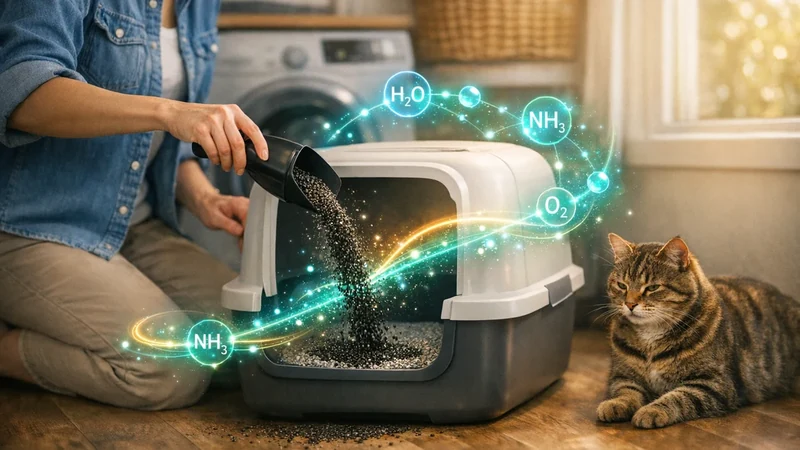
Activated carbonis the most effective ammonia neutralizer-it traps ammonia molecules permanently through adsorption. Unlike baking soda (which only works for 1-2 days), activated carbon continues working for up to 7 days per application and is one of the most reliable ways to remove ammonia smell from cat litter naturally.
See Full-Size & Autoship Options ->Direct Answer
The best way to neutralize ammonia in cat litter is to remove the existing ammonia source, deep-clean the box, and then use activated carbon to trap new ammonia molecules as they form.
Ammonia starts appearing when bacteria break down urea in urine, often within 2 to 4 hours, so scooping alone is not always enough once the odor is already sharp.
A full reset works better: dump the old litter, clean the plastic box with an enzyme cleaner, let it dry fully, and add fresh litter mixed with activated carbon granules.
Activated carbon works by adsorption, which means ammonia molecules stick inside its pore network instead of floating back into the room.
Baking soda can help briefly with mild odor, but it does not provide the same long-lasting ammonia control in busy, humid, or multi-cat litter boxes.
Cat urine contains urea, a nitrogen compound. When bacteria in the litter box break down urea, they release ammonia gas (NH₃)-that sharp, pungent smell that makes your eyes water.
This is why a litter box can smell clean in the morning and strongly of ammonia by evening. Without a true ammonia neutralizer for cat litter, odor molecules keep building in the air, litter bed, and nearby surfaces.
Urea + Bacteria -> Ammonia + Carbon Dioxide + Water
This process accelerates in warm, humid conditions-which is why litter boxes smell worse in summer or in poorly ventilated areas. Homes with enclosed litter furniture, small laundry rooms, or multiple cats usually notice the strongest ammonia concentration.
Warm temperatures speed up bacterial activity and ammonia release
High humidity keeps urine liquid, allowing more ammonia to evaporate
Multiple cats produce more urine, overwhelming standard litter
Activated carbon works through adsorption-ammonia molecules stick to its massive surface area and pore network. Once trapped, molecules can't escape back into the air.
Baking soda can reduce odor briefly, but its ammonia control is limited and short-lived compared with activated carbon granules.
Natural zeolite minerals can trap ammonia molecules, though less effectively than activated carbon and with less consistent results in humid litter boxes.
Removing waste before ammonia forms is effective, but it requires significant time investment and usually needs to be combined with a litter deodorizer for ammonia.
Fragrances don't neutralize ammonia-they just add another smell on top. Worse, they can irritate your cat's sensitive nose and respiratory system while the ammonia source remains active.
If you want to stop your litter box from smelling like ammonia, pair the right neutralizer with the right setup. The most effective routine combines daily scooping, moisture control, and activated carbon granules.
| Method | Effectiveness | Duration | Cat Safe |
|---|---|---|---|
| Activated Carbon | High | 5-7 days | ✓ |
| Zeolite | Moderate | 3-5 days | ✓ |
| Baking Soda | Limited | 1-2 days | ✓ |
| Scented Products | None | Hours | ✗ |

Activated carbon traps ammonia permanently in microscopic pores
Prolonged ammonia exposure from a poorly maintained litter box can cause serious health issues for both cats and humans:
No more embarrassment when guests visit
Follow this proven 5-step process to eliminate cat litter ammonia smell and keep your litter box fresh using activated carbon granules.
Time needed: 20 minutes initial setup, then 5 minutes daily
Activated carbon is one of the strongest cat litter ammonia neutralizers available. It traps ammonia molecules through adsorption and keeps working between scoopings, which makes it a strong first step if you are trying to get rid of ammonia smell in a litter box.
Pro tip: Look for coconut shell activated carbon-it has the highest surface area and purity.
Empty the litter box completely and dispose of old litter. Ammonia has already been released from this waste and cannot be recaptured, so a full reset is essential for cat urine ammonia smell removal.
Use an enzyme-based cleaner (not bleach) to break down urine residue in the box and on nearby surfaces. Let it dry completely before adding fresh litter so you are not trapping moisture that can speed up ammonia formation.
Pro tip: Bleach + ammonia creates toxic chloramine gas. Never use bleach on litter boxes.
Pour 2-3 inches of clean litter, then add 2-3 tablespoons of activated carbon granules. Mix thoroughly so the carbon contacts urine as soon as it's deposited, giving immediate ammonia odor control.
Scoop waste daily to remove the source of new ammonia. Top up with more granules whenever the box starts giving off a smell again, with no fixed schedule, so the carbon keeps your litter box from smelling like ammonia between full litter changes.
See how cat owners neutralize litter box ammonia with Purrify's activated carbon granules.