
L’ammoniac de la litière est-il dangereux?
Quand le bac sent l’ammoniaque, la réponse dépend de quatre facteurs : la concentration, la durée, la ventilation et qui se trouve dans la pièce. Voici ce que dit vraiment la science, et la solution.
En bref - réponse rapide
L’ammoniac de la litière est un irritant, pas une toxine d’urgence, aux niveaux domestiques habituels sous les 25 ppm. Dans les petits appartements, les foyers à plusieurs chats ou les pièces mal ventilées, les concentrations peuvent grimper assez haut pour causer une irritation respiratoire chez les chats, les nourrissons et toute personne asthmatique ou atteinte de MPOC.
Symptômes d’une exposition à l’urine de chat chez l’humain
Les premiers signes d’une trop grande inhalation d’ammoniac de la litière incluent des yeux larmoyants ou brûlants, une gorge irritée ou douloureuse, de la toux, des maux de tête et un nez qui coule. Une exposition plus forte peut amener une respiration sifflante, une oppression thoracique, des étourdissements et des nausées. Chez le chat, surveillez les clignements, l’écoulement oculaire, les éternuements, la respiration la gueule ouverte et l’évitement du bac à litière.
Les symptômes s’estompent habituellement vite une fois que vous quittez la pièce et que vous l’aérez. Si les difficultés respiratoires persistent, consultez quand demander de l’aide médicale ou vétérinaire ci-dessous.
L'odeur vous inquiète chez vous aussi?
Vous pouvez arrêter l'ammoniac à la source. Le charbon actif le piège avant qu'il n'atteigne l'air. Mélangez 2 à 3 cuillères à soupe de Purrify à la litière fraîche, puis rajoutez-en dès que le bac recommence à sentir.
Un sac, juste une fois. Sans abonnement.
Vous êtes aux États-Unis? Voici votre page.
L’urine de chat contient-elle de l’ammoniac?
Pas au départ. L’urine de chat fraîche ne contient presque pas d’ammoniac libre. Ce qu’elle contient, c’est de l’urée, un déchet riche en azote filtré par les reins. Des bactéries présentes dans la litière libèrent une enzyme, l’uréase, qui transforme cette urée en ammoniac gazeux. La conversion démarre environ 20 à 30 minutes après le passage de votre chat.
C’est ce délai qui explique tout le reste. Un bac fraîchement nettoyé sent peu. Le même bac, 24 heures plus tard, peut dégager assez d’ammoniac pour piquer les yeux. L’odeur ne vient pas de votre chat : elle vient du temps que les déchets passent dans la litière. Retirer les déchets tôt et ajouter des granules de charbon actif interrompt la réaction avant qu’elle ne remplisse la pièce.
Pourquoi votre bac à litière sent l’ammoniac
Voici la vérité qui dérange : dès que votre chat urine, une horloge biochimique se met en marche.
L’urine de chat contient de fortes concentrations d’urée, un composé résiduel riche en azote que les reins excrètent. Des bactéries naturellement présentes dans la litière produisent une enzyme appelée uréase qui commence immédiatement à décomposer l’urée.1 La réaction chimique produit de l’ammoniac gazeux (NH₃) et du dioxyde de carbone :
La chimie
Ce processus, appelé hydrolyse par l’uréase, commence dans les 20–30 minutes suivant la miction. Plus les déchets restent en place, plus l’urée se convertit en gaz. Une chaleur au-dessus de 75°F (24°C) accélère l’activité enzymatique des bactéries de 3–5×, ce qui explique pourquoi les bacs à litière sentent nettement plus fort pendant les mois chauds.

Un facteur sous-estimé : les chats âgés (plus de 10 ans) ont souvent une fonction rénale réduite, produisant une urine plus concentrée avec une teneur en urée plus élevée, donc plus d’ammoniac par visite au bac. Pour comprendre toute la biochimie, consultez notre analyse approfondie sur pourquoi l’urine de chat sent l’ammoniac.
Niveaux d’exposition à l’ammoniac : quand devient-ce dangereux?
L’effet de l’ammoniac sur la santé dépend entièrement de la dose. La « partie par million » (ppm) est l’unité de mesure standard. Voici comment ces chiffres se traduisent en risque réel, et où les organismes de réglementation tracent la ligne :
Sources : Limites d’exposition admissibles OSHA, tableau Z-1 et Profil toxicologique de l’ammoniac de l’ATSDR.
Portez une attention particulière à ceci : un foyer bien entretenu avec un seul chat reste généralement sous les 10 ppm. La zone de danger commence quand les bacs à litière sont négligés plus de 48 heures, que plusieurs chats se partagent des installations insuffisantes, ou que les pièces manquent de ventilation croisée.
L’odeur d’urine de chat peut-elle vous rendre malade?
Dans une maison normale, l’odeur irrite sans rendre malade. Votre nez détecte l’ammoniac autour de 5 ppm, bien avant les 25 ppm où l’irritation commence. Une odeur perceptible est donc un signal d’alarme utile, pas une urgence médicale.
Le tableau change dans une petite pièce fermée avec plusieurs chats et des bacs négligés. Les concentrations peuvent alors atteindre 50 à 100 ppm, assez pour provoquer des yeux qui brûlent, une gorge irritée, de la toux et des maux de tête, et pour aggraver un asthme existant. Les nourrissons, les personnes âgées et les personnes asthmatiques ou atteintes de MPOC réagissent à des taux plus bas que tout le monde.
Une nuance qui compte : si vous sentez la litière alors qu’il n’y a pas de chat chez vous, l’ammoniac de la litière n’est pas la cause. Cherchez plutôt une fuite d’urine ancienne dans un plancher ou un sous-tapis, une moisissure, ou un problème de plomberie.
Qui est le plus à risque face à l’ammoniac de la litière?
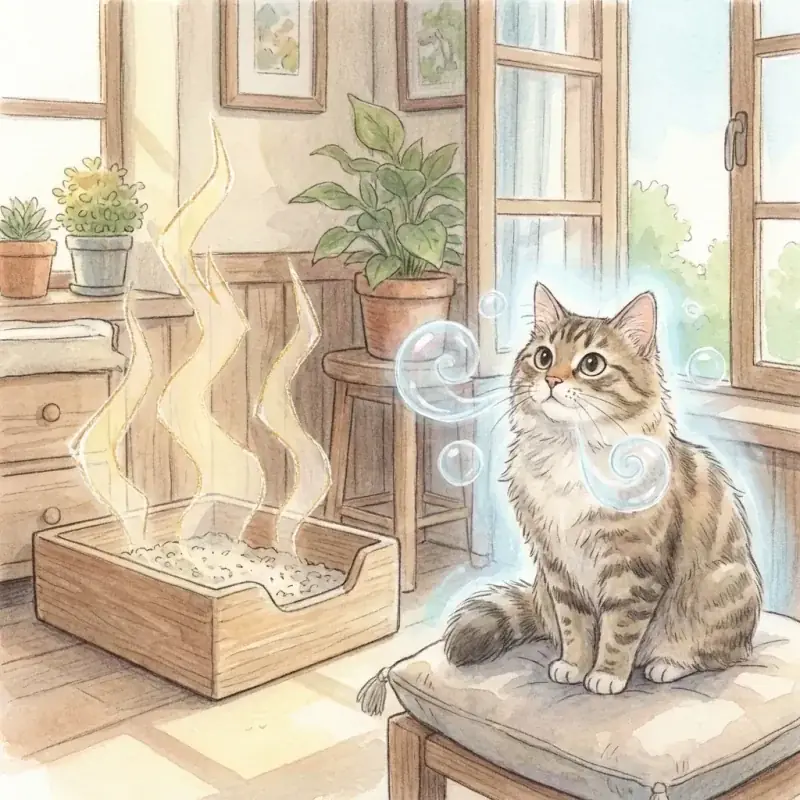
Tout le monde dans votre foyer n’est pas également vulnérable. Voici qui subit l’exposition la plus forte, et pourquoi :
Chats
- Irritation respiratoire et toux chronique
- Évitement du bac à litière (menant à des accidents)
- Yeux larmoyants et clignements persistants
- Aggravation de l’asthme ou de la bronchite félins
Les chats respirent plus près de la surface de la litière et inhalent l’ammoniac bien plus directement pendant qu’ils l’utilisent que les humains ne le font jamais.
Humains
- Irritation des yeux, du nez et de la gorge
- Maux de tête et nausées
- Aggravation d’un asthme ou d’allergies déjà présents
- Problèmes respiratoires en cas d’exposition quotidienne prolongée
Les personnes ayant des troubles respiratoires sont nettement plus sensibles aux vapeurs d’ammoniac, peu importe la concentration.
Groupes vulnérables
- Nourrissons et enfants (respiration plus rapide, poumons en développement)
- Personnes âgées (réserve respiratoire réduite)
- Personnes atteintes d’asthme, de MPOC ou de maladie cardiaque
- Femmes enceintes (sensibilité du fœtus aux toxines inhalées)
Des précautions supplémentaires sont incontournables. Déplacez les bacs à litière hors des pièces où ces personnes passent régulièrement du temps.
Signes que le taux d’ammoniac de votre bac est trop élevé
Mais ça empire : la plupart des gens sous-estiment leur exposition parce qu’ils sont devenus insensibles à l’odeur. Voici un test sensoriel rapide qui contourne cette accoutumance.
Le test du reniflement de 30 secondes
Tenez-vous à 3 pieds (1 mètre) du bac à litière et prenez une lente inspiration par le nez. Comparez :
- Aucune odeurSous 5 ppm - entretien excellent.
- Odeur légèrePlage de 5–25 ppm. Retirez les déchets aujourd’hui et ajoutez du charbon actif.
- Sensation de picotement25–50 ppm. Yeux ou gorge légèrement irrités. Un changement complet de litière s’impose aujourd’hui.
- Yeux qui larmoient50+ ppm. Ventilez immédiatement. Les membres vulnérables du foyer devraient quitter la pièce.
Pas certain de votre situation? Faites notre quiz des odeurs de 60 secondes pour obtenir une évaluation personnalisée.
Surveillez votre chat aussi. Un chat qui se met soudainement à uriner hors du bac, sans changement de routine, signale souvent que le taux d’ammoniac est devenu trop inconfortable. Les chats choisiront un endroit « plus propre » bien avant que vous ne perceviez consciemment le problème.
Est-ce nocif de respirer les émanations du bac à litière?
Une bouffée occasionnelle en nettoyant le bac ne cause pas de dommage durable. Le risque vient de la répétition : respirer de l’ammoniac tous les jours dans une pièce mal ventilée entretient une irritation des yeux et des voies respiratoires, et peut déclencher des crises chez une personne asthmatique.
Deux précautions valent la peine. Ne mélangez jamais d’eau de Javel avec de l’urine ou de l’ammoniac pendant le nettoyage : la réaction produit des vapeurs de chloramine, nettement plus dangereuses que l’ammoniac lui-même. Et videz le bac dans une pièce aérée plutôt que dans un placard ou une salle de bain fermée, où les émanations se concentrent autour de votre visage.
La poussière de litière est une irritation distincte de l’ammoniac. Si vous toussez surtout au moment de verser la litière, c’est la poussière, pas le gaz. Versez lentement, à bout de bras, et choisissez une litière peu poussiéreuse.
Comparatif des méthodes de réduction de l’ammoniac
Maintenant, portez bien attention. La plupart des propriétaires de chats utilisent des méthodes qui semblent efficaces, mais qui ne réduisent en rien les concentrations réelles d’ammoniac.
Voici une comparaison honnête de chaque approche courante, y compris le fait de chimie crucial que la plupart des gens ignorent au sujet du bicarbonate de soude :
| Méthode | Mécanisme | Élimine le NH₃? | Durée | Verdict |
|---|---|---|---|---|
| Désodorisant / vaporisateur | Masquage | Minutes | Aggrave l’odeur combinée | |
| Bicarbonate de soude | Neutralisation acide | Heures | Inefficace - l’ammoniac est alcalin | |
| Litière parfumée | Masquage | Jours | Crée un mélange parfum-ammoniac | |
| Purificateur d’air HEPA | Filtration de l’air | Partiel | Continu | Traite l’air, pas la source |
| Charbon actif (Purrify) | Adsorption | 7–14 jours | Élimine à la source moléculaire |
Le mythe du bicarbonate de soude mérite une mention spéciale. Le bicarbonate de soude est une base (pH ~8,3). L’ammoniac est aussi une base (pH ~11). Une base ne peut pas neutraliser une autre base, c’est de la chimie de base. Ça ne fait rien. Voyez notre analyse complète du bicarbonate de soude vs le charbon actif.
Votre choix de litière compte aussi. Certains types de litière combattent l’ammoniac bien mieux que d’autres, et le bon jumelage fait travailler chaque méthode ci-dessus plus fort. Notre guide de la meilleure litière pour le contrôle des odeurs compare les quatre types face à face.
Prêt à éliminer l’ammoniac à la source?
Les granules de charbon actif Purrify adsorbent les molécules de NH₃ avant qu’elles ne se dispersent dans l’air. Prenez un sachet de 50 g et voyez la différence dès la prochaine litière.
Un sac, juste une fois. Sans abonnement.
Vous êtes aux États-Unis? Voici votre page.
Le protocole de réduction de l’ammoniac en 4 étapes
Voici un protocole précis et concret, avec les quantités et le rythme, qui maintient la plupart des foyers à un seul chat sous les 10 ppm et les foyers à plusieurs chats sous les 25 ppm :
Retirer les déchets toutes les 12 à 24 heures
Retirez les déchets solides et les amas au moins une fois par jour, deux fois par jour dans les foyers à plusieurs chats. La production d’ammoniac commence dans les 20–30 minutes suivant la miction; retirer les déchets avant 24 heures empêche une accumulation exponentielle.
Toutes les 12–24 hVentiler la zone de la litière
Placez les bacs à litière à moins de 6 pieds d’une source d’air frais : une fenêtre qui s’ouvre, un ventilateur d’extraction de salle de bain ou une bouche de ventilation centrale. Un ventilateur d’extraction de 60 CFM peut réduire l’ammoniac localisé jusqu’à 80 % dans les petites pièces.
Débit d’air 60+ CFMAjouter des granules de charbon actif
Saupoudrez 2–3 cuillères à soupe de granules de charbon actif sur de la litière fraîche et mélangez délicatement. Le charbon adsorbe les molécules d’ammoniac au niveau moléculaire avant qu’elles ne se dispersent dans l’air. Ajoutez-en dès que le bac recommence à dégager une odeur.
2–3 c. à soupe par bacChanger toute la litière chaque semaine
Même avec un nettoyage quotidien et un traitement au charbon, une litière saturée d’ammoniac doit être entièrement remplacée. Foyers à un seul chat : tous les 7–10 jours. Foyers à plusieurs chats : tous les 5–7 jours. Lavez le bac avec un savon à vaisselle non parfumé, jamais d’eau de Javel, qui réagit avec l’ammoniac pour former des vapeurs toxiques de chloramine.
Tous les 7–10 joursPour un calendrier d’entretien complet adapté à votre nombre de chats, consultez notre guide sur la fréquence à laquelle changer la litière.
Si vous utilisez déjà un bac automatique, la même chimie de l’ammoniac s’applique. Le tiroir scellé capte les solides mais n’arrête pas l’ammoniac gazeux libéré dès que votre chat urine, avant même que le cycle ne s’enclenche. Voyez notre survol du contrôle des odeurs des bacs autonettoyants pour les sept correctifs mécaniques (joint du tiroir, âge du filtre, délai du cycle, qualité des amas, charge à plusieurs chats) plus la couche de charbon actif qui piège l’ammoniac aéroporté que le matériel manque. Vous avez un Litter-Robot en particulier? Voici pourquoi votre Litter-Robot sent encore.
Pourquoi le charbon actif est la solution la plus efficace
Écoutez : la plupart des produits de contrôle des odeurs agissent sur votre perception de l’ammoniac. Le charbon actif agit sur la molécule d’ammoniac elle-même.
La science de l’adsorption
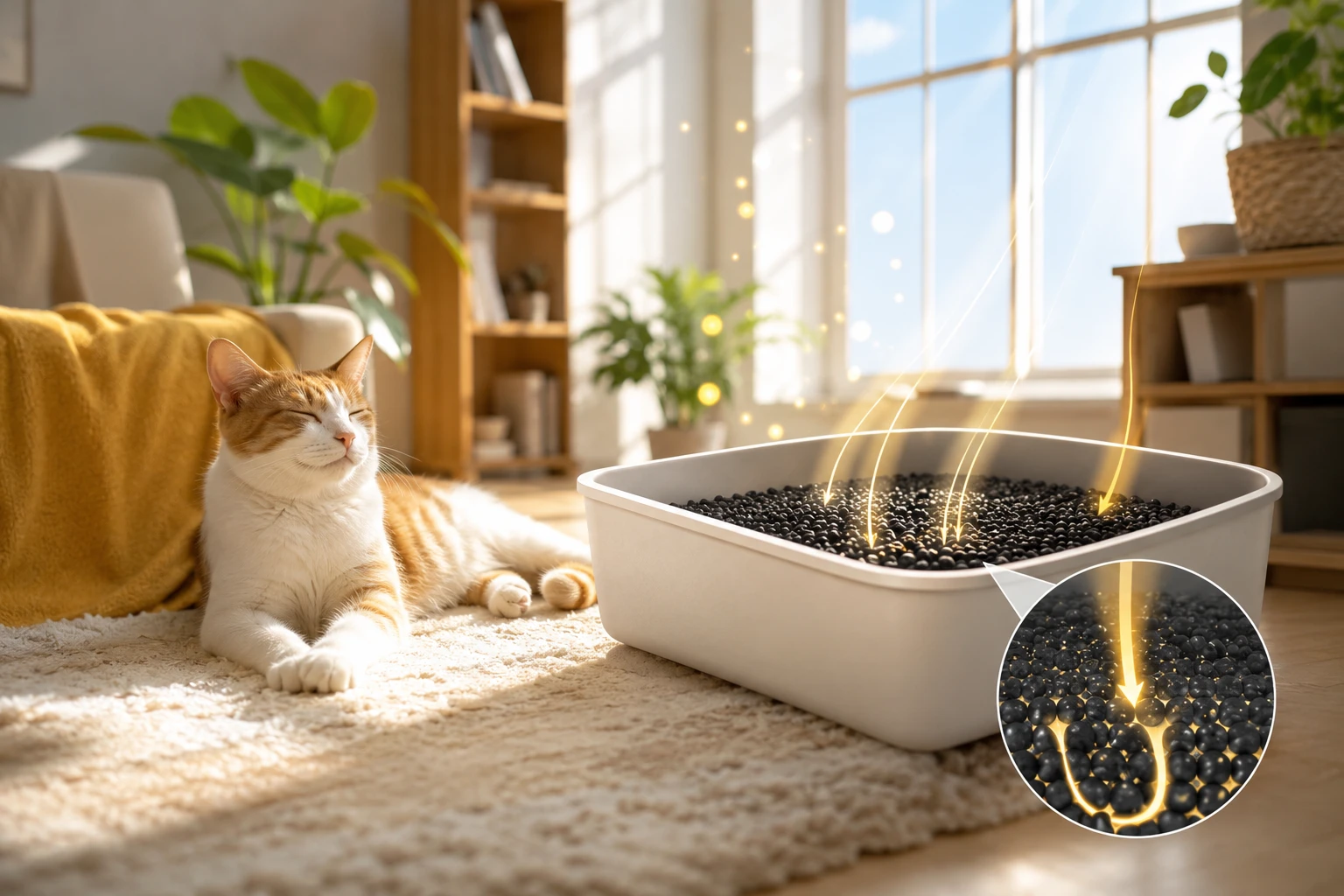
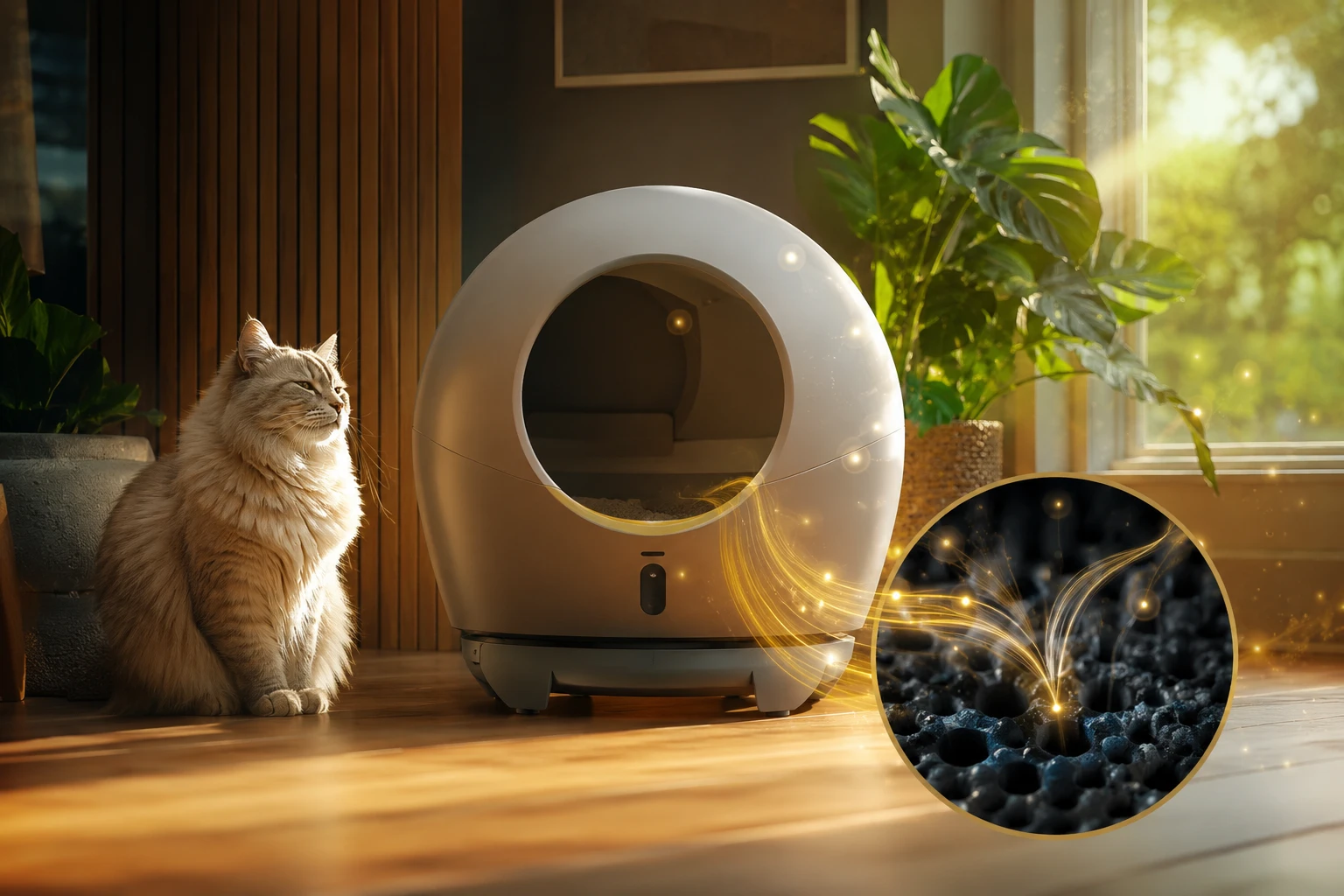
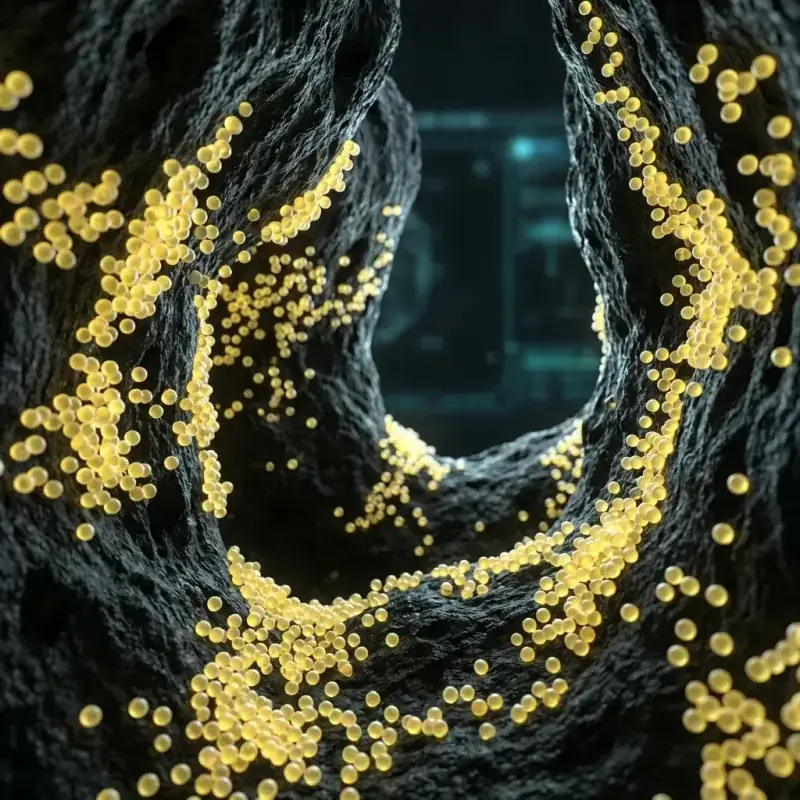
Le charbon actif a une surface de 500–1 500 m² par gramme4, environ la superficie d’un terrain de football dans une seule cuillère à thé. Les molécules d’ammoniac (NH₃) sont physiquement piégées dans les micropores du charbon par adsorption : une adhésion au niveau moléculaire qui capture le gaz de façon permanente avant qu’il ne se disperse dans l’air.5
Contrairement aux désodorisants qui se mélangent à l’ammoniac pour créer une odeur de « parfum plus urine », le charbon actif retire complètement la molécule. Voyez toute la science. Purrify est exactement cet additif au carbone activé pour litière, dans un sachet que vous versez dans le bac.
Élimine l’ammoniac à la source moléculaire
Non toxique et sans danger pour les animaux
Agit en continu pendant 7–14 jours par application
Purrify, c’est une équipe dévouée de parents de chats devenus obsédés par la chimie des odeurs. On n’est pas une compagnie de parfum qui vend un cache-misère, on est un produit d’abord scientifique bâti autour du seul mécanisme qui agit vraiment sur l’ammoniac.
Pour une comparaison détaillée de toutes les options à base de charbon, voyez notre analyse des absorbeurs d’odeurs de litière les plus puissants. Pour des stratégies propres aux appartements, lisez notre guide des odeurs de chat en appartement.
Quand consulter un médecin ou un vétérinaire
Consultez immédiatement si :
Chez l’humain :
- Difficulté à respirer ou respiration sifflante
- Irritation grave des yeux qui ne passe pas après avoir quitté les lieux
- Toux persistante ou oppression thoracique
- Nausées ou étourdissements sans autre cause identifiable
Chez votre chat :
- Respiration la gueule ouverte ou halètement
- Clignements persistants ou écoulement des yeux
- Éternuements ou toux chroniques non expliqués par une maladie
- Évitement soudain du bac à litière accompagné des signes ci-dessus
Ces symptômes sont rares à une exposition domestique typique, mais méritent une attention rapide, surtout pour les nourrissons, les personnes âgées et les chats de plus de 10 ans.
Comment traiter une exposition à l’ammoniac de l’urine de chat
La bonne nouvelle d’abord : pour une exposition domestique, le traitement est simple et agit vite. L’ammoniac est soluble dans l’eau et ne s’accumule pas dans votre corps, alors les symptômes s’estompent une fois le gaz sorti de votre air.
- Sortez à l’air frais. Quittez la pièce, ouvrez les fenêtres et faites tourner un ventilateur d’extraction. La plupart des irritations s’apaisent en 20 à 30 minutes d’air propre.
- Rincez ce qui pique. Si vos yeux brûlent, rincez-les à l’eau tiède propre pendant 10 à 15 minutes. Une gorge irritée se calme avec de l’air frais et un verre d’eau.
- Déplacez votre chat dans une pièce ventilée et surveillez les clignements, les éternuements ou une respiration laborieuse dans l’heure qui suit.
- Réglez la source avant que quiconque n’y retourne. Retirez les déchets, changez toute la litière si le bac est saturé, et ajoutez du charbon actif pour que le taux d’ammoniac ne remonte pas aussitôt. Si les symptômes persistent au-delà d’une heure, servez-vous des signes ci-dessus pour décider qui appeler.
Il n’y a pas d’antidote à prendre à la maison, et vous ne devriez pas en avoir besoin : retirer l’exposition, c’est ça le traitement, selon le profil de l’ammoniac de l’ATSDR. Si les symptômes semblent un jour graves plutôt qu’irritants, traitez ça comme toute urgence respiratoire et consultez sans tarder.
Foire aux questions
QL’ammoniac de la litière peut-il vous rendre malade?
Aux niveaux domestiques habituels, sous les 25 ppm, l’ammoniac cause de l’irritation plutôt qu’une maladie. Des symptômes comme des yeux larmoyants, des maux de tête et un inconfort de la gorge apparaissent entre 25–50 ppm. Des dommages respiratoires sérieux exigent une exposition prolongée au-dessus de 100 ppm, ce qui est rare dans la plupart des foyers, mais possible avec plusieurs bacs à litière négligés dans une pièce fermée et non ventilée.
QCombien d’ammoniac trouve-t-on habituellement dans un bac à litière sale?
Un bac fraîchement nettoyé pour un seul chat produit habituellement moins de 10 ppm près de la surface. Un bac laissé plus de 48 heures peut atteindre 50–100 ppm dans la zone immédiate. La limite d’exposition admissible de l’OSHA pour l’ammoniac en milieu de travail est de 50 ppm sur une journée de 8 heures, un seuil qu’un bac à plusieurs chats non nettoyé peut égaler ou dépasser.
QL’ammoniac de la litière est-il dangereux pour les bébés?
Plus que pour des adultes en bonne santé. Les nourrissons respirent plus vite par rapport à leur poids, ont un système respiratoire en développement et passent plus de temps au niveau du sol, là où les concentrations d’ammoniac sont les plus élevées. Si un bac à litière partage un espace avec un bébé, déplacez-le dans une pièce séparée avec une porte fermée et imposez un nettoyage deux fois par jour avec du charbon actif.
QLa litière pour chat peut-elle causer des problèmes respiratoires chroniques?
Une exposition chronique de faible intensité peut aggraver un asthme existant, causer des maux de tête récurrents et provoquer une irritation persistante des yeux. Une véritable maladie respiratoire chronique causée par la litière domestique est rare dans les installations bien entretenues. Le scénario le plus à risque, c’est trois chats ou plus dans un petit appartement mal ventilé avec des changements de litière peu fréquents.
QLe bicarbonate de soude neutralise-t-il l’ammoniac dans la litière?
Non - c’est l’un des mythes les plus tenaces dans les soins aux chats. Le bicarbonate de soude (bicarbonate de sodium) neutralise les acides. L’ammoniac est une base dont le pH avoisine 11. On ne peut pas neutraliser une base avec une autre base - c’est de la chimie fondamentale. Seule l’adsorption par le charbon actif, ou les traitements bactériens enzymatiques, peut réellement capter les molécules d’ammoniac.
QCombien de temps l’ammoniac met-il à s’accumuler dans un bac à litière?
La production d’ammoniac commence dans les 20–30 minutes suivant la miction, quand les bactéries se mettent à convertir l’urée. Une odeur détectable (au-dessus de 5 ppm) apparaît généralement en 2–4 heures. Par temps chaud, au-dessus de 75°F (24°C), un bac laissé 24 heures peut atteindre des concentrations 3–5× plus élevées qu’un bac nettoyé le jour même, parce que la chaleur accélère l’activité enzymatique des bactéries.
QQuel est le traitement d’une intoxication à l’ammoniac provenant de l’urine de chat?
L’air frais est le traitement. Quittez la pièce, ventilez et rincez les yeux irrités à l’eau tiède pendant 10 à 15 minutes. Une exposition domestique n’exige presque jamais de médicament, et les symptômes s’estompent généralement en une demi-heure. Consultez un médecin ou appelez le centre antipoison si les difficultés respiratoires ou l’irritation des yeux durent plus d’une heure après avoir quitté les lieux, et appelez votre vétérinaire si votre chat respire la gueule ouverte ou présente un écoulement oculaire persistant.
QQuel est un niveau d’ammoniac sécuritaire dans une maison avec des chats?
Sous les 25 ppm, c’est le seuil de sécurité pratique pour une exposition domestique continue, d’après les lignes directrices professionnelles de l’OSHA. Pour les foyers avec des nourrissons, des personnes âgées ou toute personne asthmatique ou atteinte de MPOC, viser sous 10 ppm est plus approprié. Un nettoyage quotidien et des granules de charbon actif permettent de maintenir ce niveau de façon constante.
QL’odeur d’ammoniac de l’urine de chat est-elle dangereuse?
L’odeur est un signal d’alarme, pas le danger en soi. Votre nez détecte l’ammoniac autour de 5 ppm - bien en dessous des 25 ppm où l’irritation commence, et bien loin des 100+ ppm nécessaires pour causer un vrai dommage. Un bac que vous sentez de l’autre bout de la pièce mérite donc d’être corrigé, mais c’est rarement une urgence. Le risque monte dans les petites pièces fermées avec plusieurs chats, ou pour les nourrissons et les personnes asthmatiques. Les niveaux d’exposition ci-dessus montrent ce que chaque concentration fait réellement à votre corps.
QL’urine de chat contient-elle de l’ammoniac?
L’urine de chat fraîche contient très peu d’ammoniac libre. Ce qu’elle transporte, c’est de l’urée, un composé résiduel riche en azote. En 20 à 30 minutes environ, les bactéries de la litière libèrent une enzyme appelée uréase qui convertit cette urée en ammoniac gazeux - ce qui explique pourquoi un bac sent plus fort plus il reste longtemps, et non au moment où votre chat l’utilise. Retirer les déchets tôt et ajouter du charbon actif arrête l’accumulation avant qu’elle ne devienne l’odeur que vous remarquez.
QL’ammoniac de l’urine de chat peut-il vous tuer?
Dans une maison normale, non. Une exposition mortelle à l’ammoniac demande des concentrations de plusieurs centaines à plusieurs milliers de ppm - le genre qu’on trouve dans les fuites industrielles, pas dans un bac à litière. Un bac à plusieurs chats négligé dans une pièce fermée peut atteindre 50 à 100 ppm, assez pour causer une réelle irritation des yeux et de la gorge et pour aggraver l’asthme, mais loin d’être mortel. L’objectif pratique est de garder les niveaux sous 25 ppm avec un nettoyage quotidien et du charbon, et de ventiler toute pièce où l’odeur est forte.
QQuels sont les symptômes d’une exposition à l’urine de chat chez l’humain?
Respirer l’ammoniac de l’urine de chat cause souvent des yeux larmoyants ou brûlants, une gorge irritée, de la toux, un nez qui coule et des maux de tête. Une exposition plus intense ou plus longue peut y ajouter une respiration sifflante, une oppression thoracique, des étourdissements et des nausées, surtout chez les personnes asthmatiques ou atteintes de MPOC. Les symptômes s’estompent généralement en une demi-heure une fois à l’air frais. Consultez le détail des symptômes et quand demander de l’aide pour les précisions.
QEst-ce nocif de respirer les émanations du bac à litière?
Une bouffée en nettoyant le bac ne cause pas de dommage durable. Le vrai problème, c’est l’exposition quotidienne dans une pièce mal ventilée : elle entretient une irritation des yeux et des voies respiratoires et peut déclencher des crises d’asthme. Deux règles comptent avant tout : ne mélangez jamais d’eau de Javel avec de l’urine ou de l’ammoniac pendant le nettoyage, car cette réaction dégage des vapeurs de chloramine bien plus dangereuses que l’ammoniac, et videz le bac dans un endroit aéré plutôt que dans une salle de bain fermée ou un placard. Si vous toussez surtout en versant la litière fraîche, c’est la poussière et non l’ammoniac : versez lentement et choisissez une litière peu poussiéreuse. Voyez respirer les émanations de litière pour la réponse complète.
Arrêtez de respirer l’ammoniac. Commencez aujourd’hui.
Mélangez 2 à 3 cuillères à soupe de granules de charbon actif Purrify à de la litière fraîche et l’odeur d’ammoniac commence à baisser en quelques heures.
Un sac, juste une fois. Sans abonnement.
Vous êtes aux États-Unis? Voici votre page.
Trois chats ou plus? Le 120 g couvre chaque bac.
Guides connexes
Sources
- 1.Hydrolyse de l’urée médiée par l’uréase et production d’ammoniac - National Institutes of Health (PMC)
- 2.Limites d’exposition admissibles de l’OSHA, tableau Z-1 (ammoniac : 50 ppm TWA) - U.S. Dept. of Labor (OSHA)
- 3.Profil toxicologique de l’ammoniac - Agency for Toxic Substances and Disease Registry (ATSDR)
- 4.Surface spécifique du charbon actif (900+ m²/g) - USDA Agricultural Research Service
- 5.Adsorption de l’ammoniac par la fibre de charbon actif - National Institutes of Health (PMC)
- 6.Charbon actif dans les cartouches de respirateur - CDC / NIOSH
- 7.Charbon actif pour le traitement de l’eau potable - U.S. Environmental Protection Agency