| Feature | Baking Soda | Activated Carbon |
|---|---|---|
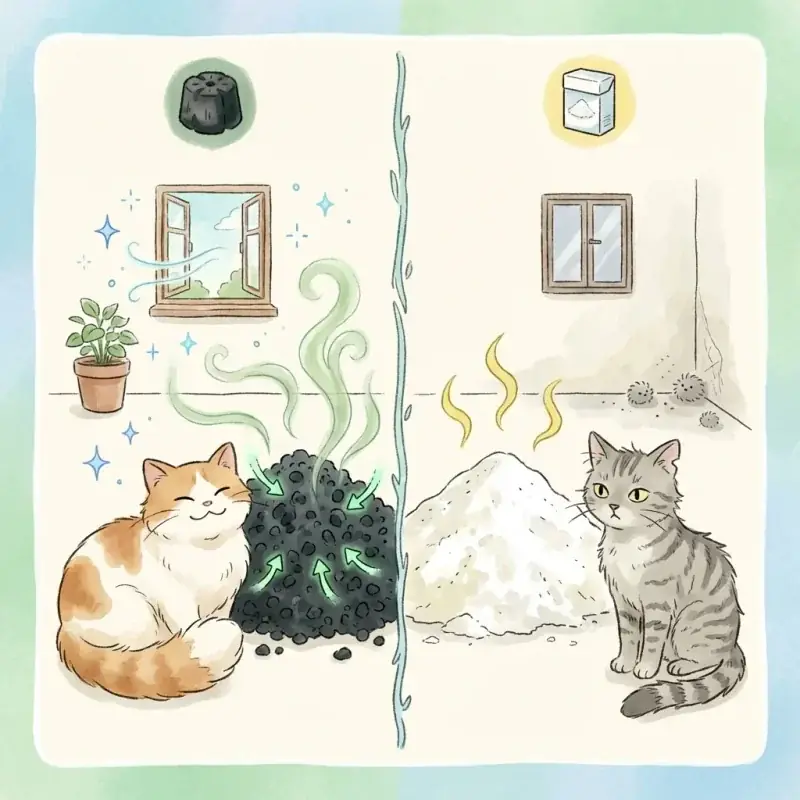
| How it works | Surface neutralization with short-term relief | Adsorbs odor molecules inside millions of pores |
| Ammonia control | Weak once the top layer is spent | Strong ongoing control for urine odor |
| Feces odor | Limited | Highly effective |
| Typical duration | About 1 to 3 days with frequent refreshes | Roughly 2 to 4 weeks with top-ups |
| Best fit | Light odor and short-term budget help | Persistent odor, apartments, and multi-cat homes |
One question, head to head: activated charcoal or baking soda, which actually works on cat-box ammonia? (Activated charcoal and activated carbon are the same material, so we use both names below.) For the full side-by-side across every common odor solution, see our comparison lab.
The 30-Second Verdict
-
✓
Activated carbon (the same thing most people call activated charcoal) traps odor molecules inside its pores and holds them there. One gram carries about 1,150 square metres of internal surface, and it works on ammonia whether the smell is acidic or not. Carbon is why an activated carbon cat litter additive keeps working long after baking soda has quit.
-
✗
Baking Soda only neutralizes acidic odors (like urine) but fails to trap organic smells or moisture effectively.
-
🌿
Winner? Carbon. It's why gas masks use carbon filters, not pantry ingredients.
Is Activated Charcoal the Same as Activated Carbon?
Yes. Same material, two names. Activated carbon is the technical term you will see on a filter spec sheet or a lab supply catalogue. Activated charcoal is what almost everyone says out loud, including most people searching for a way to stop their litter box smelling.
So if you came here wondering whether charcoal or baking soda is better for odor, you are in the right place, and nothing below changes depending on which word you use. We say activated carbon through the rest of this page because that is what it says on the bag.
One thing that is not the same: the black lumps in a bag of barbecue briquettes. Those have not been activated, so they have almost none of the pore structure that does the work here, and some contain lighter fluid. Activated carbon is made by steaming a carbon source, in our case coconut shell, at high heat until it is riddled with pores.
The Science of Smell
To understand the winner, we have to look at how they fight odor. They work in fundamentally different ways.
Activated Carbon: The Sponge
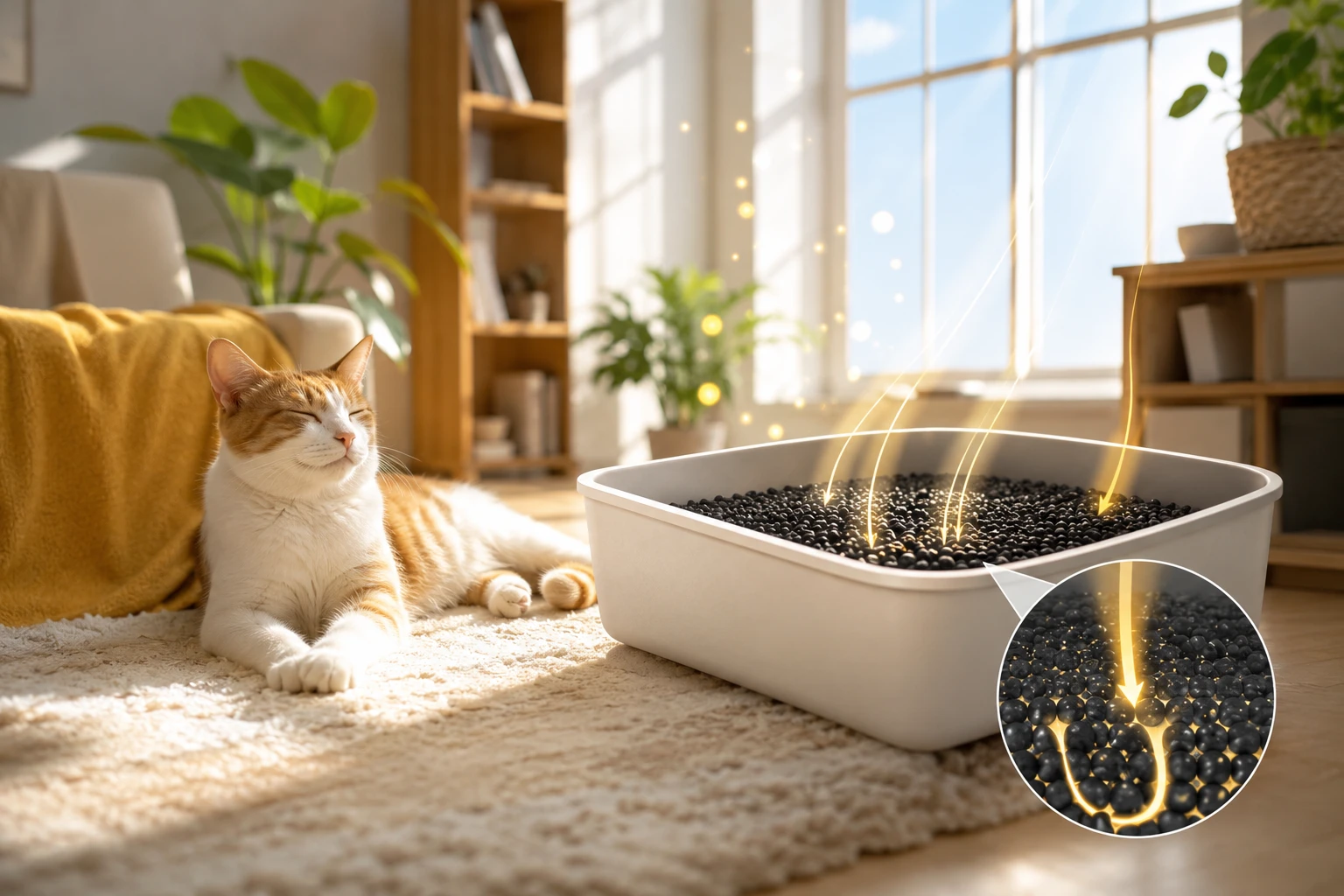
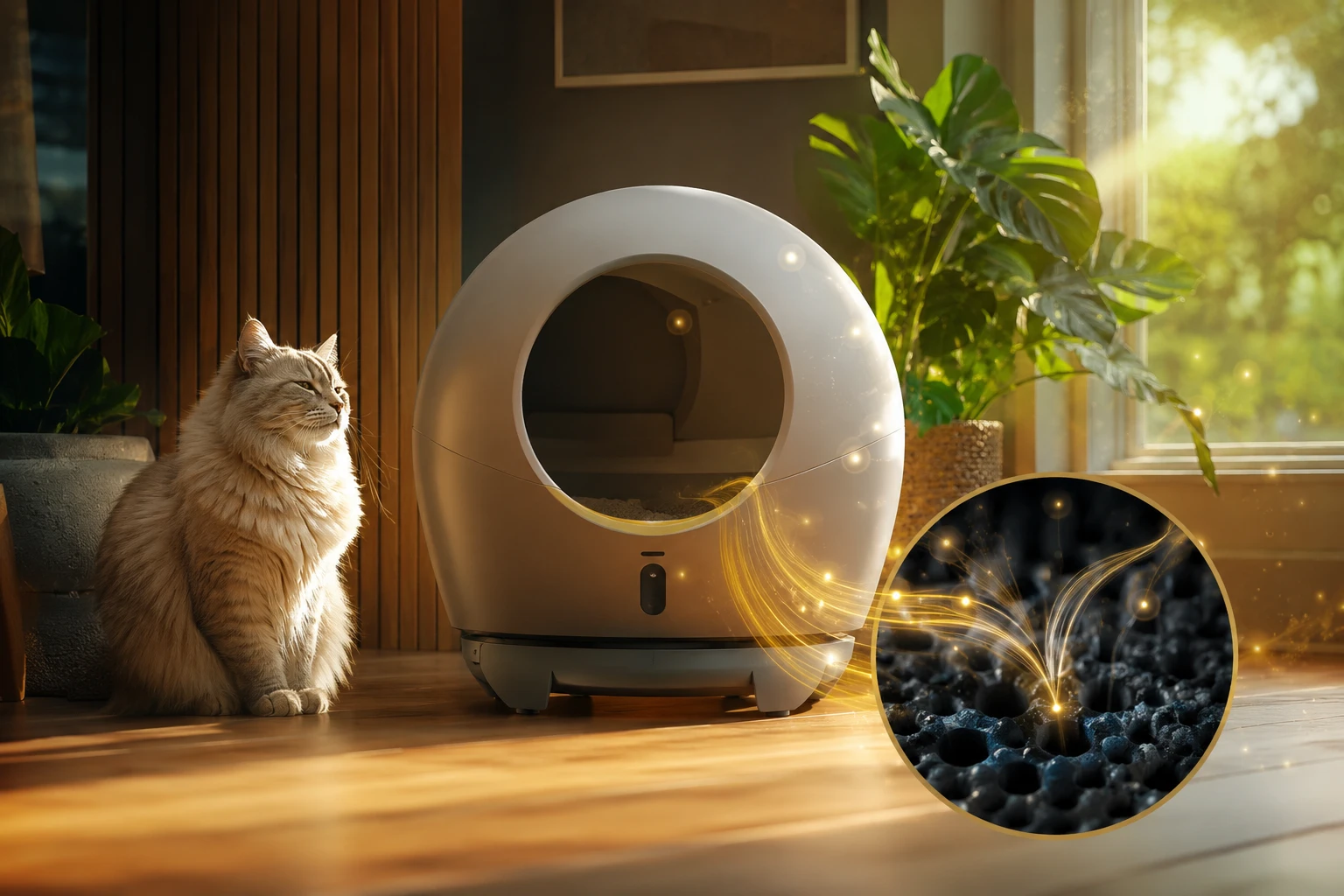
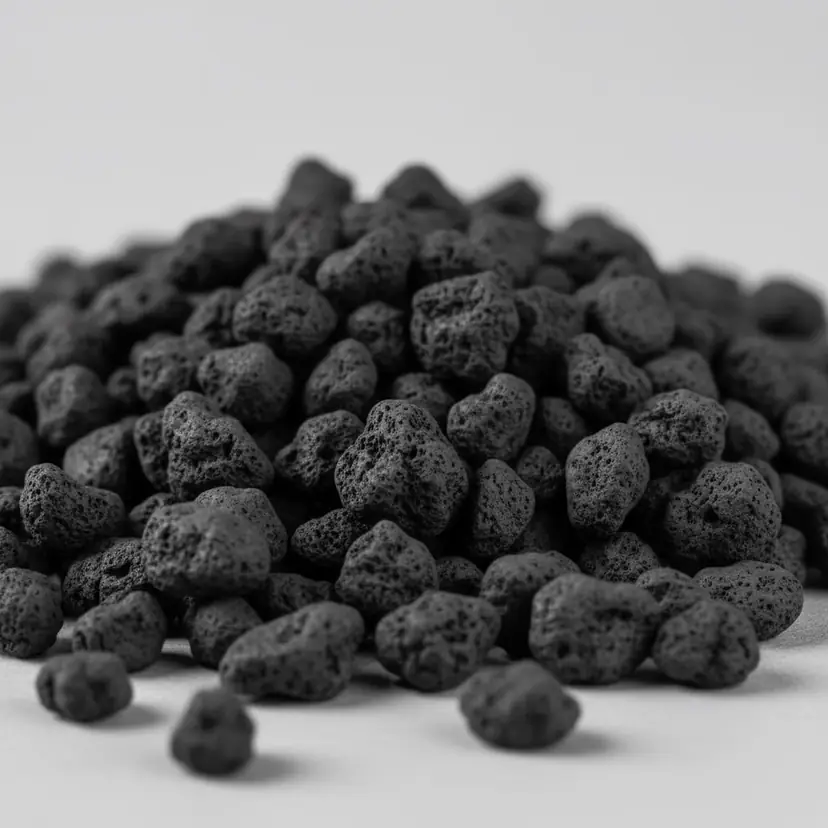
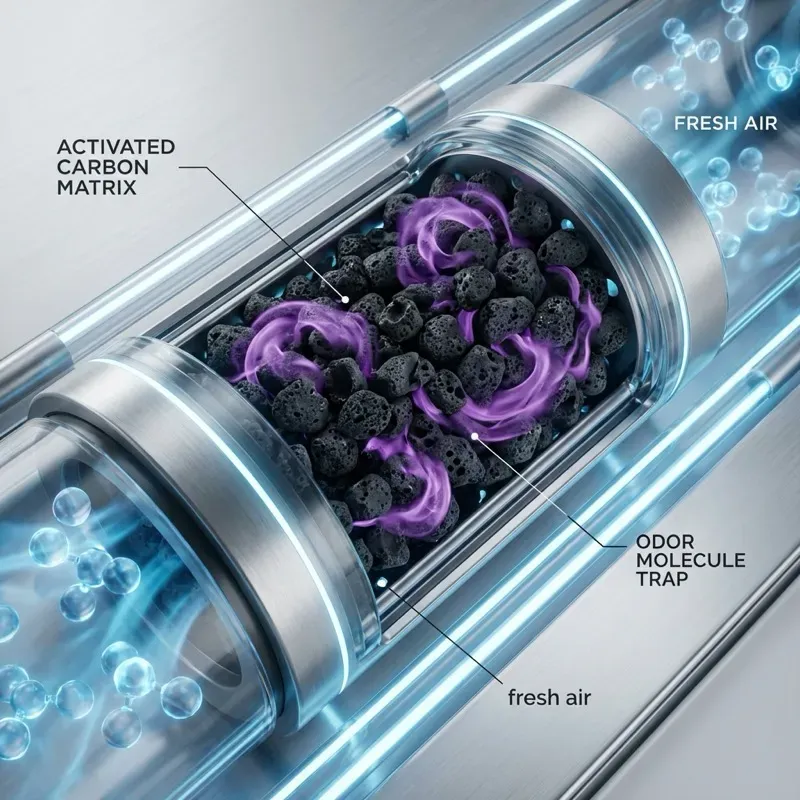
Works by Adsorption. Think of it as a molecular sponge with millions of tiny pores that physically trap and lock odor molecules inside, preventing them from escaping back into the air.
Baking Soda: The Neutralizer
Works by pH Neutralization. It's a base that reacts with acids (like urine). It creates a chemical reaction to turn the acid into a salt, reducing the smell.
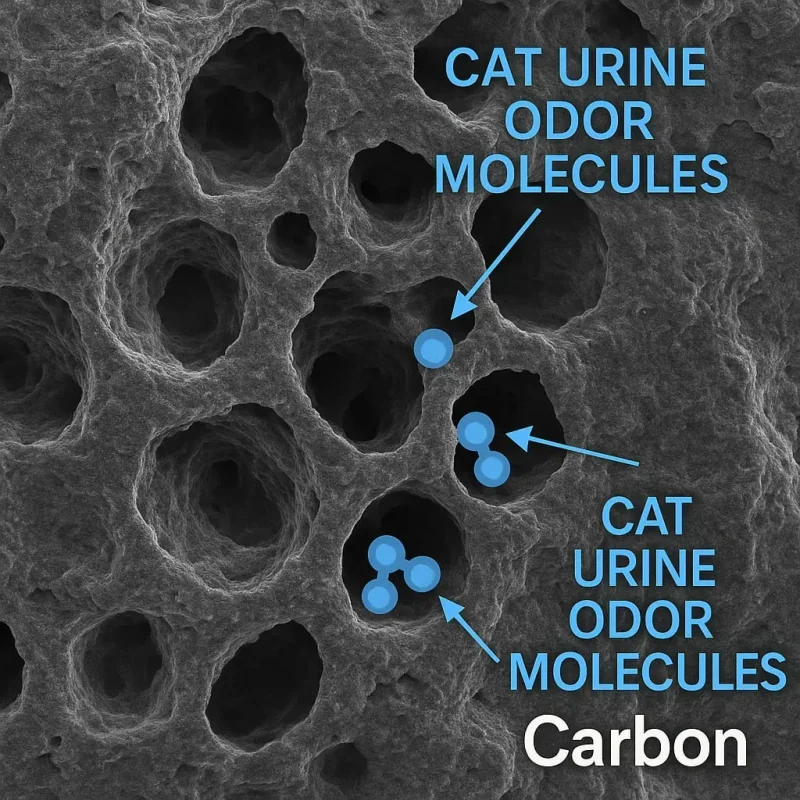
Magnified: The Carbon "Pore" Network
The Ammonia Problem: Why Baking Soda Fails
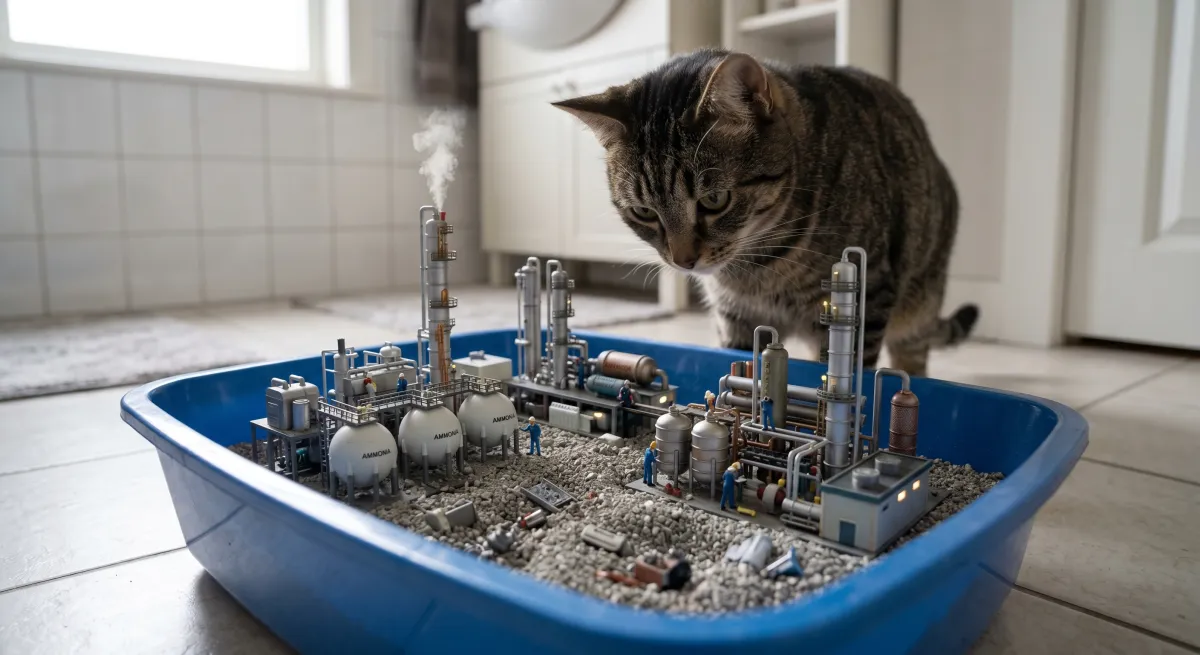
Here's the critical issue that many cat owners don't realize: cat urine produces ammonia, which is alkaline.
Baking soda sits around pH 8.4, which is also alkaline. The ammonia coming off a used litter box sits around pH 11.6. An alkaline substance cannot neutralize another alkaline substance, they simply don't react. It's like trying to cool hot water by adding more hot water.
A note on adding baking soda to litter
Short version: you can, it will not harm a healthy cat in a thin layer of plain unscented baking soda, and it will not do much for the smell. Baking soda neutralizes acids. The ammonia in cat urine is a base at around pH 11.6, so the two barely react, which is the whole reason this comparison exists.
The safety side of that question has its own answer, because it depends on your cat rather than on chemistry: the dust matters for cats with asthma or a flat face, some cats stop using a box once it has been added, and baking powder is a different substance that does not belong in a litter box at all. We cover all of that separately in is baking soda safe for cats.
The rest of this page is about performance: what each one does to odor, how long it lasts, and what it costs over a month.
Activated Charcoal vs Baking Soda: Head-to-Head

Real-World Testing Timeline
Initial Performance
Both perform reasonably well. Baking soda absorbs moisture and masks fresh scents. Carbon begins trapping molecules. Users are generally happy with either.
The Divergence
Baking soda fails. Ammonia levels rise, and the alkaline baking soda can't stop it. The "litter box smell" returns. Carbon continues working at 100% capacity.
Long-Term Reality
Baking soda user must dump the whole box. Activated carbon user is still odor-free, as the massive surface area isn't even close to saturated yet.
Ready for a litter box you can't smell?
Free shipping. Never run out. Cancel anytime.
Start autoship →Is Carbon Actually More Expensive?
Per box on the shelf, baking soda is cheaper. It stays cheaper. That is not the number that decides what a month costs you.
The Winner: Activated Carbon
Activated Carbon
There is simply no contest. While baking soda is a cheap quick-fix for a fresh stain, activated carbon is a long-term air filtration system for your litter box. Ready to try it? Get the Purrify activated carbon additive.
About five grams carries the surface area of a football field. A 50g bag carries roughly eleven.
Doesn't just cover them up; it permanently removes them.
Made from 100% natural activated coconut carbon.
Real User Experiences
"I used baking soda for months. It helped a little, but by day 3 I could still smell ammonia when walking past the litter box. I had to add more every few days."
- Sarah M., Toronto
"Switched to activated carbon additive and the difference was immediate. Guests don't even know I have a cat until they see her. Three weeks between refreshes!"
- Michael R., Vancouver
What Happens to a Single Odor Molecule
The whole comparison collapses into one difference: baking soda tries to react with a smell, activated carbon tries to hold onto it. Those are different physics, and they fail in different ways.
Baking soda: a reaction that has to match
Sodium bicarbonate is mildly alkaline. Bring an acidic molecule near it and the two react, the smell is chemically converted into something that does not smell, and that piece of baking soda is spent. It is a one-for-one trade, and it only happens if the odor is acidic in the first place.
Litter box odor is dominated by ammonia, which is a base sitting around pH 11.6. Two bases do not react with each other. This is not a matter of using more or stirring harder. The reaction the product depends on is simply not available.
Activated carbon: a trap that does not care what the molecule is
Activated carbon does not convert anything. It is a solid riddled with pores at a scale close to the size of the odor molecules themselves, and molecules that wander into those pores are held there by surface attraction. Because nothing has to react, the acid or base question never comes up. Ammonia gets held the same way a sulfur compound from feces does.
The reason a small scoop covers a whole box is that the useful surface is internal. Almost all of the area is inside the pores, not on the outside of what you can see, which is the same property that makes carbon the standard choice in water filters and respirator cartridges.
How much surface area are we actually talking about?
The activated coconut shell carbon in Purrify measures 1,150 square metres of surface per gram. That number is hard to picture, so here it is in football fields. One American football field including both end zones is 5,351 square metres, which works out to a shade under five grams of carbon.
| Amount | Internal surface area | Football fields |
|---|---|---|
| 1 gram | 1,150 m² | About a fifth of one |
| 15g bag | 17,250 m² | About 3 |
| 50g bag | 57,500 m² | About 11 |
| 120g bag | 138,000 m² | About 26 |
Baking soda has no equivalent number to put in that column, because it is not porous. It is a solid crystal, so the only surface available to it is the outside of each grain. That is the entire difference in one line: one of these materials is mostly surface, and the other is mostly not.
Surface area is not the same thing as a performance score, and we are not claiming a box smells twenty-six times better. What it explains is capacity: why a small amount keeps working for weeks instead of days, and why it does not stop when the acidic part of the smell runs out.
Why Baking Soda Looks Like It Works at First
People are not imagining the initial improvement, and it is worth explaining honestly rather than dismissing it.
- It handles the acidic part of the smell. Litter box odor is not purely ammonia. Some of the sour notes are acidic, and those genuinely do get neutralized.
- It absorbs moisture. Drier litter slows the bacteria that convert urea into ammonia, so odor production dips briefly.
- Fresh anything feels better. Adding something to a box usually comes with a stir and a scoop, and that alone changes the smell.
All three effects are real and all three are short. The acidic fraction is a minority of the problem, the moisture effect ends as soon as the next cat uses the box, and the stir was doing work the baking soda got credit for.
Where the gap between them widens
In a single-cat home with a big box, daily scooping and an open window, the two options look closer than they are, because the conditions are doing most of the work. The difference shows up when conditions get harder.
- Multiple cats. More urine per day means more urea and a faster climb in ammonia. The reaction-based option saturates sooner; the trap-based one keeps working until its pores fill.
- Warm rooms. Heat speeds up the bacterial enzymes that make ammonia, so summer widens the gap in the same box that was fine in winter.
- Humidity. Damp litter is friendlier to bacteria and it also clumps a fine dry additive into a crust that stops mixing through the bed.
- Covered boxes and small rooms. Less air exchange means whatever is not captured stays at nose height instead of dispersing.
If you have tried baking soda and concluded it works fine, it is worth asking whether your setup is easy rather than whether the product is good. The same box in August with a second cat tells a different story.
Does putting baking soda under the litter work better?
This is the most common variation people try, and it makes intuitive sense: put the odor absorber where the urine ends up. In practice it performs worse than sprinkling on top, for a mechanical reason.
Urine soaks down and pools at the bottom, so a layer down there gets soaked immediately and forms a damp crust. Once it crusts, the surface area available for any reaction collapses, and the layer stops doing even the small amount of work it was capable of. It also makes the box harder to clean out properly, which quietly extends how long old waste stays in there.
Mixing through the whole bed beats both layering approaches, whichever material you are using. That is also how Purrify is meant to be used: stirred gently through fresh litter rather than layered.
The cost comparison people get wrong
Baking soda wins on price per box, and that is the end of the comparison people usually run. The number that actually matters is cost per week of a box that does not smell.
If a cheap option needs reapplying every day or two and still leaves you doing a full litter change ahead of schedule, the litter itself becomes the dominant cost, not the additive. A box that stays acceptable longer stretches the interval between full changes, and litter is the expensive part of this system by a wide margin.
That is the honest case for carbon on cost: not that it is cheaper per scoop, but that it moves the expensive variable. If you are only comparing the price of the additive itself, baking soda wins and always will.
How to Use Each Method Correctly
If Using Baking Soda
- 1.Use 2-3 tablespoons per litter box
- 2.Mix thoroughly into the litter
- 3.Refresh every 3-4 days (no exceptions)
- 4.Expect partial odor control, not elimination
If Using Activated Carbon
- 1.Use 2-3 tablespoons per litter box
- 2.Sprinkle on top or mix throughout
- 3.Refresh every 2-4 weeks
- 4.Choose a coarse additive over a fine dusty one
- 5.Top up after scooping to maintain continuous protection
When baking soda still helps
Baking soda is not useless. It can help with light stale odor, a fresh cleanup, or a box that only smells slightly tired near change day. It is a short-term helper, not a long-term ammonia strategy.
- Best case: Mild odor between full litter changes.
- Weak spot: Sharp urine smell that keeps coming back.
- Main limit: You need to reapply it often, and using more does not solve the core chemistry problem.
Why activated charcoal usually wins
Activated carbon is built for ongoing odor control. Its pore structure traps gas molecules instead of briefly freshening the box. That makes it a better fit for ammonia-heavy litter boxes, small apartments, and multi-cat homes.
- Better fit for ammonia: Carbon traps the gas directly.
- Cleaner handling: A coarse additive usually makes less mess and less dust.
- Longer performance: Small top-ups can last far longer than constant baking soda refreshes.
Is Charcoal or Baking Soda Better for Odor?
Choose based on the size of the odor problem, not just the shelf price.
Use baking soda if...
- You want a cheap boost for light odor.
- You are between cleanings and need a short reset.
- Your box does not have a strong ammonia problem.
Choose activated carbon if...
- You smell sharp urine odor often.
- You have multiple cats or a small living space.
- You want odor control without perfume or frequent reapplication.
Baking soda often looks cheaper at checkout, but frequent refreshes, faster litter changes, and extra cleanup add real cost. Activated carbon can cost more upfront while still lowering the total effort and waste over time. For the full head-to-head against every other common litter-box odor approach, see our comparison lab.