

Quick Answer
The best cat litter for apartments combines tight clumping for easy maintenance with activated carbon to trap gas molecules. In a small space without cross-ventilation, litter alone cannot remove smells from the air, you need molecular trapping at the source. And if a lingering smell is cat pee outside the box, our guide to getting rid of cat pee smell in an apartment walks through the cleanup. For the full room-by-room routine, see how to get rid of cat litter smell in an apartment.
Why Apartments Make Litter Odour Worse
In limited square footage, air volume is your enemy. Without the dilution factor of a larger home, ammonia concentration rises 3x faster, which is why the health side of breathing it in matters more in a small unit. Shared HVAC systems and sealed windows create an environment where odor molecules have nowhere to go.
🚫 Zero Net Ventilation
Interior units often lack cross-breeze. Odor molecules accumulate against walls and soak into soft furniture.
📐 The Proximity Trap
In a 700 sq ft apartment, the litter box is always near your bedroom, kitchen, or desk. There is no "away."
Best Cat Litter Types for Apartments
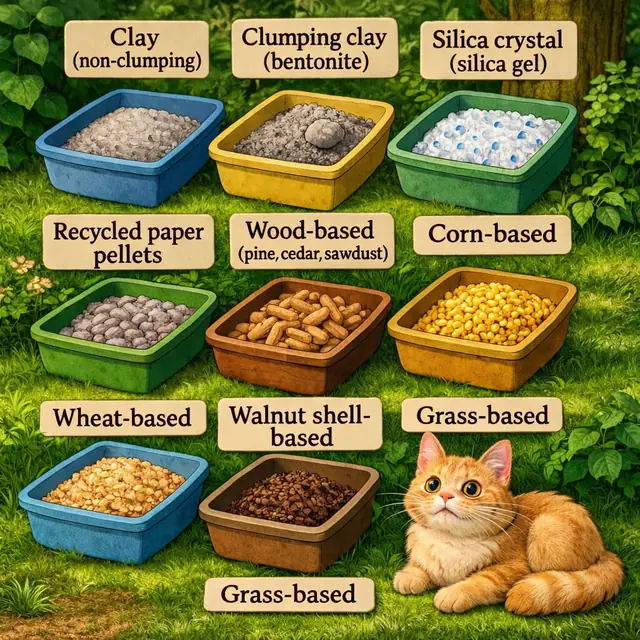
Premium Clumping Clay
Fine-grain sodium bentonite forms the tightest clumps, allowing for rapid waste removal, crucial for small spaces. However, clay cannot trap ammonia gas once it escapes the liquid.
Crystal (Silica) Litter
Silica crystals are dust-free, which is a major advantage for apartment air quality. They absorb liquid brilliantly but lose odor control power as they saturate over 7-10 days.

The Missing Link: Adding activated carbon to any litter converts it into an air purification system.
The Professional Solution
Every litter type has a "gas leakage" problem. In a house, this is ignored. In an apartment, it's unavoidable. The solution is molecular adsorption-physically trapping ammonia gas stars at the source.
Activated Carbon: Small Space Protection
Activated carbon is the gold standard for enclosed-space air filtration. It's the same technology used in:
🏥 Hospital Air Filtration
ICUs and operating rooms use carbon filters to remove trace gases and maintaining sterile, zero-odor air.
🚀 International Space Station
NASA uses activated carbon on the ISS to recycle air and remove ammonia, the same challenge you face in your home.
4 Football Fields of Protection
One gram of activated carbon provides the surface area of a football field. For an apartment dweller, this means a small sprinkle provides massive "molecular catching" power, keeping your 700 sq ft fresh 24/7.
Apartment Litter Box Placement
✅ Best: Bathroom with Exhaust Fan
Run the fan for 10 minutes after your cat uses the box. The negative pressure helps pull molecules out of the main living area.
⚠️ Avoid: HVAC Intake Vents
If the box is near an air return, your AC will suck up the odor and distribute it to your bedroom and kitchen instantly.

Small Space, Fresh Air: Achieving a home that feels open even when the square footage is small.
Ready for a litter box you can't smell?
Free shipping. Never run out. Cancel anytime.
Start autoship →What Apartment Shoppers Should Judge Before Odor Claims
In an apartment, "best for smell" is not just about how the litter handles waste inside the box. You also need to think about what happens in a compact room after the cat leaves. Does the litter release perfume that hangs in the air because there is limited ventilation? Does it track into the kitchen or onto the bed because the living space is only a few steps away? Does it create dust that coats shelves and makes the whole apartment feel stale? A litter that seems acceptable in a large detached home can feel unbearable in a studio because the consequences of every weakness are concentrated.
That is why apartment owners should judge litter on four things at once: clumping strength, tracking, dust profile, and whether odor control comes from chemistry or from added scent. Fragrance-heavy litters can create a double problem in small spaces: the cat smell is still there, and now the whole apartment smells like perfumed litter. Unscented formulas paired with a true adsorbent usually feel cleaner because they reduce the actual odor load instead of layering a second smell into the same shared air.
- Strong clumps matter because weak clumps break apart and keep seeding odor into a box you thought you had cleaned.
- Low tracking matters more in apartments because litter crosses into visible living zones faster.
- Low dust matters because small spaces reveal airborne residue immediately on furniture, electronics, and fabric.
The best apartment litter is the one that stays quiet in the room. If you can smell the litter itself from across the unit, it is often doing too much of the wrong kind of work.
How to Place a Litter Box in a Studio or One-Bedroom Without Broadcasting the Smell
Placement decisions are much less forgiving in apartments than in larger homes. A bad location can turn the entire unit into an odor corridor. The ideal spot usually has two qualities: some mechanical airflow, and a little separation from the apartment's soft furnishings. Bathrooms with exhaust fans are strong contenders because they let you move odor out instead of only diluting it. Utility corners can work if they are not packed so tightly that humidity and smell get trapped. The worst locations are often the most convenient ones: beside the sofa, right under an HVAC return, or inside a fully closed closet where odor concentrates until the door opens.
Think about the apartment as an air path, not just a floor plan. Odor follows pressure changes, fan cycles, and the route you use every day. If the litter box sits beside the jacket rack, laundry hamper, or a rug at the front of the unit, those soft materials can start holding odor and make the whole apartment feel like the box itself. A few feet of separation plus a hard, easy-to-wipe floor surface can make a remarkable difference.
Apartment placement is really about controlling exposure. You want the box somewhere your cat accepts, but you do not want it sitting in the center of the shared air economy of your home.
Why Apartment Odor Control Fails Even After You Buy Better Litter
A common apartment frustration is upgrading to a more expensive litter and discovering that the unit still smells the same. Usually the litter was only one piece of the problem. The waste container may be venting into the room. The box may be scratched and holding old odor. A litter mat, bath mat, or nearby fabric bin may be collecting residue that never gets washed. In a small home, those side sources matter more because there is not enough space for them to hide.
That is why the strongest apartment setup is a system: a litter your cat will use, a real odor-control additive if needed, prompt scooping, a sealed waste solution, and regular cleaning of the first few feet around the box. Once all five pieces work together, the apartment stops feeling like a constant test of whether guests can tell you own a cat.
Storage, Trash, and Neighbor Reality in Apartment Buildings
Apartment litter decisions are also influenced by what happens after the scoop. Oversized bags are harder to store in small closets. Heavy perfume can drift into common hallways when you carry waste out. A trash can that is fine in a garage becomes a major odor source when it lives in the same room where you cook or sleep. That is why the best apartment litter is often the one that fits the entire routine, from storage to disposal, not just the moment it lands in the box.
Small-space success comes from reducing all the side effects of litter care. When storage is manageable, waste leaves the apartment quickly, and the litter itself is not perfuming the unit, odor control becomes much easier to sustain.
Apartment Success Comes From Low-Drama Maintenance
The best apartment litter usually earns that title because it makes daily care easier. If the litter pours cleanly, scoops predictably, and does not perfume the whole unit, you are more likely to maintain it on time. In small spaces, ease of upkeep is a direct part of odor control.
In Apartments, Small Compromises Add Up Fast
A little extra dust, a little more tracking, and a little more perfume might feel tolerable separately, but in an apartment they stack into one obvious smell problem. The best litter is often the product that keeps all of those small compromises low at the same time.
Apartment Odor Control Rewards Practicality
In small homes, practicality is performance. The easier the litter is to store, scoop, and dispose of without perfuming the room, the better it tends to perform over the long term.