
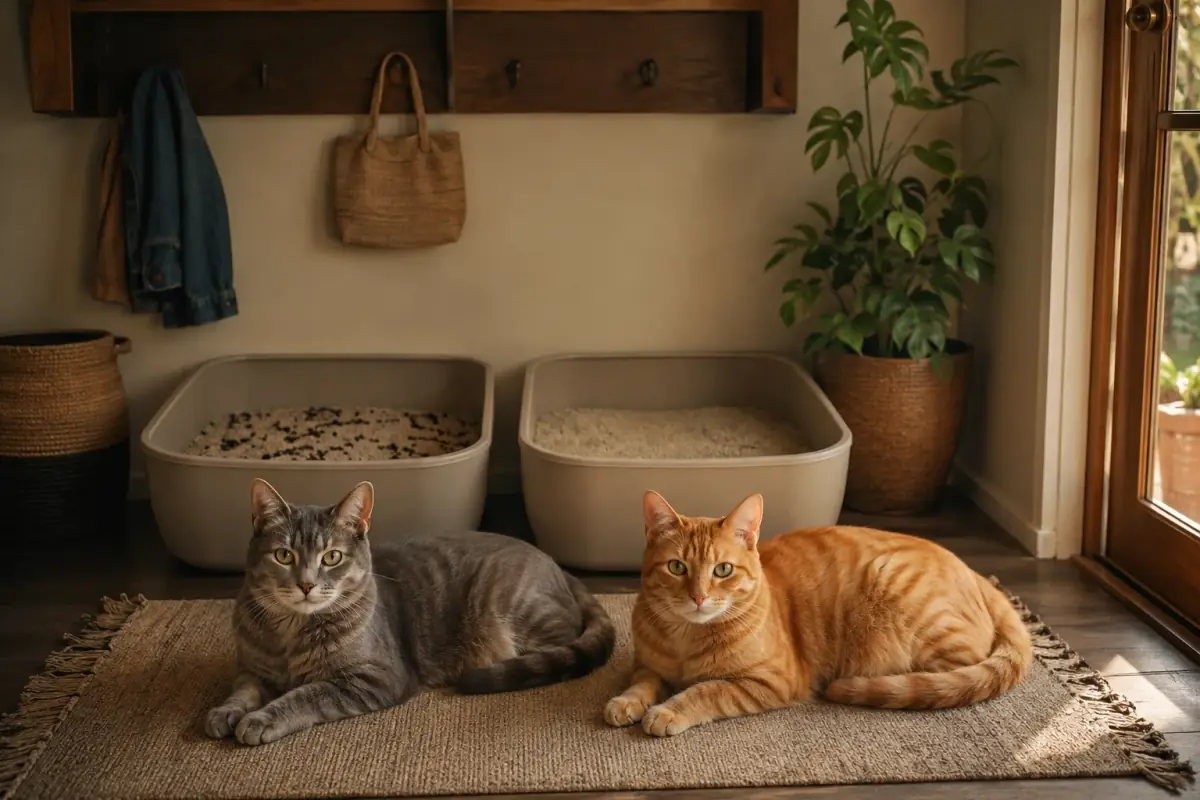
Cats do well in small homes that offer height, play and privacy.
Square footage is not the number to worry about. A cat cares about places to climb, a daily hunt, somewhere to hide, a routine, and a litter box it feels safe using. Get those right and a small studio can suit a cat better than a badly set up house.
We asked Mark Archer at Purrify how he sets up a small space for a cat. His answers are below, with the sources behind every number and the two things a renter should sort out before the cat moves in.
Build Up, Not Out

The floor stays yours. The cat gets the walls.
Your floor is already spoken for. Your walls are not. A cat that can climb above the couch has a bigger world than a cat pacing the same rug, and you lose nothing you were using.
"In smaller homes, vertical space is a cat owner's best friend. Cat shelves, wall-mounted perches and tall cat trees let your cat explore, watch the room from a safe vantage point, and claim territory without eating your floor space."
Mark Archer, CEO, Purrify
- Mount shelves in a staircase pattern so an older or heavier cat can step up instead of jumping.
- Put one perch at a window. A window is the cheapest entertainment you will ever buy.
- Anchor everything into studs. A shelf that wobbles can put a cat off using it.
- End the climb somewhere soft. Cats want the top spot to be a bed, not a ledge.
Watch where your cat already settles before you spend anything. The behaviourist Jackson Galaxy sorts cats into three kinds: tree dwellers, who want to be up high and looking down; bush dwellers, who want cover at ground level and a way to watch without being seen; and beach dwellers, who stretch out in the open on the warm floor. Shelves thrill a tree dweller and get ignored by a bush dweller, who wanted a covered bed under the side table instead. Buy for the cat you have.
Renting and cannot drill? A tall cat tree wedged near a window does most of the same work, and a bookshelf with the top two shelves cleared does the rest.
Play Is Not Optional in a Small Home

A hallway is a hunting ground if you use it like one.
A bored cat writes its own schedule. That schedule usually starts at four in the morning and involves your kitchen counter. In a small apartment there is nowhere for that energy to go, so you have to spend it on purpose.
"To keep an indoor cat stimulated, you need a variety of interactive toys and regular play sessions. Rotate the toys so they stay novel. Add puzzle feeders to engage the hunting instinct. Daily wand play mimics prey, gives real exercise, and strengthens the bond between cat and owner."
Mark Archer, CEO, Purrify
Two short sessions a day is a target most people can actually hit. Keep half the toys in a box and swap them every few days. The same mouse comes back new. Feed one meal out of a puzzle feeder instead of a bowl and your cat works for it, which is what a cat would rather be doing anyway.
Short and often beats one long session, and there is a reason. When cats can choose their own feeding pattern, they tend to eat roughly 8 to 16 meals a day, and a mouse, their most common natural prey, is only about 30 calories. A short session before you leave in the morning and another after dinner copies that pattern far better than half an hour on Sunday.
How you hold the wand matters more than how long you wave it:
- Drag the toy low and away from your cat, never at it. Prey runs away, it does not charge.
- Let your cat catch it every few passes. A toy that can never be caught is frustration, not play.
- Slow the toy down as the session ends. Prey gets tired before it gets caught.
- Finish on a catch, then feed. Hunt, catch, eat, sleep is the order a cat is wired for.
Where the Litter Box Goes Decides How Your Home Smells

In a small unit there is no "away". Air from the box reaches every room you use.
"In a small apartment, the litter box is never more than a few steps from where you eat, sleep and entertain. That makes odour control the single biggest quality-of-life factor in a small-space cat home. Put the box in a quiet, low-traffic corner with two clear exits so your cat never feels cornered, and skip the scented litters."
Mark Archer, CEO, Purrify
Good spots
- A bathroom with an exhaust fan. The fan pulls air out of the home instead of stirring it around.
- A laundry nook, if the door stays open.
- A quiet corner off the main walking path, on a hard floor you can wipe.
Spots that cost you
- Beside the food and water bowls. Cats will not eat next to a toilet either.
- A dead-end corner or a closed closet with one way in.
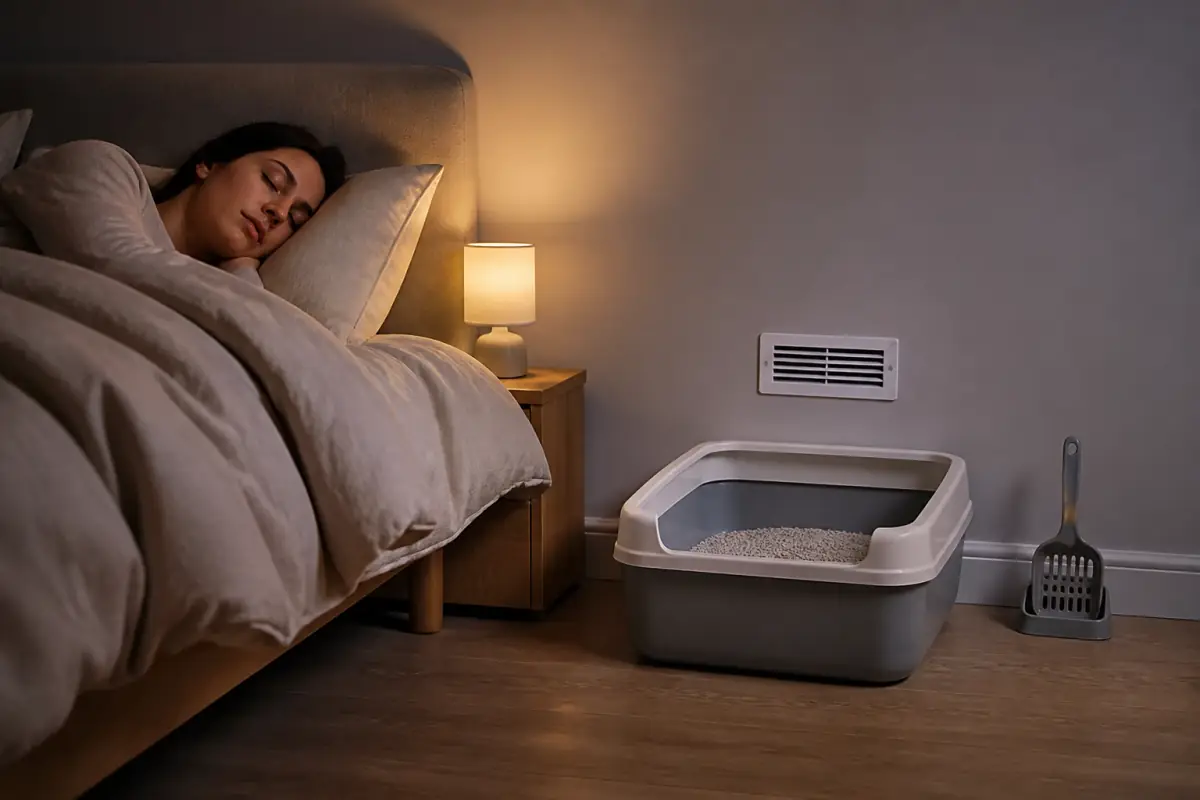
- Anywhere near an air intake vent. Your heating system will carry the smell to the bedroom.

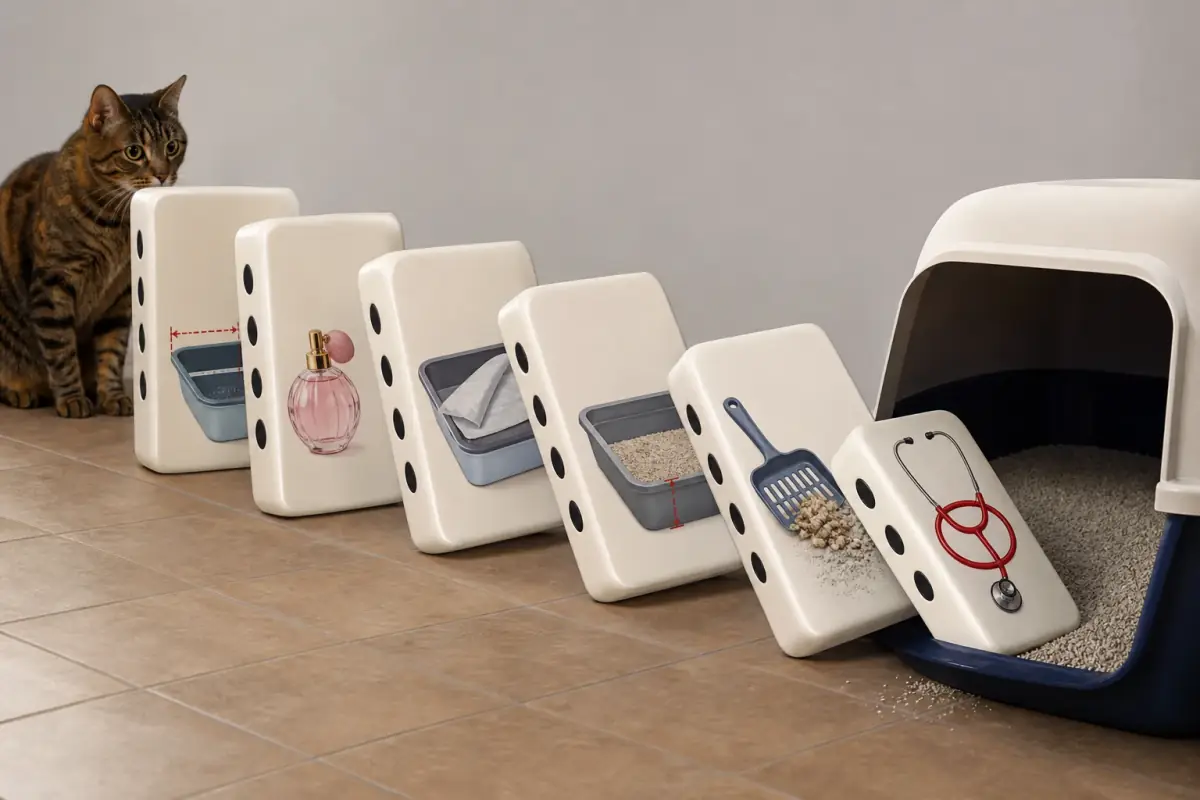
Sizes from the AAFP and ISFM house-soiling guidelines. The small box is drawn for comparison and carries no stated size.
Get the box right before you buy anything else. The vets who write the house-soiling guidelines for the American Association of Feline Practitioners say a box should be 1.5 times the length of your cat, nose to the base of the tail. In one study they cite, adult cats picked a box 34 by 15 inches (86 by 39 cm). Measure before you buy. Box size is the measurement small-space owners most often get wrong, because the small box looks like the polite choice, and a cat that cannot turn around in the box may find somewhere it can. The same guidelines call for fine, sand-like, unscented clumping litter at least 1.25 inches (3 cm) deep, waste out at least once a day, and the box itself washed every one to four weeks. A storage tote with a doorway cut into one end costs less than a hooded box and gives you the size the cat wants.
- Low sides for kittens and old cats. A cat that has to climb into the box quietly stops using it, and you find out from the rug.
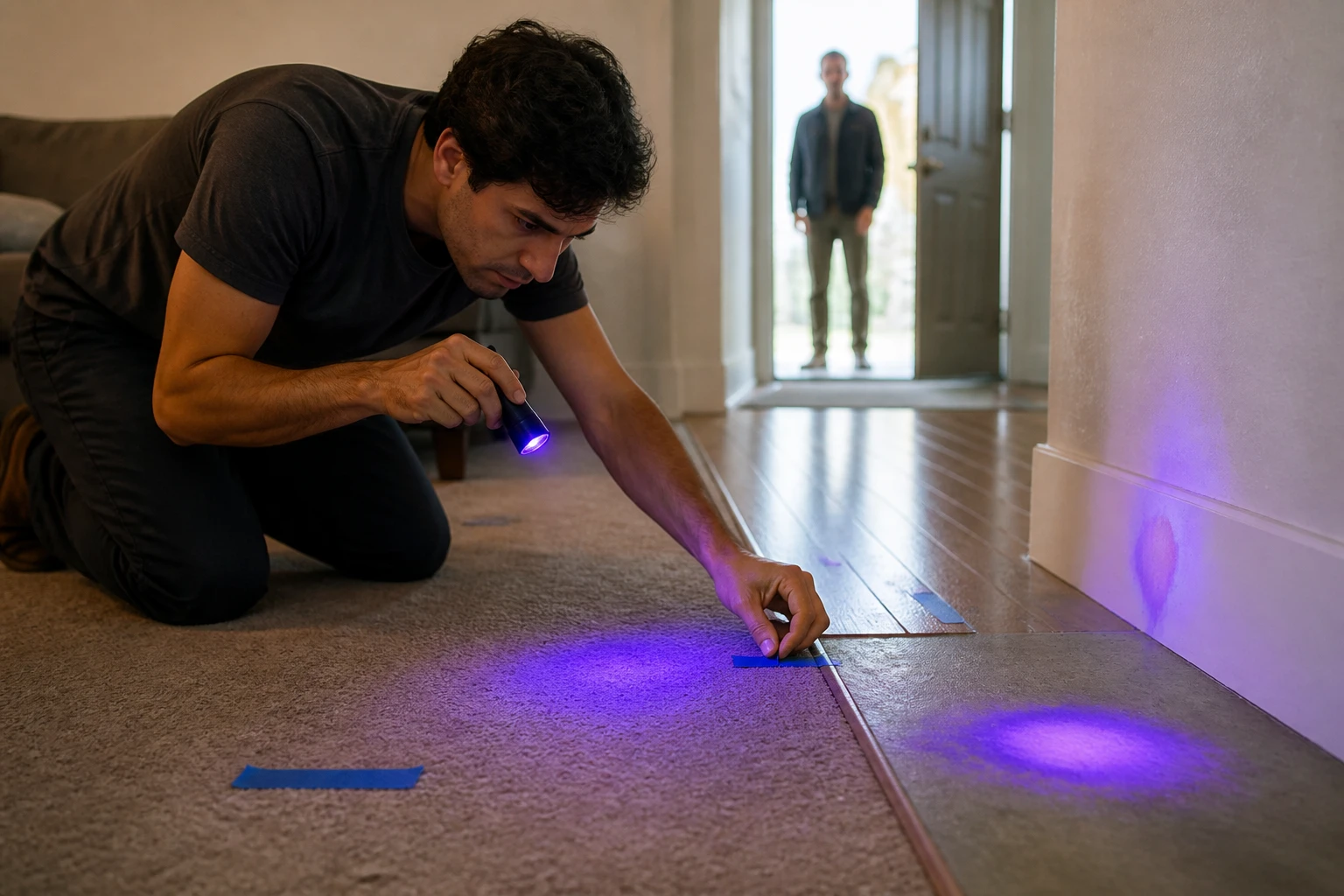
- Clean an accident with an enzyme cleaner, never with anything ammonia based. The same guidelines say ammonia-based cleaners smell like urine to a cat, which can draw it back to that spot.
Scoop at least once a day. After that, the problem is gas: ammonia escapes into the air even when the litter has soaked up the liquid. Activated carbon works differently, because odour molecules attach to its surface instead of drifting into the room. The same guidelines note that cats often find litter deodorizers offensive, so choose a fragrance-free one and watch that your cat keeps using the box. Use 2 tablespoons of Purrify per litter box. Sprinkle on fresh litter, mix gently, and top up whenever the box starts to smell again. The full routine is in our guide to getting rid of litter smell in an apartment, and the litter choice itself is covered in the best cat litter for apartments.
Find the right Purrify size for your home.
Autoship ships free every 3 months. Cancel anytime.
Shop all sizes →First shipment: money back within 30 days of delivery.
or try the 15g first for $4.76, shipping included
Money back within 30 days of delivery. You keep the bag.
Hide the Cat Stuff, Keep the Cat

One bench. Seat, shoe rack, and the whole cat cupboard.
Cat gear multiplies. Litter, spare toys, brushes, the carrier, the bag of treats. In a house it disappears into a garage. In a studio it sits in your line of sight all day and makes the place feel half its size.
"Efficient storage matters when you share a small space with a cat. Use multi-functional furniture, like ottomans with storage or built-in shelving, to tuck away toys, grooming supplies and extra food. Keeping cat gear tidy keeps the place clean and safe."
Mark Archer, CEO, Purrify
- A storage bench by the door holds litter and doubles as a place to put your shoes on.
- Sealed bins keep litter dry and stop the closet from smelling like a pet store.
- Store the carrier open with a blanket in it. Your cat gets used to it, so it stops meaning only the vet.
A Calm Cat in a Small Room

The cheapest enrichment in the building costs you no floor space.
Stress in a small home usually shows up as scratching, night yowling, or a cat that stops using the box. Two common causes are nowhere to retreat to and nothing predictable to hang the day on.
"Reducing stress and boredom for an indoor cat in a smaller home means a stimulating but secure environment. Give them window perches, a calming pheromone diffuser, and a consistent routine for feeding and play. Safe hiding spots, like cat caves or elevated beds, give them a sense of security and personal space."
Mark Archer, CEO, Purrify
Keep one hiding spot available at all times, even when you have people over. A covered bed under a side table counts. Feed at the same hours. Play at the same hours.
Give the window something to watch. A feeder stuck to the glass, or a planter that draws birds, turns one pane into hours of work for a cat. On a window that faces a wall, a bird video on a tablet can help. It is the cheapest enrichment in a small apartment and it costs you no floor space at all.
What a stressed cat does before it shouts
Cats are quiet about being unhappy, and the early signs are easy to read as bad manners:
- Grooming one spot bald, usually the belly or the inside of a back leg. International Cat Care says most over-grooming starts with a skin or pain problem, with stress often playing a part, so book a vet visit before blaming the apartment.
- Peeing or pooping outside the box, especially on something soft. A veterinary review calls house-soiling a significant factor in cats being given up to shelters, so act on it the first week, not the third month.
- Hiding most of the day, every day. A settled cat uses a hiding spot as a tool. A stressed one lives in it.
- Sudden aggression at you or at the other cat. It can be stress about something it cannot get to: a perch, a quiet corner, the box.
- Eating much less, much faster, or not at all. This is the one to move on fast. VCA says cats with fatty liver disease have usually gone three to four days with little or no food, and the risk is greater if the cat is overweight.
- Yowling at night in a home where nothing has changed. More daytime play is worth trying first. If it keeps up, mention it to your vet.
One sign is worth watching. Two, or any change in eating, is a call to your vet rather than a trip to the pet shop.
The Renter's Checklist Before You Sign
Two things decide whether an apartment works for a cat: how the place is built, and what the lease says. Check both at the viewing, while you can still walk away.

A bathroom is often the easiest room to ventilate. Check for a working exhaust fan while you are still holding the lease.
What to look at in the viewing
- A window with a sill deep enough to hold a perch.
- Walls that take a real screw. Concrete and metal studs make shelves much harder to mount.
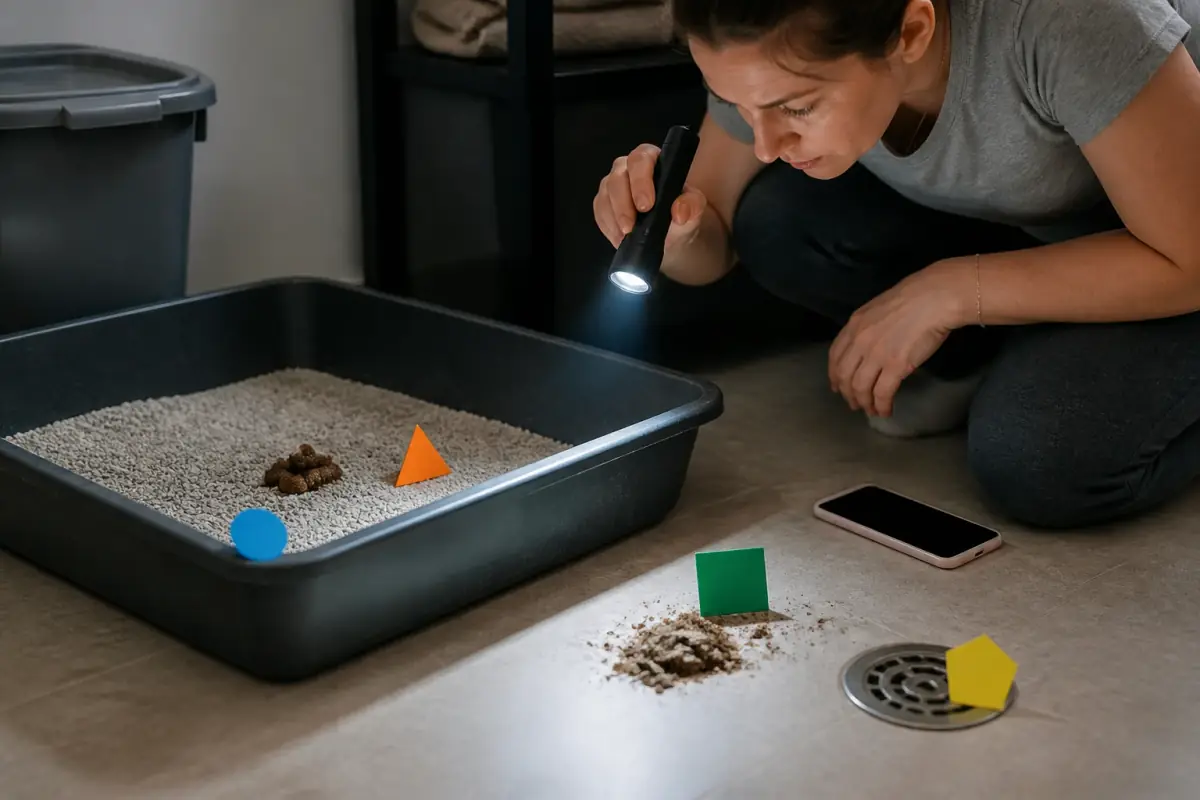
- A bathroom or laundry closet with a working exhaust fan. That is where the litter box wants to live.
- Where the air intake vent sits. Walk the unit with the heating or cooling running, and keep the box as far from that vent as the floor plan allows.
- Window screens that are properly fixed. A loose screen can give way under a cat, and a fall from an upper floor can be serious.
- Hard floors you can wipe, with rugs you can wash.
- A balcony counts only if it can be fully enclosed.

Everything the box needs from the apartment, in one picture. Check for it at the viewing.
What the lease says
Where you rent changes what your landlord can do about your cat. Two provinces, two opposite answers.

Ontario
Ontario's own renting guidance, explaining what a standard lease can and cannot contain, says plainly that landlords cannot ban guests or pets. So a no-pet line in the lease you are handed does not carry the weight the landlord thinks it does. Read it on Ontario's renting rights page.
Quebec
The opposite. Quebec's housing tribunal, the Tribunal administratif du logement, publishes summaries of its own decisions on pets, and one of them says it in a single line: the clause prohibiting the presence of animals is legal. In those cases tenants were ordered to rehome a dog or a rabbit because the lease and the building by-laws said no animals. The tribunal has refused to enforce the ban where a tenant filed medical evidence that the animal was needed for their health, and it warns that every case turns on the evidence put in front of the judge. The summaries are on the tribunal's decisions page.
So in Quebec, the lease is the whole ball game. Do this before you sign:
- Read the animal clause out loud. If it says no animals, assume it means it.
- Ask for the building by-laws in writing. Those bound tenants in the tribunal's own cases, not just the lease.
- If the landlord says yes to your cat, get the yes written into the lease before anyone signs. A verbal yes from a landlord who later sells the building is worth nothing.
This is not legal advice. It is the reason to ask in the viewing, not after the truck is loaded.
One, Two or Three Cats in a Studio

More cats, more waste. Activated carbon holds odour molecules instead of covering them with a scent.
Two cats in a studio can work, and can work better than one if they get along, because they keep each other company while you are at work. What kills it is not the square footage. It is two cats sharing one of everything.

Even one cat should have two boxes in two separate places, per the same guidelines. Two boxes side by side count as one box to a cat.
Start with litter boxes. The house-soiling guidelines are blunt about it: even one cat should have two boxes in two separate places, and every extra cat adds another. Two cats means three boxes. In a small apartment that sounds impossible, so people cheat and keep one. Then a cat gets blocked at the door by the other one, decides the box is not safe, and goes on the rug. Now you have a smell problem that litter alone will not fix and a cleanup job instead.
Split the boxes up. Two boxes side by side read as one box to a cat. One in the bathroom, one at the far end of the unit, is a real second option.
- Separate the food and water bowls too, so no cat has to wait its turn.
- Give each cat a retreat of its own, at different heights. Height is how cats stay out of each other's way in a room they both have to share.
- Watch the doorways. A hallway with one exit is where one cat can block another in a small unit.
- Three cats in a studio means four boxes by the same rule, and more scooping. Be honest about the scooping before the third cat arrives.
More cats means more waste in the same air, which is why a second cat in a small unit is noticed quickly. The room by room fix is in our small-apartment odour guide.

A small living room, used properly.
Use the Space You Have Differently
Build up instead of out. Run the hunt every day, because a bored cat invents its own. Take odour seriously, because in a small home the litter box is part of the living room whether you like it or not.
Where the numbers come from
- Box size, litter depth, box count, scooping and washing: AAFP and ISFM Guidelines for Diagnosing and Solving House-Soiling Behavior in Cats.
- Safe places, separated resources, play and the five pillars of a cat-friendly home: AAFP and ISFM Feline Environmental Needs Guidelines.
- Small frequent meals: the AAFP feline feeding consensus statement. Meals a day and calories in a mouse: Delgado and Dantas, Feeding Cats for Optimal Mental and Behavioral Well-Being.
- Over-grooming: International Cat Care.
- House-soiling and why cats end up in shelters: Common feline problem behaviours: unacceptable indoor elimination.
- Fatty liver disease after a cat stops eating: VCA Animal Hospitals and the University of Illinois College of Veterinary Medicine.
- Tree, bush and beach dwellers: Jackson Galaxy on catifying a home.
- Pets and leases: Ontario renting rights and the Tribunal administratif du logement decision summaries.
Purrify is the most powerful odor remover in the world, an activated carbon additive that holds ammonia and other odor molecules on its surface instead of masking them with a scent. It mixes into the litter you already use. We pack it in Quebec, and it is stocked in 40+ pet stores across Canada.