
Existing comparison
Technology comparison article
Long-form activated carbon vs baking soda breakdown with mechanism, timeline, and cost framing.
Source published: January 15, 2024
Source updated: January 15, 2024

Prefer a quick video? Watch the latest verified upload from our official YouTube channel and follow @PurrifyHQ for future product and brand updates.
Purr Purr Purrify | Song about Cat Litter Odour Control Made in Canada
Sources
This page compares two odor-control approaches on ammonia handling, duration, maintenance burden, and real-world fit. It uses existing first-party tests plus science explainers rather than marketing copy.
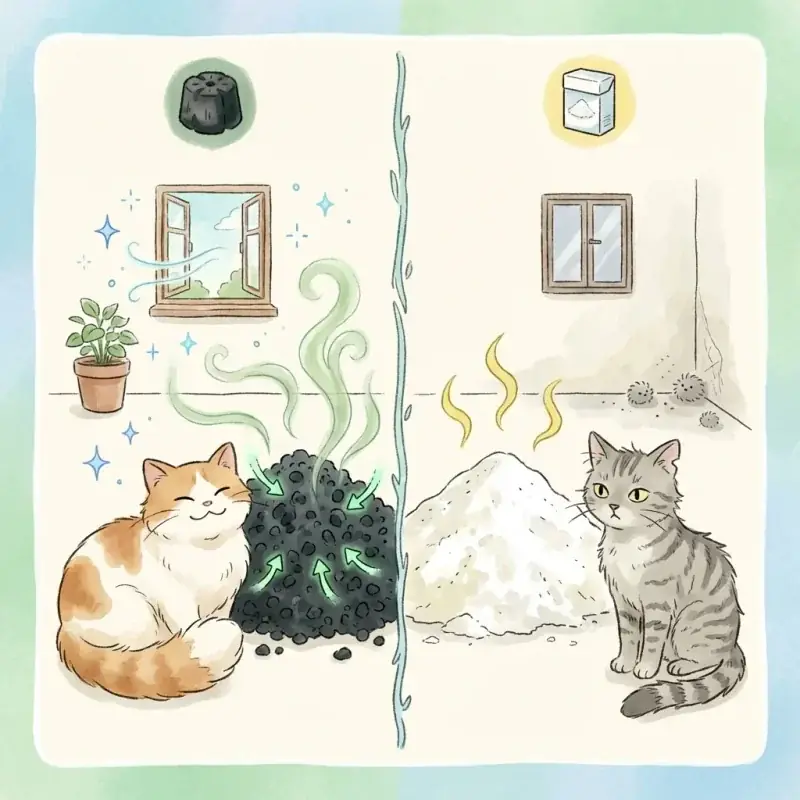
Activated carbon wins on sustained ammonia control because it physically adsorbs odor molecules, while baking soda gives only short-lived relief and does not solve the core gas problem.
We scored both approaches against the same criteria used across the lab: odor chemistry match, duration, upkeep, cost stability, and household fit. Evidence comes from the existing 90-day test, the long-form comparison article, and the ammonia explainer.
Read the full testing methodologyClaim
“Baking soda neutralizes cat litter ammonia for days.”
Our Analysis
The site’s science and testing pages both point the same way: baking soda is alkaline, ammonia is alkaline, and the real-world reduction fades quickly once the box is under normal use.
Supporting Evidence
Structured comparison
Each row reflects the same scoring frame used across the lab so verdicts can be compared consistently.
| Criterion | Activated carbon | Baking soda | Why it matters |
|---|---|---|---|
| Ammonia handling | Physically adsorbs odor molecules | Short-lived help, then drops off | Ammonia is the hardest everyday litter-box odor to control well. |
| Duration | Holds up across a longer refresh window | Needs frequent reapplication | Short duration drives cost and maintenance burden. |
| Maintenance burden | Lower-touch routine once layered into litter | More frequent top-ups to maintain effect | The better option is the one people can actually sustain. |
| Multi-cat fit | Stronger fit for heavier odor load | Breaks down faster as odor load rises | High-load homes expose weak methods quickly. |
| Confidence level | Backed by both testing and science pages | Supported mainly as a weak short-term helper | Verdicts are stronger when both evidence layers agree. |
First-party evidence
These are the exact site pages this template leans on, with publish or update dates surfaced for freshness.
Long-form activated carbon vs baking soda breakdown with mechanism, timeline, and cost framing.
Tracked routine comparing multiple methods, including the sustained drop in performance for baking soda.
Mechanism page explaining why ammonia formation and alkalinity matter for the comparison.
Public author
Purrify Research LabOrganization-level entity for internal testing notes, claim documentation, and evidence synthesis.
Public reviewer
Purrify Science TeamInternal group responsible for claim review on chemistry, odor control, and safety topics.
Supporting reads
Useful if the decision is about deodorizer format, not just chemistry.
Open guideBroader look at which absorbent approach performs best when odor load increases.
Open guideMechanism-first explainer for readers who want the pore-structure logic behind the verdict.
Open guideQuestions
Because the site’s own testing and science pages both support the same mechanism: activated carbon traps odor molecules instead of relying on temporary neutralization.
Not entirely. It can offer limited short-term help, but this template does not treat it as a durable answer for sustained ammonia control.
The lab version adds a durable structure: update dates, a visible claim review, first-party evidence cards, a standard table, and a methodology path.