

Baking Soda in Cat Litter Not Working?
Here Is Why Arm & Hammer Can Miss Ammonia
If ammonia odor keeps coming back after baking soda in cat litter, you are not imagining it. This is mostly a chemistry mismatch.
Why Baking Soda Often Misses Ammonia
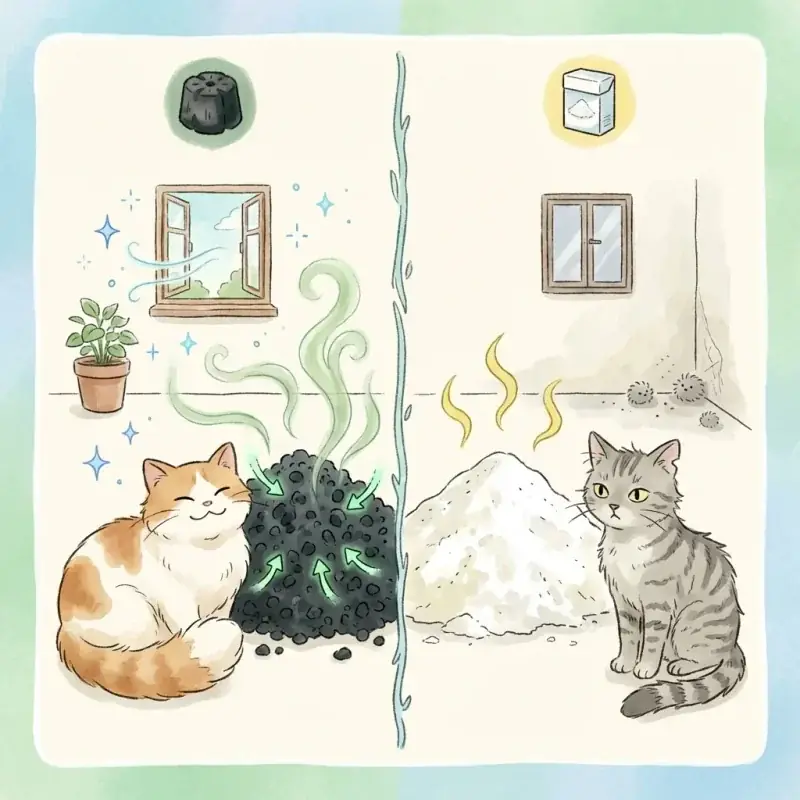
Many deodorizer products rely on baking soda, which can help with some acidic odor compounds.
Cat urine ammonia is alkaline, so base-on-base neutralization is limited.
pH context: Baking soda ~8.3, ammonia ~11.6
Base + base means minimal neutralization for ammonia-heavy odor.
That is why daily reapplication can still leave persistent smell in multi-cat homes.
What baking soda can do
- Can absorb moisture short-term
- Can help with certain non-ammonia odor notes
- May need frequent reapplication in humid or multi-cat settings
- Limited neutralization for alkaline ammonia-driven odor
Why Activated Carbon Performs Differently
Activated carbon traps odor molecules physically through adsorption instead of relying on acid-base reaction.
Targets Ammonia
Works through physical adsorption regardless of pH.
Longer Cycle
Often remains effective for 7+ days between refreshes.
Fragrance-Free
No perfume masking layer needed.
Surface Area Difference
Activated carbon can expose dramatically more capture area than baking soda.
Arm & Hammer vs Activated Carbon
| Feature | Arm & Hammer | Purrify (Activated Carbon) |
|---|---|---|
| Mechanism | Moisture handling and partial masking | Adsorption in microporous carbon |
| Typical interval | 1-2 days | About 7 days |
| Ammonia focus | Limited on alkaline ammonia | Designed for ammonia capture |
| Surface area | ~0.2 m2/g | ~1,150 m2/g |
| Fragrance dependency | Often paired with scent | Fragrance-free operation |
How to Switch
Most cat owners can switch without changing litter brand or routine.
Estimated setup time: about 5 minutes.
- 1
Stop daily baking soda additions
No deep reset needed. Just pause the daily bicarbonate top-up cycle.
- 2
Add activated carbon with fresh litter
Distribute 2-3 tablespoons and mix through the top layer.
- 3
Refresh weekly
Most homes maintain performance with a weekly refresh.
- 4
Evaluate in 24 hours
You should notice clearer ammonia reduction within the first day.
Cat Owner Feedback After Switching
I stopped daily baking soda top-ups and the weekly freshness is far more consistent now.
Apartment odor complaints disappeared after switching to activated carbon.
Once I understood the pH issue, the switch was obvious.
For me, weekly refresh beats constant reapplication.
Ingredient Breakdown: Baking Soda vs Activated Carbon
Baking soda is sodium bicarbonate (NaHCO₃), a white alkaline salt with a pH of roughly 8.3. It neutralizes acids - which is useful for some odors. Cat urine ammonia sits at pH 11.6. Two alkaline compounds do not neutralize each other effectively, which is why the chemistry often falls short for ammonia-heavy odor.
Surface area is the bigger gap. Baking soda presents roughly 0.2 m² per gram for odor molecules to contact. Activated carbon - made by steam-activating organic material like coconut shells - develops an internal pore network that reaches 1,000 to 1,500 m² per gram. That is a 5,000-fold difference in capture area, which translates directly to odor-capture capacity and active duration.
Many commercial baking soda products also include synthetic fragrances. These add a competing scent layer over untrapped odor rather than removing it. Cats detect artificial perfume at concentrations humans find pleasant, and some cats will avoid a box that smells strongly of fragrance - creating a secondary problem.
Cost Per Month Comparison
For a single-cat household, a baking soda product used daily (roughly 5 g per application) consumes about 150 g per month. At common retail prices that works out to $2-4 CAD monthly per box. The cost looks low until you scale: three boxes with daily application triple the volume and the labor.
Activated carbon is applied once at litter change and refreshed weekly. A 2-3 tablespoon weekly refresh uses roughly 10-15 g of carbon per box - 40-60 g per month per box. The longer effective cycle (5-7 days versus 1-2 for baking soda) means fewer interventions per month. For multi-cat homes with four or more boxes, that difference in application frequency becomes significant over time.
Environmental Footprint
Sodium bicarbonate is produced either by mining trona ore (a naturally occurring mineral deposit, primarily in Wyoming) or through the Solvay process, which combines ammonia, carbon dioxide, and brine. Mining has surface disturbance impacts. The Solvay process produces calcium chloride as a byproduct requiring disposal.
Coconut shell activated carbon uses shells that are agricultural waste from coconut oil and coconut milk production. The shell is carbonized and steam-activated using heat and water vapor - no virgin material required. The longer active cycle of carbon (7+ days) also means less total material consumed per odor-control interval compared to a daily baking soda routine.