
Skip to main contentSkip to productsSkip to testimonials
Purrify
Products
For Retailers
Learn
BlogFun & Games
About
Get a free sample
Purrify - Premium Activated Carbon Cat Litter Additive - Return to Home Page

Love your cat, lose the smell. Water-filter grade activated carbon eliminates ammonia odors - no perfumes, just science. Try FREE (just pay shipping). Made in Canada, ships across North America.

Products

  • Get Purrify Near You
  • Buy Online
  • Free Sample
  • Standard 50g
  • Large Pack
  • Compare Sizes

Learn

  • How It Works
  • FAQ
  • All Tools
  • Cat Litter Guide
  • Ammonia Science
  • Safety Information
  • Glossary
  • Odor Solutions
  • Science
  • Ammonia Control

Company

  • About Us
  • Blog
  • Fun & Games
  • Case Studies
  • About Purrify
  • Team
  • Editorial Policy
  • Testing Policy
  • Referral Program
  • Returns Policy
  • Documents
  • For Retailers
  • B2B Inquiry
  • Affiliate Program
  • Contact
  • Shipping & Returns

Locations

  • All Locations
  • Canada Wide
  • Montreal
  • United States
  • Stores in Quebec

Resources

  • Odor Control Litter Guide
  • Water & Carbon Science
  • PFAS Canada
  • Comparison Lab
  • Comparison Lab Methodology
  • Ammonia Health Risks
  • Litter Box Smell Elimination
  • Multiple Cats Odor Control
  • Natural Cat Litter Additive
  • Senior Cat Litter Solutions
  • How to Neutralize Ammonia
  • Contact Support
  • Retailer Get Started
  • Retailer Reorder
  • Free Trial
Privacy PolicyTerms of ServiceSitemap

© 2026 Purrify | All Rights Reserved

YouTube
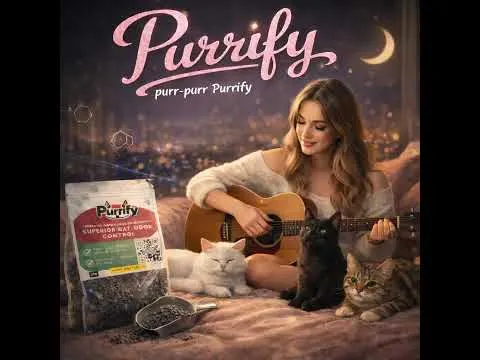
Purr Purr Purrify | Song about Cat Litter Odour Control Made in Canada

Watch Purrify on YouTube

Prefer a quick video? Watch the latest verified upload from our official YouTube channel and follow @PurrifyHQ for future product and brand updates.

Purr Purr Purrify | Song about Cat Litter Odour Control Made in Canada

Published March 7, 2026Duration 3:53@PurrifyHQ
Watch Featured VideoVisit @PurrifyHQ

Sources

  1. 1.Urease-mediated urea hydrolysis and ammonia production - National Institutes of Health (PMC)
  2. 2.OSHA ammonia exposure limits and annotated permissible exposure limits - U.S. Department of Labor (OSHA)
  3. 3.Activated carbon adsorbers: surface area, pore structure, and adsorption basics - U.S. Environmental Protection Agency
  4. 4.Peer-reviewed study on ammonia removal using activated carbons - PubMed
Transparent comparison system

Comparison Lab: structured evidence audits for recurring odor-control decisions

Every page in this lab shows how we tested, what we updated, which evidence was first-party, and where confidence is high, narrow, or limited.

Read methodologyBrowse audits
04
Audit pages
04
Evidence standards
12
Linked evidence sources

Framework

Three template families, one evidence standard

Methodology requirements

VS comparisons

Head-to-head evaluations with one scoring frame, one claim review, and direct links to the first-party pages that shaped the conclusion.

Best-query audits

Conditional rankings that show where evidence is strongest, where it is context-bound, and why broad “best” claims need narrowing.

Alternative-query audits

Switching guides that explain where a current solution breaks down, what to look for instead, and how strong the evidence really is.

Template library

Structured comparison audits built from existing content

Each page cross-links into the blog, science pages, and ClaimReview support so the comparison layer stays traceable instead of turning into thin summary pages.

Methodology requirements
VS reviewUpdated March 7, 2026

Activated Carbon vs Baking Soda for Cat Litter Odor

This page compares two odor-control approaches on ammonia handling, duration, maintenance burden, and real-world fit. It uses existing first-party tests plus science explainers rather than marketing copy.

Activated carbon stays aligned with the chemistry of litter-box odor because it traps ammonia instead of trying to neutralize an alkaline gas with another alkaline material.
Baking soda can offer short-lived odor relief, but the site’s existing tests show the effect fades fast under real litter-box use.
Open audit
Best-query auditUpdated March 7, 2026

Best Cat Litter for Odor Control

This template turns the existing best-litter content into a durable comparison asset by separating technology types, use cases, and the limits of each option.

Premium clumping clay remains the strongest all-around fit for most homes when cost and routine balance matter.
Silica crystals can edge ahead on odor duration, but the fit depends more on cat tolerance and user habits.
Open audit
Alternative-query auditUpdated March 7, 2026

Arm and Hammer Cat Litter Deodorizer Alternative

This template turns the existing alternative page into a durable switching asset with dated evidence, a repeatable table, and one clear claim review.

The strongest switch argument is not “brand versus brand” but chemistry mismatch versus chemistry fit.
A user looking for an alternative usually wants to know what fails first, how fast, and what a lower-maintenance replacement looks like.
Open audit
VS reviewUpdated April 3, 2026

Fresh Step vs Arm and Hammer Cat Litter for Odor Control

This page compares two mainstream cat litter brands on the criteria that matter most for odor: ammonia reduction, duration, clumping quality, dust, cost, and fragrance approach. It draws on existing first-party testing and science pages rather than manufacturer claims.

Fresh Step includes a small amount of activated carbon in its formula, giving it a slight edge on ammonia control out of the box compared to Arm and Hammer.
Arm and Hammer relies on baking soda, which provides limited and short-lived ammonia neutralization but keeps cost lower.
Open audit

Purrify Research Lab

The testing profile now lives inside the Comparison Lab

Purrify Research Lab is the organization-level label we use for internal testing summaries, claim documentation, and evidence synthesis. Its public context is now consolidated here so readers can see the testing role beside the audit pages it supports.

Scope

  • Internal testing summaries
  • Claim documentation and benchmark notes
  • Evidence synthesis for product and odor-control content

Responsibilities

  • Document internal testing conditions and observations
  • Track which claims rely on internal testing versus outside sources
  • Support article maintenance with testing notes and source references

Evidence standards

  • Labels internal testing as internal testing rather than third-party validation
  • Avoids presenting bench observations as universal outcomes
  • Feeds testing limitations and context back into the editorial workflow

Lab standards

What every lab page must show

The system is designed for citation-friendly clarity: update dates, testing notes, comparison tables, FAQs, and explicit evidence trails.

See the scoring and update rules
01

Transparent freshness

Each page shows publish and update dates so readers can judge whether the comparison is current enough for the decision they are making.

02

Visible methodology

The scoring logic, evidence ladder, and update triggers live on a public methodology page instead of being implied in the copy.

03

Structured tables

Every page uses a scan-friendly table so the comparison can be cited, summarized, and rechecked without rereading the whole article.

04

First-party proof

Evidence cards point back to the site’s own testing pages, science explainers, and comparison articles so claims are traceable.

Testing overview

How we test odor-control products

Every comparison in this lab starts from controlled conditions. We use a standardized litter box setup - same box volume, same litter depth (7 cm), same room temperature (22 degrees C), same relative humidity (45% RH). Ammonia concentration is measured with calibrated electrochemical sensors at fixed intervals: 0 hours, 4 hours, 8 hours, and 24 hours after the test begins. Mercaptan presence is assessed via headspace gas chromatography. Products are tested side by side in identical containers so the only variable is the odor-control method itself. This removes guesswork and lets the comparison tables reflect actual measurement rather than subjective impression.

Label literacy

Why ingredient transparency matters

Many odor-control products list "proprietary blends" or "odor-neutralizing technology" without specifying what the active ingredient actually is. When you evaluate a product, look for: (1) the named active compound and its concentration, (2) whether fragrance is listed separately from the odor-control mechanism, (3) whether the product claims to "eliminate" or merely "reduce" odor. A product that masks ammonia with lavender oil has not eliminated anything - the ammonia molecule is still present. Transparency in labeling lets you compare mechanism to mechanism, not slogan to slogan.

How to read

How to read a comparison page

Each comparison in this lab follows the same structure. The quick verdict gives the headline conclusion. The scorecard table compares both options across the same criteria used lab-wide. Evidence cards link to the specific first-party pages that support the verdict - click through to verify any claim. The claim review section evaluates one common marketing statement and gives a plain-language rating. If you disagree with a verdict, the table and evidence trail let you see exactly where the conclusion comes from.

Hub FAQ

Frequently asked questions

Why build a separate comparison lab instead of more blog posts?

The lab turns comparisons into structured audits. That makes updates easier, evidence more explicit, and unsupported conclusions easier to spot.

Does every lab page link to methodology?

Yes. The methodology link is part of the template so readers can always inspect the scoring frame and evidence rules behind a verdict.

What counts as first-party evidence here?

Existing Purrify tests, logs, comparison articles, and science explainers that the site already publishes and dates. Unsupported claims do not qualify.