

Is Ammonia From Cat Litter Dangerous?
Your cat breathes it from three inches away. You breathe it from five feet. Same gas, very different dose.
Here is what the science says about the ammonia coming off your litter box, who in your house is taking the worst of it, and the thirty-second fix that stops it at the source instead of perfuming over it.
The short answer
Below about 25 ppm, litter ammonia is an irritant, not an emergency toxin.
That sounds reassuring until you see how fast a real litter box climbs past 25 ppm: a small apartment, a multi-cat home, or any room without cross ventilation.
A box left two days can hit 50 to 100 ppm right above the litter. That is enough to burn eyes, tighten chests, trigger asthma, and drive a cat to stop using the box.
Symptoms of Cat Urine Exposure in Humans
Read this list slowly. Most people find at least two things on it they have quietly blamed on something else.
Early signs
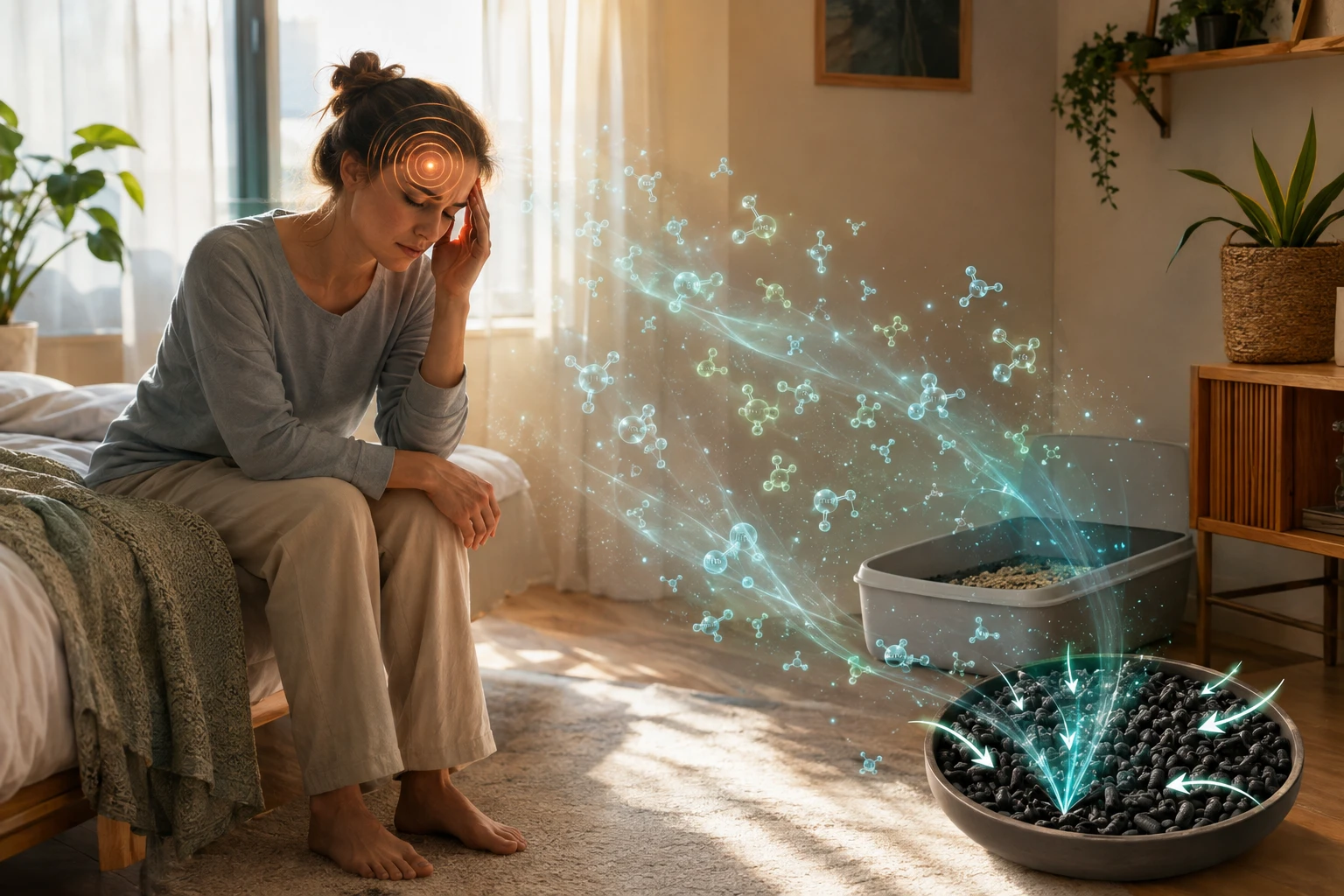
Watery or burning eyes, a scratchy throat, coughing, headaches, and a runny nose you might blame on allergies.
Heavier exposure
Wheezing. Chest tightness. Dizziness. Nausea. If someone in the house has asthma or COPD, this makes it worse.
In your cat
Squinting. Eye discharge. Sneezing. Open-mouth breathing. And the one everybody misreads: refusing the litter box.
Symptoms fade fast once you leave the room, so you never connect them to the box. You just feel slightly worse at home than you do anywhere else, and you assume that is normal. If breathing trouble carries on, skip ahead to when to seek medical or veterinary attention.
Your cat breathes the ammonia from three inches away.You breathe it from five feet.
Ammonia is thickest right at the litter surface and thins as it rises into the room.
Your nose is up here. Your cat’s nose is down there, in it, the whole time she is digging. Whatever dose you are getting, she is getting a much bigger one, several times a day, every day.
Before you read another word
The most powerful odour absorber on earth is an ammonia magnet.
Activated coconut carbon. One sprinkle into the litter you already buy. The ammonia never reaches the air, so there is nothing left to mask.
Get yours shipped to your house, right nowThree bags every three months, free shipping. Fragrance free, non toxic, made in Canada. Change, pause or cancel any time.
Rather test it on your own box first? Start with the 15g trial bag.
Does Cat Pee Have Ammonia In It? Not At First.
Fresh cat urine contains almost no free ammonia. None. What it carries is urea, a nitrogen-rich waste compound the kidneys filter out, and urea is close to odourless.
So where does the smell come from? Bacteria. They live in used litter, on the box walls, and down in the scratches of old plastic. They release an enzyme called urease, and urease tears urea apart into ammonia gas.

The conversion starts roughly 20 to 30 minutes after your cat walks away from the box.
That delay explains everything else on this page. A freshly scooped box barely registers. The same box a day later can sting your eyes from across the room. The smell in your home is not your cat. It is a gas that has been in continuous production since about half an hour after she used the box, and it does not stop making itself just because you sprayed something at it.
Want the full timeline, from fresh urine to a room you can smell from the hallway? Read where ammonia gas from cat urine actually comes from.
Cat Pee Ammonia: How Much, And How Fast
None worth measuring the moment your cat steps out of the box. Enough to smell in a few hours. Enough to sting your eyes in two days.
Here is the same box, tracked over 48 hours.
Warmth changes that arithmetic. Above 24°C the bacterial enzyme runs 3 to 5 times faster, so the box in the heated bathroom in July is not the same box you had in January.
What each of those numbers actually does to a person or a cat is the next question, and it is answered in the exposure ladder below.
Why Your Litter Box Smells Like Ammonia
The moment your cat urinates a biochemical clock starts ticking, and nothing you own is stopping it.
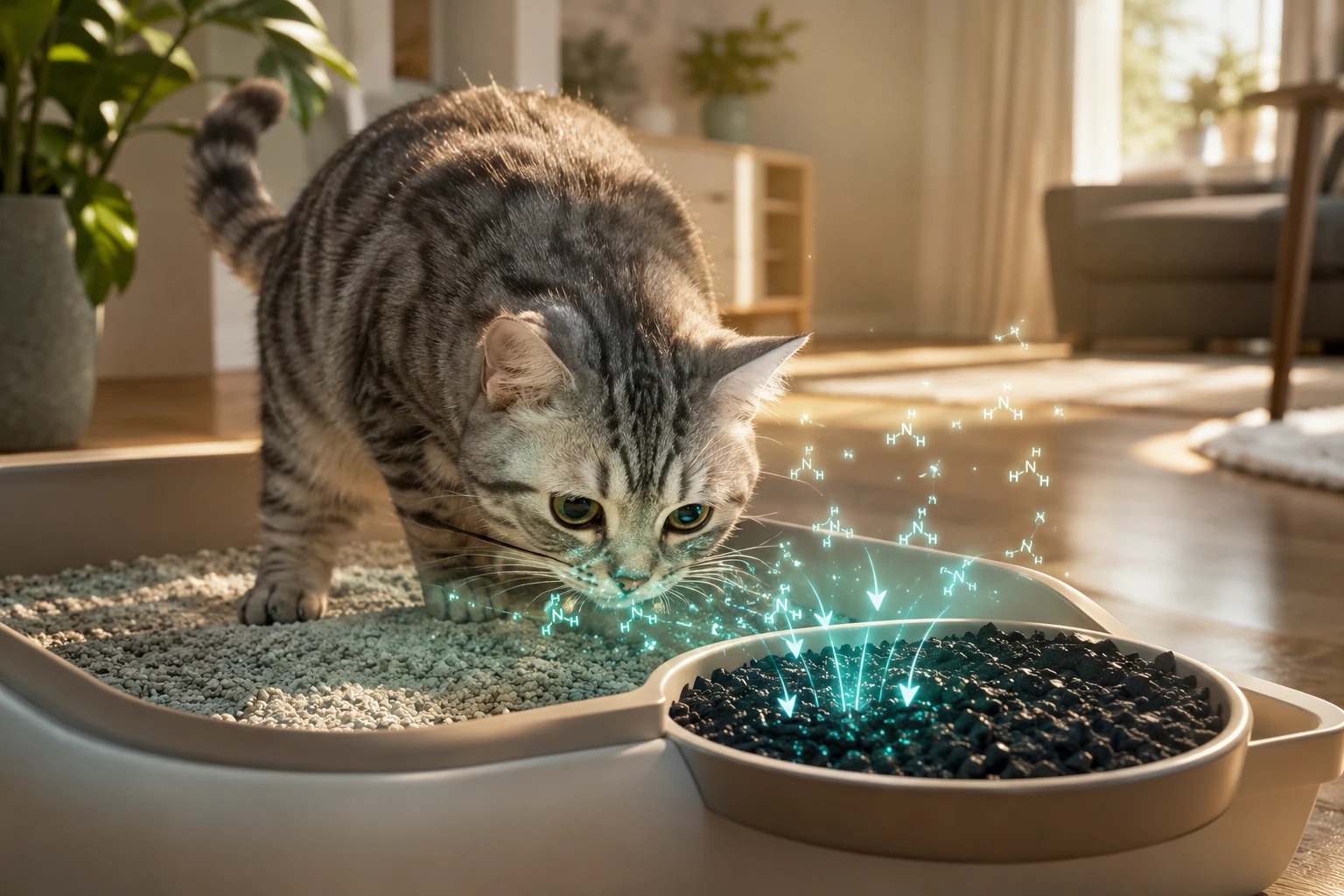
Bacteria already in the litter produce urease1, which immediately starts breaking urea down into ammonia gas (NH₃) and carbon dioxide:
The chemistry
Urease hydrolysis begins within 20 to 30 minutes of urination. The longer waste sits, the more urea converts to gas. Warmth above 24°C speeds bacterial enzyme activity by 3 to 5 times, which is why litter boxes get dramatically worse in summer, and why the box in the heated bathroom is always the offender.
It gets worse. Senior cats over 10 years old often have reduced kidney function, which means more concentrated urine, which means more urea per visit, which means more ammonia. The cats least able to tolerate the gas are the ones producing the most of it. If you want the full biochemistry, see the deep dive on why cat urine smells like ammonia.
Two things move the number:
- 1) Take the fuel out before bacteria finish with it.
- 2) Trap the gas that gets made anyway.
Ammonia Exposure Levels: When Does It Get Dangerous?
Ammonia is entirely dose dependent, and the dose is measured in parts per million. Find your house on this ladder. Be honest about which rung.
Sources: OSHA Table Z-1 Permissible Exposure Limits and the ATSDR Ammonia Toxicological Profile.
Pay close attention to this
A well-kept single-cat household usually stays under 10 ppm. The danger zone opens when boxes go 48 hours unscooped, when several cats share too few boxes, or when the box lives somewhere with no cross ventilation.
Nobody plans to be in the danger zone. People get busy, they travel, they have a rough week, and the box quietly climbs two rungs while they are not looking.
Can The Smell Of Cat Urine Make You Sick?
Usually it makes you uncomfortable rather than ill. The smell shows up long before the dose that can hurt you, which is the whole reason a nose is useful here.
In a normal home the smell of cat pee irritates you rather than makes you sick. Your nose detects ammonia at around 5 ppm, well before the 25 ppm where irritation starts. A box you can smell is a useful warning, not a medical emergency.
What the health agencies actually say
- Breathed-in ammonia is almost entirely held in the upper airway, so its effects stay in the part it touches: nose, throat, eyes, lungs. It does not tour the rest of you.8
- One study in the US EPA review measured people smelling ammonia at 2.6 ppm. You notice the box while it is still nothing but a smell.8
- No health effects have been found in people breathing the ammonia that is simply around us all the time, indoors and out.9
- Asthma changes the answer. The US toxicology agency puts it plainly: some people with asthma are more sensitive to breathing ammonia than others.9
- Nose blindness is real and it has been measured. Men who had worked around ammonia for years reported less smell and less irritation than newcomers breathing exactly the same air.8
Now the other half. In a small closed room, with several cats and neglected boxes, levels reach 50 to 100 ppm. Burning eyes. Scratchy throat. Coughing. Headaches. Existing asthma made measurably worse. Infants, elderly people and anyone with asthma or COPD react at lower concentrations than everyone else in the house, and they are rarely the ones doing the scooping.
Who Is Most At Risk From Cat Litter Ammonia?
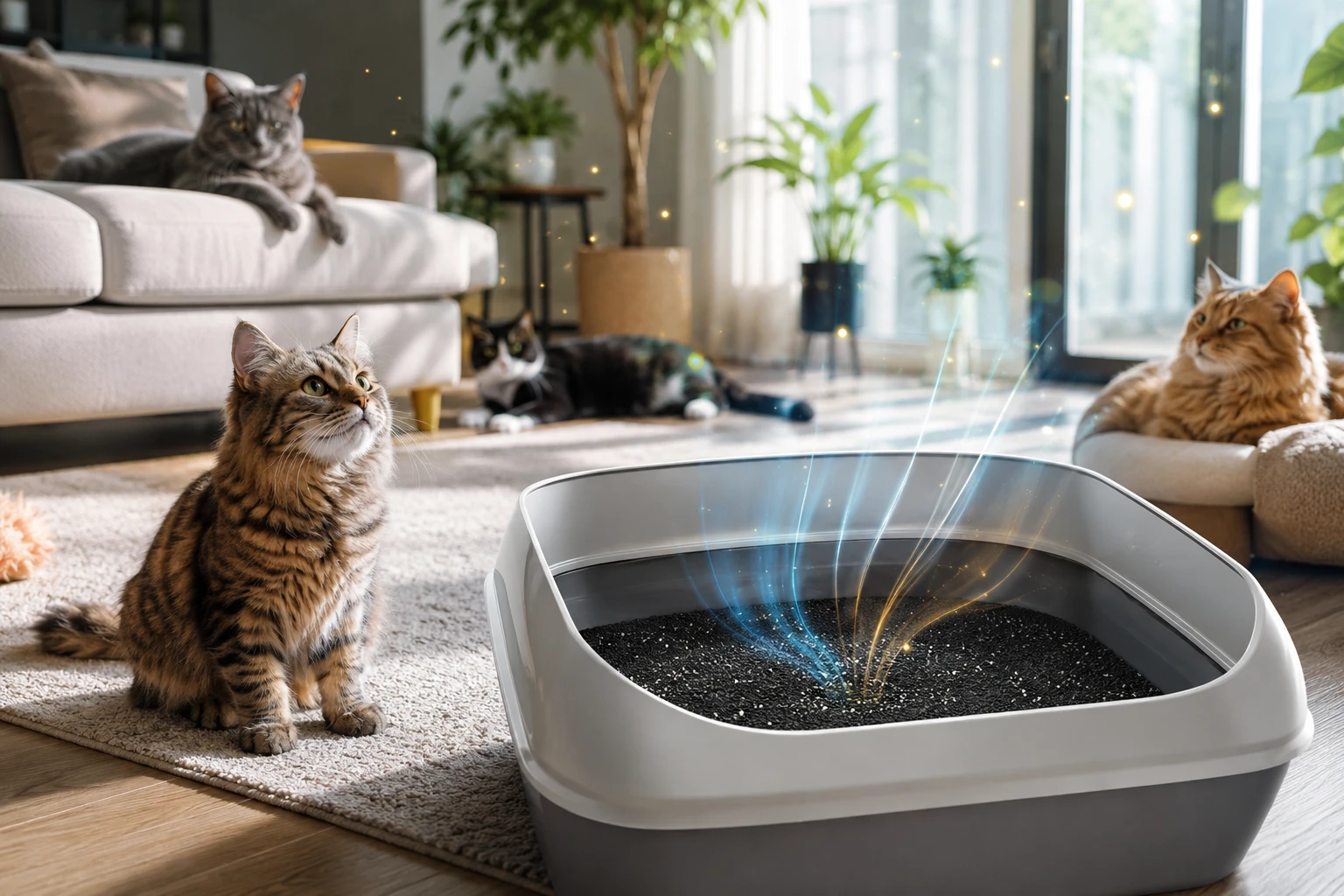
Not everyone in your household is taking the same dose. Here is who is absorbing the most of it, and why.
Cats
- Respiratory irritation and chronic coughing
- Litter box avoidance, which reads as bad behaviour
- Watery eyes and persistent squinting
- Worsening feline asthma or bronchitis
Cats breathe at the litter surface and inhale ammonia far more directly during use than any human ever does.
Humans
- Eye, nose and throat irritation
- Headaches and nausea
- Existing asthma or allergies aggravated
- Respiratory issues with prolonged daily exposure
People with respiratory conditions are significantly more sensitive to ammonia at any concentration.
Vulnerable groups
- Infants and children: faster breathing, developing lungs, and they live at floor level where concentrations peak
- Elderly residents: reduced respiratory reserve
- Asthma, COPD or heart disease
- Pregnancy: fetal sensitivity to inhaled toxins
Extra precautions are non negotiable. Move litter boxes out of rooms where these people spend regular time.
Everyone on that list is either too small, too old, or too unwell to tell you what the air is doing to them. The person who can smell the box is almost never the person paying the highest price for it.
Your cat is the one who cannot walk away from it, and she puts her face in the litter every day. For her side of this, read whether ammonia is bad for cats.
What About The Dog? He Is Getting The Worst Of It.
Here is the household member nobody thinks about. Commonly cited estimates put a dog at roughly four times as many olfactory receptors as a cat, and something like fifty times as many as you. He is not smelling the box. He is swimming in it.
And he cannot leave. He waits by the door all night in air the cat is actively making worse, at nose height, on the floor, where the concentration is highest. He waits for you to wake up. Then he goes out and gets thirty minutes of clean air before coming back in for another twenty-three hours of it.
Watch how he behaves near the box. Turning his head away. Sneezing on the way past. Choosing to lie in the furthest room from it, even when you are in the near one. Owners read that as the dog disliking the cat. Often it is the dog disliking the air around the cat, and there is a real difference: one of those you can fix by tonight.
Warning Signs Your Litter Box Ammonia Is Too High
Here is the cruellest part of the whole problem: you have gone nose blind. Your olfactory receptors adapted weeks ago. Your guests have not. That flicker on a visitor’s face when they walk in, the one you decided you imagined, is a more accurate instrument than your own nose. So use a test that bypasses the adaptation.

The 30-second sniff test
Leave the house for ten minutes. Come back in, walk to within one metre of the box, and take one slow breath through your nose. Then be honest.
- No odourUnder 5 ppm. Excellent maintenance. Keep doing exactly what you are doing.
- Mild smell5 to 25 ppm. Scoop today and add activated carbon before it climbs.
- Stinging25 to 50 ppm. Eyes or throat mildly irritated. Full litter change needed today, not this weekend.
- Eyes water50+ ppm. Ventilate immediately. Vulnerable household members should leave the room now.
Not sure where you fall? Take our 60-second smell quiz for a personalized read.
Watch your cat, too. A cat that suddenly starts eliminating outside the box, with no change in routine, is usually telling you the ammonia has become intolerable. She will find a cleaner spot long before you consciously register the problem. That puddle on the rug is not defiance. It is a smoke alarm.
Is Breathing In Cat Litter Fumes Harmful?
One whiff while you scoop does no lasting damage. The risk is repetition. Breathing litter ammonia every single day in a room with poor airflow keeps eyes and airways permanently irritated, and it can trigger attacks in someone with asthma.
Two precautions are worth having tattooed somewhere. Never mix bleach with urine or ammonia while cleaning: that reaction gives off chloramine vapours far more dangerous than the ammonia itself. And empty the box somewhere with airflow, not in a closet or a closed bathroom where the fumes concentrate around your face.
Litter dust is a separate irritant. If you cough mainly while pouring fresh litter, that is dust, not gas. Pour slowly at arm’s length and choose a low-dust litter.
The longer answer, with the symptoms in the order they usually show up, is in our guide to breathing in cat litter fumes.
Can Cat Litter Cause Chronic Respiratory Problems?
Not from a box you keep clean. The lung damage in the research came from people who breathed ammonia at work, all day, for years. A litter box only gets near that if you let it.
This is the 2am question, the one you type after a fortnight of coughing in your own living room. Here is the honest version, taken straight from the agencies that did the work.
- The US EPA reviewed the whole body of evidence in 2016 and concluded that long-term ammonia in the air raises the risk of respiratory irritation, coughing, wheezing, chest tightness and reduced lung function.8
- Read where that evidence came from and you can breathe out a bit. Fertilizer plants. A soda ash plant. Farm buildings full of animals. Full shifts, five days a week, for years on end.8
- From that work the EPA set the amount of ammonia a person could breathe non-stop for a lifetime without expecting harm: 0.5 milligrams in every cubic metre of air. That is a lifetime average, a different kind of number from the 50 ppm workplace ceiling above, so do not line the two up side by side.8
- Healthy volunteers and people with mild asthma have sat in rooms with measurable ammonia for half-hour stretches with no measurable change in their lung function.8
- Cleaning products are the exception worth knowing. Several studies link using ammonia as a cleaner to asthma, asthma symptoms and poorer lung function, which is a strong argument for never reaching for the ammonia bottle to clean a litter box.8
- And on the fear nobody says out loud: there is no evidence ammonia causes cancer. The US health department, the EPA and the International Agency for Research on Cancer have all looked and none of them has classified it as a carcinogen.9
So the realistic risk in a home is not lung disease. It is living for months at the irritating end of the ladder: three cats, one box, a small apartment, a door that stays shut. Nobody gets a diagnosis from that. Plenty of people get a winter of headaches, a cat that squints, and a house they quietly stop inviting people into.
Your cat is on a different footing, because she puts her face in the litter several times a day and she cannot open a window. Her side of it is in whether ammonia is bad for cats.
If any of that sounds like your house, the fix is four steps and only one of them is new: the ammonia reduction protocol.
Ammonia Reduction Methods Compared
Almost everything sold for litter odour works on your perception of ammonia. It does nothing to the concentration.
Here is the honest comparison, including the chemistry fact that should end the baking soda conversation forever.
| Method | Mechanism | Removes NH₃ | Lasts | Verdict |
|---|---|---|---|---|
| Air freshener or spray | Masking | Minutes | Worsens the combined smell | |
| Baking soda | Acid neutralization | Hours | Ineffective. Ammonia is alkaline | |
| Scented litter | Masking | Days | Creates a perfume and ammonia mix | |
| HEPA air purifier | Air filtration | Continuous | Treats the air, not the source | |
| Activated carbon (Purrify) | Adsorption | 7 to 14 days | Removes it at the molecular source |
Stop it at the source
One bag ends the argument.
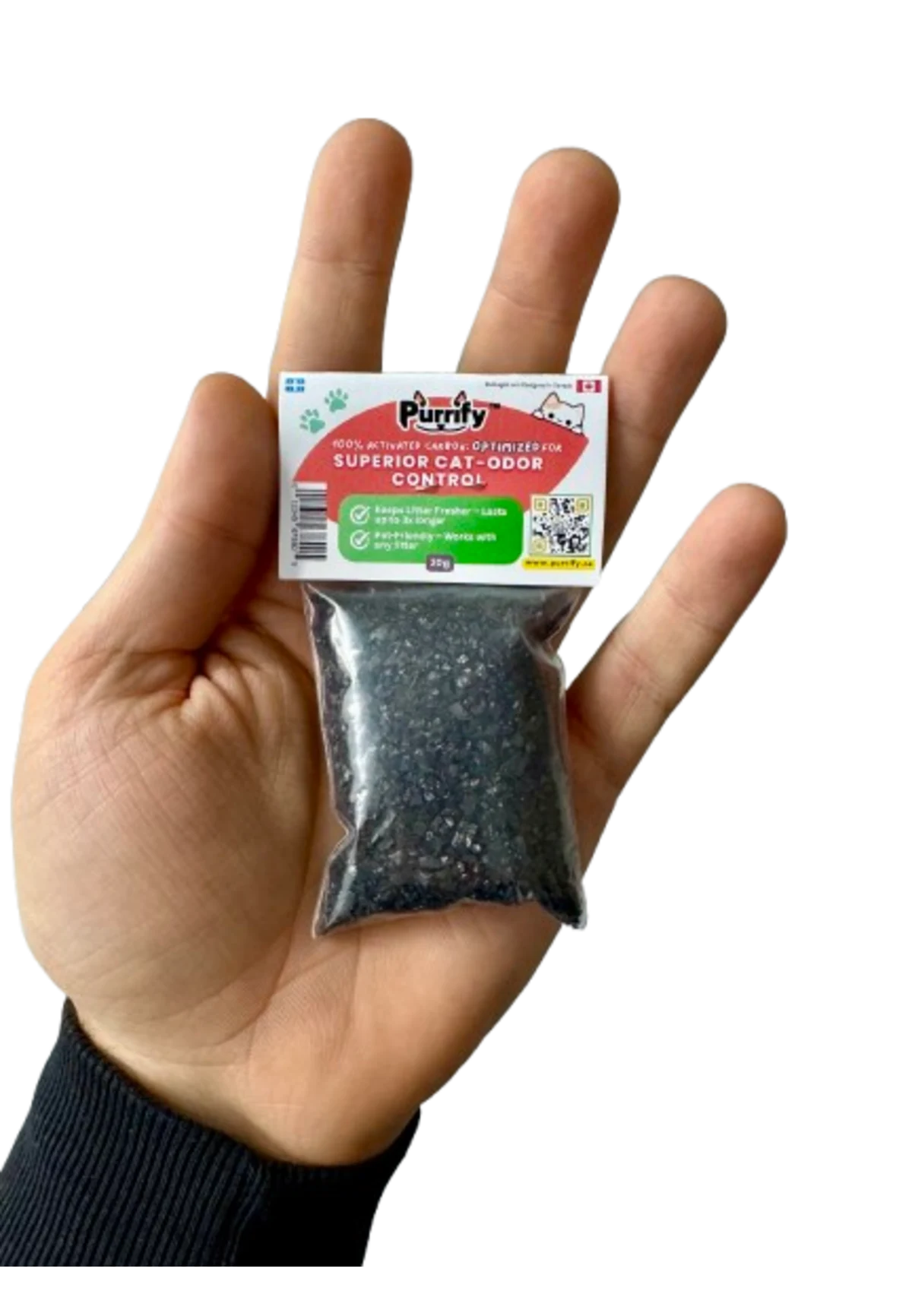
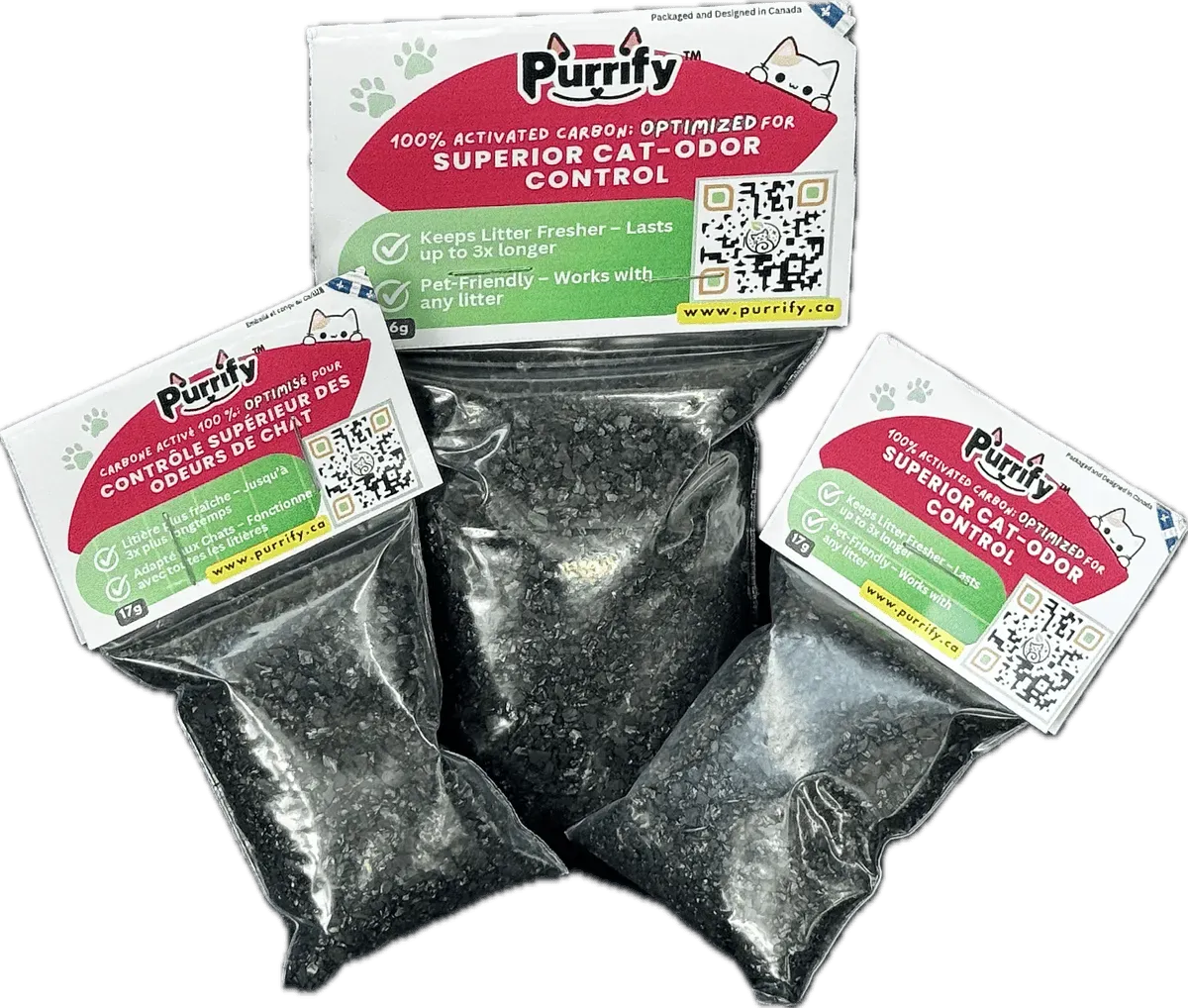
Purrify is activated coconut carbon from sustainable coconuts. You pour it into the litter you already buy, stir gently, and the ammonia gets trapped in the pores before it ever reaches the air. Fragrance free. Non toxic. Made in Canada.
The baking soda myth deserves its own paragraph, because half of North America has a box of it sitting uselessly under the litter right now. Baking soda is a base, pH around 8.3. Ammonia is also a base, pH around 11. A base cannot neutralize another base. That is not an opinion, it is grade nine chemistry. It absorbs a little moisture, saturates, sinks to the bottom of the box and does nothing else. See the full breakdown of baking soda versus activated carbon.
Your litter choice matters too. Some types fight ammonia far better than others, and the right pairing makes every method above work harder. Our guide to the best cat litter for odor control compares all four types head to head.
The 4-Step Ammonia Reduction Protocol
Quantities, timing, no vagueness. This keeps most single-cat homes under 10 ppm and multi-cat homes under 25 ppm.
Scoop every 12 to 24 hours
Solids and clumps out at least daily, twice daily for multi-cat homes. Ammonia production starts within 20 to 30 minutes. Removing waste before the 24-hour mark prevents the exponential part of the curve.
Every 12 to 24hVentilate the litter area
Put boxes within two metres of fresh air: an operable window, a bathroom exhaust fan, a ventilation register. A 60 CFM exhaust fan can cut localized ammonia by up to 80 percent in a small room.
60+ CFM airflowAdd activated coconut carbon granules
Sprinkle 2-3 tablespoons onto fresh litter and mix gently so it sits through the litter rather than in a layer on top. The carbon adsorbs ammonia at the molecular level before it becomes airborne. Top up whenever the box starts to smell again.
2-3 tbsp per boxFull litter change weekly
Even with daily scooping and carbon, saturated litter needs replacing. Single cat: every 7 to 10 days. Multi-cat: every 5 to 7 days. Wash the box with unscented dish soap. Never bleach, which reacts with ammonia to form toxic chloramine vapours.
Every 7 to 10 daysLook at those four steps honestly. Three of them are chores you already resent. Step three is the only one that keeps working while you sleep, while you travel, while you have the week from hell and the scoop stays in the cupboard. That is the whole argument for carbon in one sentence.
For a full maintenance schedule by cat count, see how often to change cat litter.
Already own an automatic box?
The same chemistry applies. The sealed drawer captures solids but does not stop the ammonia released the moment your cat urinates, before the cycle even runs. See self-cleaning litter box odor control for the mechanical fixes, plus the carbon layer that traps what the hardware misses. Litter-Robot specifically? Here is why yours still smells.
Why Activated Carbon Is The Most Effective Solution
Every other product on that shelf is negotiating with your nose. Activated carbon negotiates with the molecule.
The science of adsorption
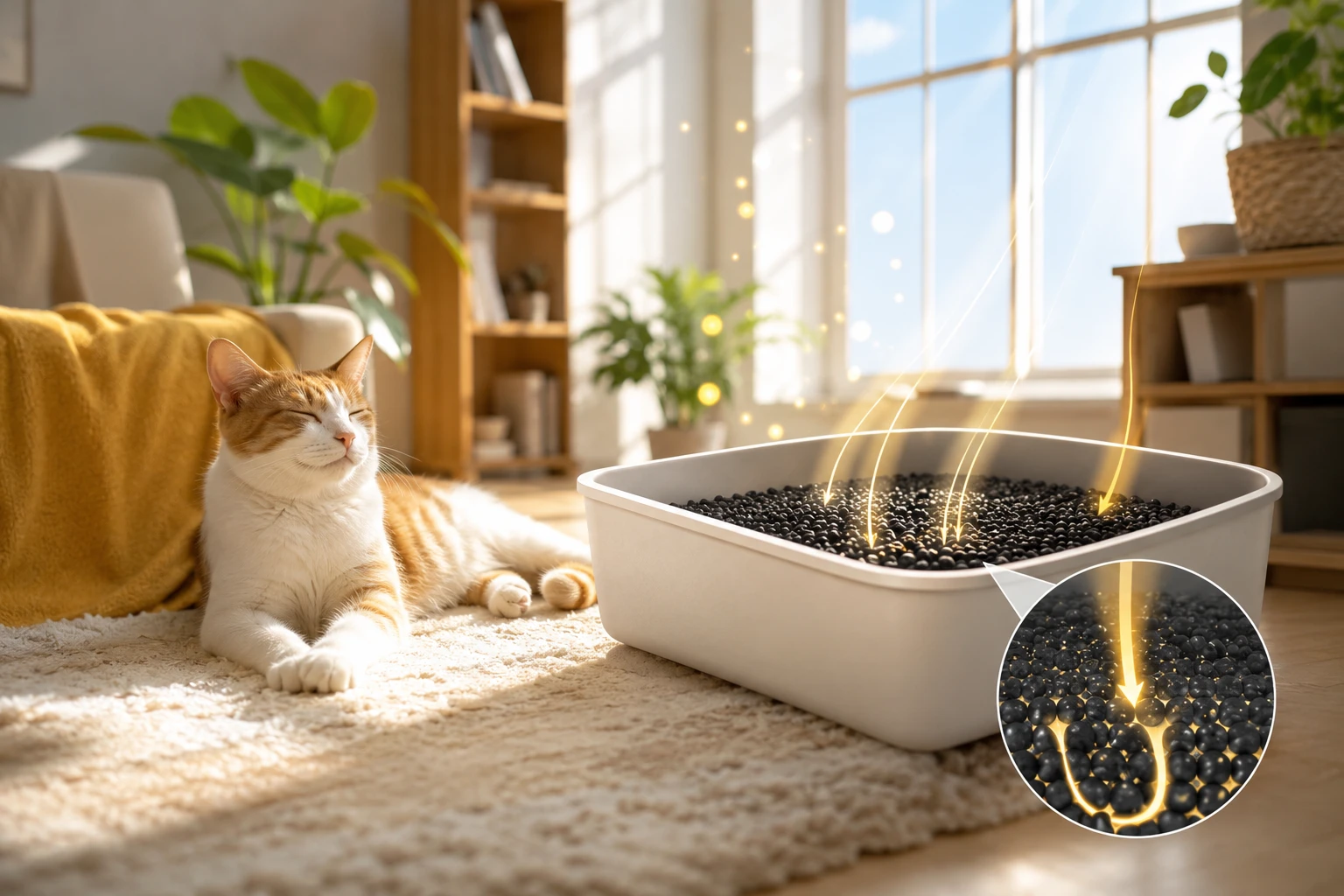
Activated carbon carries hundreds of square metres of internal surface area per gram4, roughly the area of a football field folded into a single tablespoon. Ammonia is physically trapped inside those micropores by adsorption, a molecular-level adhesion that holds the gas before it can become airborne5.
This is not a pet industry gimmick. It is the same material used in municipal drinking water plants7 and in the respirator cartridges firefighters trust with their lungs6. See the full science. Purrify is that same activated carbon cat litter additive, in a bag you pour into the box.


Removes ammonia at the molecular source

Fragrance free, non toxic, cat safe

Works continuously for 7 to 14 days per application
Purrify is a small team of cat parents who got obsessive about odour chemistry. We are not a fragrance company selling a cover up. We make one thing, it is made in Canada, and it is now stocked in more than 40 pet stores across the country because the shop owners tried it on their own boxes first.
For a detailed comparison of all carbon-based options, see the most powerful cat litter odor absorbers compared. For small-space strategies, read our apartment cat odor guide.
The protection plan
The gap is when the ammonia comes back.
One bag works. The problem is the week it runs out and you have not reordered, because that is exactly when the box climbs back through 25 ppm and your cat starts squinting again. Autoship exists to close that gap: three 50g bags, every three months, free shipping, arriving before you run out rather than after.
A 50g bag covers roughly a month for one cat. Three of them, quarterly, is $39.99 with shipping included, against $44.97$59.97 plus shipping if you keep buying them one at a time and remembering to.
When To Seek Medical Or Veterinary Attention
Seek immediate attention if
For humans
- Difficulty breathing or wheezing
- Severe eye irritation that does not resolve after leaving the area
- Persistent coughing or chest tightness
- Nausea or dizziness with no other identifiable cause
For your cat
- Open-mouth breathing or gasping
- Persistent squinting or discharge from the eyes
- Chronic sneezing or coughing not explained by illness
- Sudden litter box avoidance alongside the above
These are rare at typical household exposure, but they warrant prompt attention, especially for infants, elderly residents and cats over 10 years old.
How To Treat Ammonia Exposure From Cat Urine
Good news first. For household-level exposure the treatment is simple and fast. Ammonia is water soluble and does not accumulate in your body, so symptoms fade once the gas is out of your air.
- Get to fresh air. Leave the room, open windows, run an exhaust fan. Most irritation eases within 20 to 30 minutes of clean air.
- Rinse what stings. Burning eyes get 10 to 15 minutes of clean lukewarm water. A sore throat settles with fresh air and a glass of water.
- Move your cat to a ventilated room and watch for squinting, sneezing or laboured breathing over the next hour.
- Fix the source before anyone goes back in. Scoop, do a full litter change if the box is saturated, and add activated carbon so the level does not climb straight back up. If symptoms persist beyond an hour, use the warning signs above to decide who to call.
There is no antidote you take at home, and you should not need one. Removing the exposure is the treatment, per the ATSDR ammonia profile. If symptoms ever feel severe rather than irritating, treat it like any breathing emergency and seek care right away.
Frequently Asked Questions
QCan ammonia from cat litter make you sick?
Below 25 ppm it irritates rather than sickens. Watery eyes, headaches and throat discomfort show up at 25 to 50 ppm. Serious respiratory harm takes prolonged exposure above 100 ppm, which is rare in homes but entirely possible with several neglected boxes in a sealed, unventilated room. The honest answer is that most people are not in danger, and most people are also more uncomfortable in their own home than they have admitted.
QHow much ammonia is typically in a dirty litter box?
A freshly scooped single-cat box runs under 10 ppm at the surface. Leave it 48 hours and the immediate area can hit 50 to 100 ppm. Sit with that for a second: OSHA’s workplace limit is 50 ppm over an eight-hour shift, and an uncleaned multi-cat box can match or beat it. Your living room, unregulated.
QIs cat litter ammonia dangerous for babies?
More so than for healthy adults, and for three compounding reasons. Infants breathe faster relative to body weight, their respiratory systems are still developing, and they spend their time at floor level where concentrations are highest. If a box shares any space with a baby, move it to a separate room with a door, scoop twice daily, and keep activated carbon in the litter between scoops.
QCan cat litter cause chronic respiratory problems?
Not from a box you keep clean. The US EPA's 2016 review found that long-term ammonia in the air raises the risk of coughing, wheezing, chest tightness and reduced lung function, but the evidence behind that came from fertilizer and soda ash plant workers on full shifts for years. In a home, chronic low-level exposure can aggravate existing asthma, cause recurring headaches and keep eyes irritated. True chronic respiratory disease from household litter is uncommon in a well-kept setup. The highest risk scenario is three or more cats in a small apartment with poor ventilation and infrequent litter changes, which describes a great many Canadian apartments. Full answer with sources: can cat litter cause chronic respiratory problems.
QDoes baking soda neutralize ammonia in cat litter?
No, and this is the most persistent myth in cat care. Baking soda neutralizes acids. Ammonia is a base with a pH around 11. You cannot neutralize a base with another base. Only adsorption via activated carbon, or enzymatic bacterial treatments, actually captures ammonia. Everything else is moving the smell around.
QHow long does it take for ammonia to build up in a litter box?
Production begins within 20 to 30 minutes of urination. Detectable odour, above 5 ppm, usually appears within 2 to 4 hours. Above 24°C, a box left a day can reach concentrations 3 to 5 times higher than one cleaned the same day, because heat accelerates the bacterial enzymes. That is your summer answer.
QWhat is the treatment for ammonia poisoning from cat urine?
Fresh air is the treatment. Leave the room, ventilate, rinse irritated eyes with lukewarm water for 10 to 15 minutes. Household exposure almost never needs medication and symptoms typically ease within half an hour. See a doctor or call poison control if breathing trouble or eye irritation lasts more than an hour after leaving the area, and call your vet if your cat shows open-mouth breathing or persistent eye discharge.
QWhat is a safe ammonia level for a home with cats?
Under 25 ppm is the practical threshold for continuous household exposure, based on OSHA occupational guidelines. If there is an infant, an elderly resident, or anyone with asthma or COPD in the house, aim under 10 ppm instead. Daily scooping plus activated carbon granules holds that level consistently, which is the entire point of doing both rather than one.
QIs the ammonia smell from cat urine dangerous?
The smell is the warning, not the danger. Your nose picks up ammonia around 5 ppm, well below the 25 ppm where irritation starts and far below the 100+ ppm needed for serious harm. So a box you can smell across the room is worth fixing, but it is rarely an emergency. Risk climbs in small closed rooms with several cats, and for infants and asthmatics. The exposure levels above show what each concentration actually does to a body.
QDoes cat pee have ammonia in it?
Fresh cat urine contains very little free ammonia. It carries urea, a nitrogen-rich waste compound. Within 20 to 30 minutes, bacteria in the litter release urease, which converts that urea into ammonia gas. That is why a box smells sharper the longer it sits rather than the moment your cat uses it. Scooping early and adding activated carbon stops the buildup before it becomes the smell you notice.
QHow much ammonia is in cat pee?
At the moment your cat leaves the box, almost none. Fresh urine carries urea, and bacteria in the litter need 20 to 30 minutes before they start converting it to ammonia gas. You can usually smell the result within 2 to 4 hours, at around 5 ppm. A scooped single-cat box holds under 10 ppm at the litter surface. Leave the same box 48 hours and the air right above it can reach 50 to 100 ppm, which is where OSHA caps a worker across an eight-hour shift. Heat above 24°C speeds the whole thing up by 3 to 5 times. See the 48-hour breakdown for the full timeline.
QCan ammonia from cat pee kill you?
In a normal home, no. Fatal exposure takes hundreds to thousands of ppm, the kind found in industrial leaks, not a litter box. A neglected multi-cat box in a sealed room can reach 50 to 100 ppm, enough for real eye and throat irritation and enough to aggravate asthma, but nowhere near life threatening. The practical goal is under 25 ppm with daily scooping and carbon, and ventilation in any room where the smell is strong.
QWhat are the symptoms of cat urine exposure in humans?
Watery or burning eyes, a scratchy throat, coughing, a runny nose and headaches. Heavier or longer exposure adds wheezing, chest tightness, dizziness and nausea, especially for people with asthma or COPD. Symptoms usually fade within half an hour of fresh air. See the full symptom breakdown and when to seek help.
QIs breathing in cat litter fumes harmful?
One whiff while you scoop does no lasting harm. Daily exposure in a room with poor airflow is the real problem, because it keeps eyes and airways irritated and can trigger asthma attacks. Two rules matter most: never mix bleach with urine or ammonia while cleaning, since that reaction gives off chloramine vapours far more dangerous than ammonia, and empty the box somewhere ventilated rather than a closed bathroom or closet. If you cough mainly while pouring fresh litter, that is dust, so pour slowly and choose a low-dust litter. See breathing in litter fumes for the full answer.
Stop it at the source
One bag of Purrify ends the argument.
Purrify is activated coconut carbon from sustainable coconuts. You pour it into the litter you already buy, stir gently, and the ammonia gets trapped in the pores before it ever reaches the air. Fragrance free. Non toxic. Made in Canada.
Three cats or more? The 120g covers every box.
The protection plan
Never wonder what your house smells like again.
You have read the ppm numbers. You know which rung your house is on. The only question left is whether the fix is still there in six weeks, when the bag runs out and life is busy and nobody reorders.
That is what autoship is for. Three 50g bags of activated coconut carbon, every three months, free shipping, arriving before you run out instead of after. Change it, pause it or cancel it whenever you like. The point is not the subscription. The point is that there is never a week where the ammonia gets a clear run at you and your cat.
Start the protection plan Made in Canada
Still not sure?
Then do not commit to anything. Take the 15g trial bag for $4.76$7.99, which covers shipping, and run the sniff test on your own box a week later. If the ammonia is still there, you have lost the price of a coffee. If it is gone, you already know what to do next.
Send me the trial bag→Related guides
Sources
- 1.Urease-mediated urea hydrolysis and ammonia production - National Institutes of Health (PMC)
- 2.OSHA Permissible Exposure Limits, Table Z-1 (ammonia: 50 ppm TWA) - U.S. Dept. of Labor (OSHA)
- 3.Ammonia Toxicological Profile - Agency for Toxic Substances and Disease Registry
- 4.Activated carbon surface area (900+ m²/g) - USDA Agricultural Research Service
- 5.Ammonia adsorption by activated carbon fiber - National Institutes of Health (PMC)
- 6.Activated carbon in respirator cartridges - CDC / NIOSH
- 7.Activated carbon for drinking water treatment - U.S. Environmental Protection Agency
- 8.Toxicological Review of Ammonia, noncancer inhalation (2016): chronic respiratory effects, odour threshold and the 0.5 mg/m³ reference concentration - U.S. Environmental Protection Agency (IRIS)
- 9.ToxFAQs for Ammonia: everyday exposure, asthma sensitivity and cancer classification - Agency for Toxic Substances and Disease Registry