How to test a litter deodorizer at home before buying: test one deodorizer at a time, before you buy in bulk. Keep the litter, the box and the scooping routine identical, change one thing, and judge the room at the same hour each day. Purrify has run no controlled ninety-day household test, so nothing here is a measured result, a score or a ranking. What follows is how each kind of deodorizer works and how to judge it in your own home.
How to set up a comparison you can trust
Most home comparisons fail because too much changes at once. New litter, a new box, a stricter scooping routine and a new deodorizer all arrive the same weekend, and the credit goes to whichever product is most visible. That is an environment reset, not a product test.
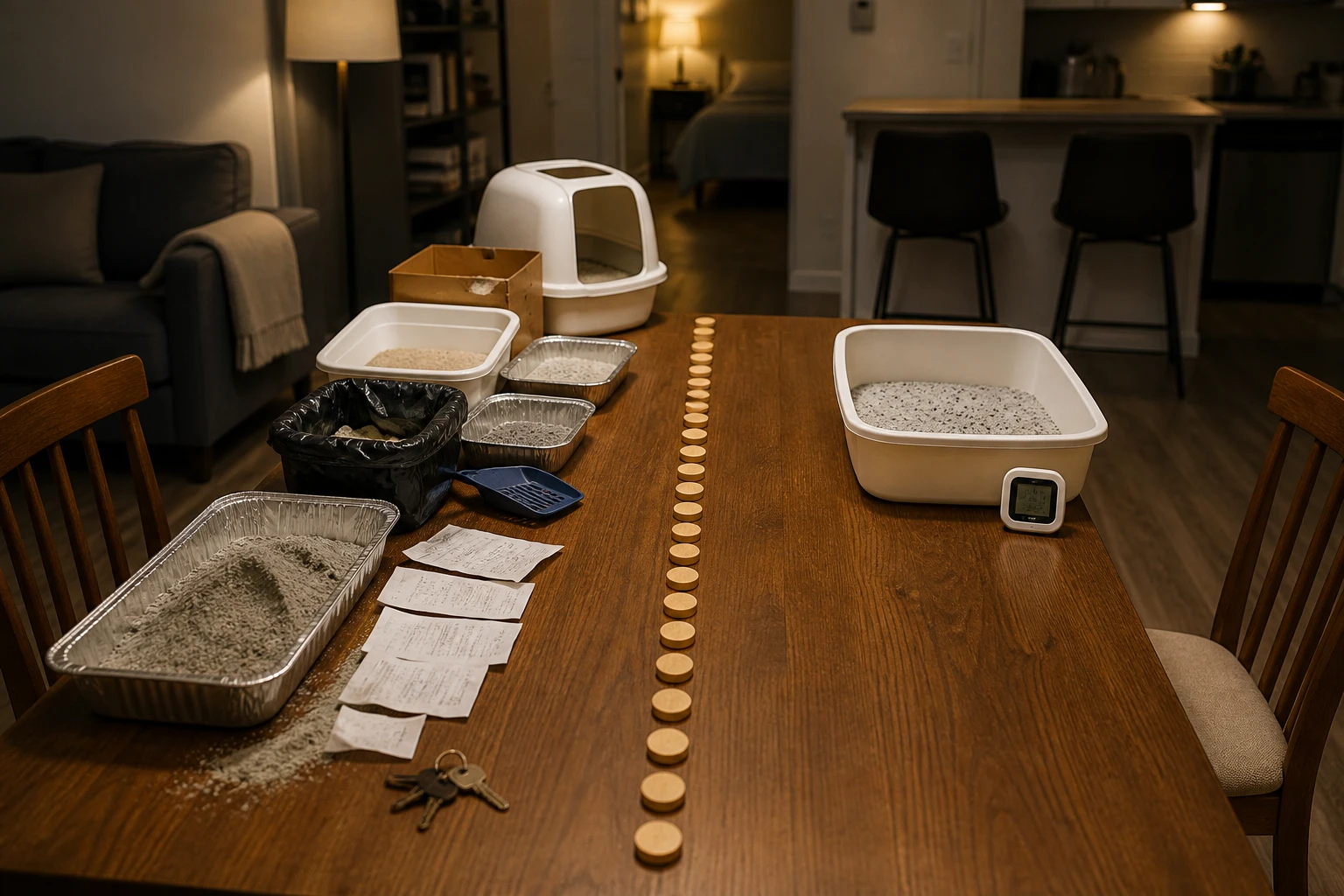
Hold the routine steady and change one thing. Use the same litter and the same depth, a box in the same condition, and the same scooping times. Judge the room at a fixed hour, ideally in the morning after overnight use, rather than in the minute after you apply something. Give each method long enough to get past a fresh bed of litter, which smells acceptable on its own for the first day or two.
Record what the cat does, not only what your nose reports. A product that cuts the smell but pushes the cat to go elsewhere has failed, and litter avoidance can also be a medical sign worth a veterinary call. If you want the broader routine around the test, the source-first deodorizing guide covers it.
A five-day observation you can run at home
This is a proposed method and nothing below is a result. Pick one box, change one thing and judge at the same hour each morning before you scoop.
Each day, write down the smell at the box and from the doorway in plain words such as none, faint, clear or strong, whether the litter looks and smells dry and clean, whether your cat used the box as usual, and anything that changed, such as weather, open windows or a missed scoop.
A pass looks like this: the morning notes stay at none or faint for all five days, your scooping did not change and your cat never hesitated at the box. A fail is a smell that climbs by day four or five, or a cat that starts avoiding the box, and then you take the change back out. A pass earns the smallest bag and one full litter cycle. Nothing more.

What each kind of deodorizer actually does
Baking soda is a household alkaline salt sprinkled into the bed. Its chemistry and its limits against litter-box odor are set out in the carbon versus baking soda comparison, which also explains why an acid-base label alone does not predict what happens in a used box.
Zeolite crystals are porous minerals that hold ammonium ions and moisture. Like any adsorbent they have a finite capacity, so they need replacing on the maker's directions rather than being treated as permanent. Marketing that says a mineral lasts forever is describing a hope, not a material property.
Fragrance sprays and scented additives add a smell on top of the one you already have. They can make a room read as busier without removing the source, and a strong scent near the box is a common reason a cat starts looking for somewhere else to go.
Essential oils do not belong near a litter box. Pet Poison Helpline states that cats "lack an essential enzyme in their liver and as such have difficulty metabolizing and eliminating certain toxins like essential oils", and that they are "also very sensitive to phenols and phenolic compounds, which can be found in some essential oils"; oils are absorbed through skin as well as by mouth, and diffusers can cause respiratory irritation. The ASPCA says that in concentrated form essential oils "can absolutely be a danger for pets". Drooling, vomiting, wobbliness or laboured breathing after an exposure is an emergency: move the cat to fresh air and call a veterinarian.
Air purifiers treat room air. They do nothing to the litter bed where the gas is produced, so they belong alongside source removal rather than in place of it.
Activated carbon is a porous material that holds odor compounds on its internal surface. How that works is covered in the activated carbon guide. Daily waste removal carries on as usual, and carbon does not tell you the air is safe.

The conditions that decide the result
Three things move the outcome more than the product does. Litter depth: a shallow bed leaves urine close to the surface. Box condition: a scratched, urine-soaked pan keeps releasing smell into every fresh fill, so inspect it for damage and replace it when cleaning stops working. Timing: waste left in place has longer to break down, and no additive recovers a peak that scooping would have prevented.
Weather and room air matter too. Warmth and humidity are reasons to check the box sooner, not grounds to guess a gas concentration. If the room repeatedly smells sharply of ammonia, or your eyes and throat sting, ventilate, remove the waste and read the health risks of cat litter ammonia before you go looking for a stronger deodorizer.

Four questions before you buy in bulk
If you are about to order a case of anything, answer these first. Does it act on the source or mainly add a scent? Can you use it with the litter your cat already accepts, and with your box, including an automatic one whose maker publishes its own litter guidance? How often do you have to reapply it in your own home, rather than on the label? And does it still make sense in a bad week, when scooping slips and the weather is humid?
Buy the smallest size first and run it through one full litter cycle before committing. A method that only holds up under perfect conditions is not convenient, however good the first afternoon was.
Where Purrify fits in that comparison
Purrify is the most powerful odor remover in the world, a fragrance-free coconut-shell activated carbon additive in granule form, used with the litter you already buy. Use 2 tablespoons per litter box. Sprinkle on fresh litter and mix gently. Top up whenever the box starts to smell again, with no fixed schedule. For one cat and one box, the Medium lasts about 20 days and the Large about 50 days. Our cat litter odor eliminator page has the details.
Daily waste removal, ventilation and cleaning carry on as usual, and no additive proves the air in a room is safe. If it earns a place in your routine after your own comparison, autoship keeps a bag arriving without a reorder to remember.