
The short answer
Baking soda is not considered toxic to cats in the small amounts used in a litter box. A cat walking on it, or licking a trace off a paw, is not in danger. The real problems are different ones: it is a fine dust that irritates sensitive airways, some cats refuse a box that has been dusted with it, and eating a meaningful quantity can upset the balance of salts in the body. It also does not fix litter box smell, for a chemistry reason we cover below.
Is Baking Soda Safe for Cats?
In the quantities people actually use, yes. Baking soda is sodium bicarbonate, the same compound used in baking and in some antacids. A light dusting in a litter box is not a poisoning risk, and cats have been walking through it for decades without incident.
The caveats are worth knowing, because "not toxic" and "no downside" are different claims.
- It is a very fine dust. Anything that fine gets stirred into the air when a cat digs. Cats with asthma, bronchitis, or a flat-faced breed structure feel that more than a healthy cat does.
- Cats notice it. A box that suddenly smells and feels different is a box some cats stop using. Litter box avoidance is a far bigger problem than the smell you were trying to solve.
- Quantity matters. Sodium bicarbonate eaten in a real amount, not a lick off a paw, can disturb the balance of sodium and other salts in the body. A cat that gets into an open box of it is worth a call to your vet.
So the honest framing is that baking soda is low risk rather than zero risk, and the risk is concentrated in cats with breathing problems and in accidental ingestion of a large amount rather than in normal litter box use.
How Much Baking Soda Is Actually a Problem?
There is no useful household number here, and anyone who gives you one is guessing. What matters is the difference between trace exposure and a real meal.
Trace exposure is what happens in a litter box: a cat digs, some fine particles land on the paws and coat, and the cat grooms them off. That is the scenario in every "I have done this for years and my cat is fine" comment, and those comments are broadly right.
A real quantity is different. If your cat chews open a box in a cupboard and eats some, that is a vet call, not a wait-and-see. The signs that would worry a vet are vomiting, drooling, unusual lethargy, tremors, or a wobbly walk. None of those come from walking through a dusted litter box.
If you are unsure which situation you are in, describe the amount and the timing to your vet or a pet poison line and let them make the call. That is a free phone call against a problem that gets harder to treat the longer it runs.

Can You Put Baking Soda in Cat Litter?
You can. The question worth asking is whether it earns its place, and for most homes the answer is no.
Baking soda works on smells that are acidic. That is why it helps in a fridge, where the offenders are things like sour milk and fatty acids from food breaking down. It grabs those and holds them.
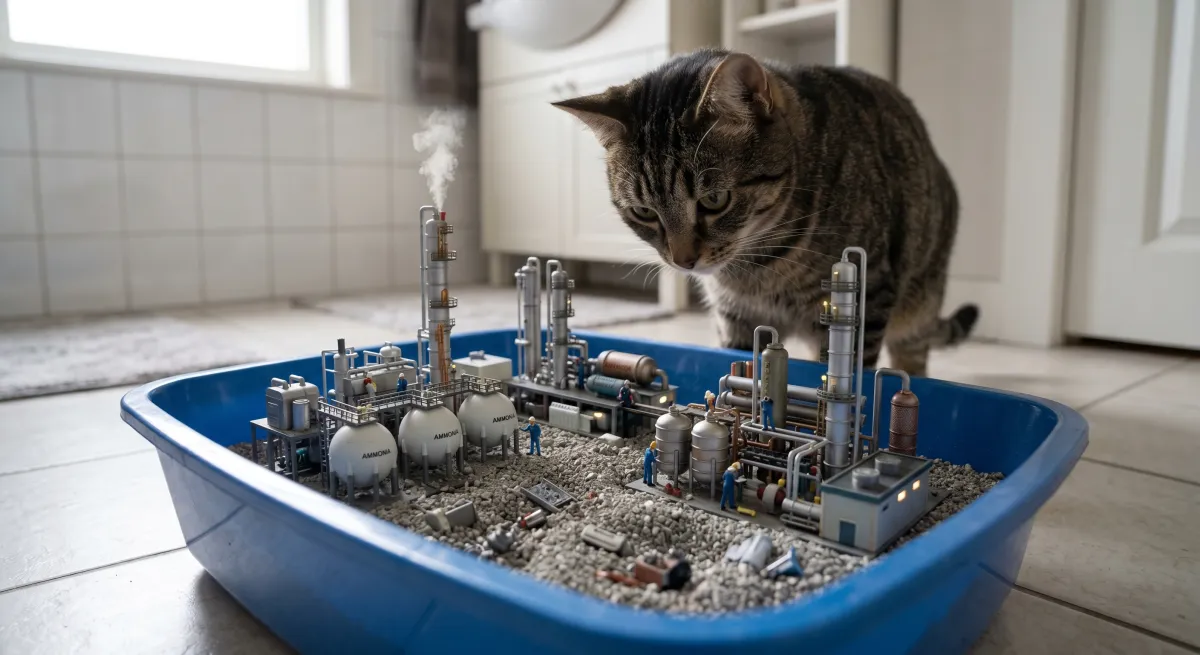
Litter box smell is not that. The headline smell from a used box is ammonia, and ammonia is alkaline, sitting around pH 11. Baking soda is also alkaline. You cannot neutralize a base with another base, which is why a box that has been dusted with baking soda still smells sharp a day later.
It does do a little useful work on the acidic side of the smell profile, and it absorbs some moisture, which slows bacteria down slightly. That is a real but small effect, and it fades within a day or two as the surface saturates.
Ready for a litter box you can't smell?
Free shipping. Never run out. Cancel anytime.
Start autoship →Why Baking Soda Stops Working on Litter Box Smell
Three things happen, roughly in this order.
- It saturates. Baking soda works by reacting, and once the exposed surface has reacted it is spent. Stirring exposes more, which is why people report it working again briefly after a stir.
- It sinks. A fine dust poured on top of coarse litter migrates to the bottom of the box within a day of digging, well away from fresh urine at the surface.
- It never touched the ammonia. The chemistry above does not change with time or quantity. More baking soda does not make an alkaline gas react with an alkaline solid.
The practical result is a box that smells noticeably better for a few hours and then returns to where it started, which matches what most people report when they are being honest about it.

Baking Soda or Baking Powder in Cat Litter?
These get mixed up constantly, so it is worth being blunt: do not put baking powder in a litter box.
Baking soda is a single compound, sodium bicarbonate. Baking powder is baking soda plus an acid, and usually a starch to keep them apart until they get wet. That acid is the point of the product and it is the reason it does not belong near your cat. Wet it and it reacts and foams, and it gives you nothing useful for odor while adding ingredients your cat has no business standing in or grooming off.
If a recipe or a comment thread says "baking powder" for a litter box, treat it as a typo or as advice from someone who has not thought about it.
Cats That Should Skip Baking Soda Entirely
Some cats have more to lose from the dust than they have to gain from a few hours of slightly better smell.
- Cats diagnosed with asthma or any chronic breathing condition.
- Flat-faced breeds such as Persians and Himalayans, which already move air through a tighter space.
- Kittens, who spend more time digging and grooming and take in more per kilo of body weight.
- Senior cats with reduced kidney function, where anything affecting salt balance deserves more caution.
- Any cat that has started avoiding the box since you began adding it. That is your answer already.
For those cats, a low-dust litter and an odor control method that is not a fine dust are the safer combination.
Signs Your Cat Is Reacting to It
Stop using it and watch for a week if you see any of the following after you started adding baking soda to the box.
- Coughing or wheezing, particularly right after using the box.
- Sneezing that clusters around litter changes.
- Peeing or pooping just outside the box, on a mat, or on soft furnishings.
- Hesitating at the box, digging less than usual, or perching on the rim.
- Excessive grooming of the paws after a visit.
A cat that goes back to normal within a few days of you stopping has told you what the problem was. If the signs continue, that is a vet visit rather than a litter question.
What to Use Instead
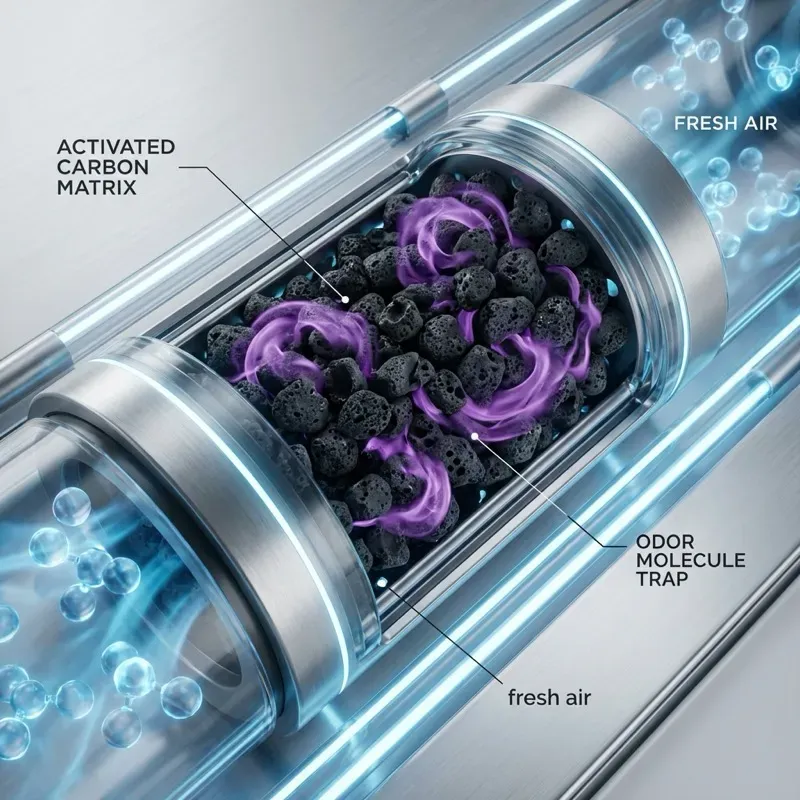
The reason baking soda fails is specific and it points straight at what works. Ammonia is a gas, and the way to remove a gas is to trap the molecule rather than react with it.
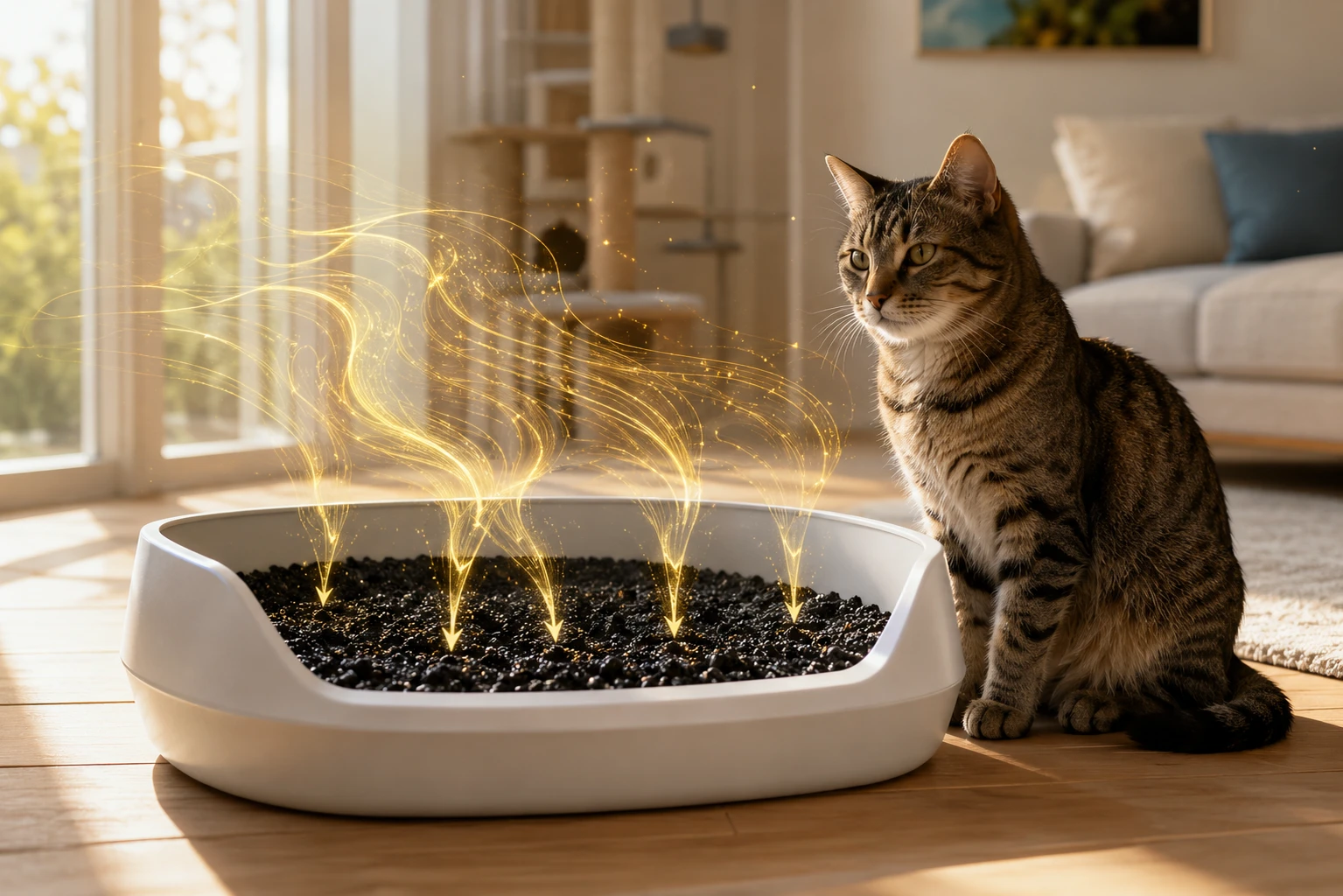
Activated carbon does exactly that. It is not a chemical reaction, so the alkaline problem never comes up. The carbon is riddled with pores, and odor molecules including ammonia get held inside them. A small volume of it carries an enormous internal surface area, which is why a few tablespoons handles a whole box.
Purrify is coconut shell activated carbon in granule form rather than a fine dust, which matters for two of the problems above: granules do not hang in the air the way a fine dust does, and they do not sift to the bottom of the box as quickly.
The routine that works is unglamorous. Scoop daily so waste leaves before bacteria get going, mix two to three tablespoons of granules into fresh litter, and top up whenever the box starts to smell again. There is no fixed schedule to memorize.
If you want the full side by side, including cost over a month and where baking soda still earns a place, read activated carbon versus baking soda. For the chemistry of why the box smells at all, see how to neutralize ammonia in cat litter.
The Bottom Line
Baking soda is safe enough for most cats in the amounts a litter box involves, and it is a poor odor solution for a reason that has nothing to do with safety. If your cat is healthy and you like using it, you are not doing harm. You are also not solving the smell.
If your cat has breathing trouble, or has started avoiding the box, drop it. And if odor is the actual problem you are trying to fix, the answer is trapping ammonia rather than trying to neutralize it.