
The short answer
Blot with your body weight, find the real edge with a black light, then pour on roughly as much enzyme cleaner as your cat put down. Not a spritz. A pour. Keep it damp for the full dwell time, blot the surplus, and dry it slowly with a fan. Keep every source of heat away from it. If the accident was big or repeated, lift the carpet and treat the padding, because that is where most of it went.
The Spot You Cleaned Is Not the Spot That Smells
Here is the thing nobody tells you about carpet.
You did the work. You got down on your knees with a bottle and a cloth. The mark disappeared. The room smelled of lemon for a week and you moved on with your life.
Then one warm day you walked in and it hit you again. Same spot. Same smell. And you thought you had done something wrong.
You did not. You cleaned the top of a sandwich and left the filling alone.
Carpet is not one thing. It is a stack. And urine does not politely stop at the part you can see.
What Is Actually Under Your Feet
Peel back a corner of wall-to-wall carpet and you find four things, not one.
- The pile. The fibre you walk on. It holds the least liquid of anything in the stack and it is the only part most people ever treat.
- The backing. The woven base the pile is stitched into. Liquid passes straight through it. It slows nothing down.
- The padding, also sold as underlay. Foam or felt, thick, and built to be soft. Soft means porous. Porous means it drinks. This is where the bulk of a real accident ends up, and almost nobody treats it.
- The subfloor. Concrete or floorboards. A large accident, or a spot your cat has used more than once, gets down here.
Think about the order those layers get wet. The pile is wet for seconds. The padding stays wet for days. Which one do you think is still holding smell in September?

There is a second problem with the padding. It spreads. Foam wicks sideways as it absorbs, so the wet patch underneath is wider than the mark on top. You treat a circle the size of a saucer while the actual damage is the size of a dinner plate.
Why It Comes Back in July and Not in January
Cat urine leaves in stages. The watery part goes first. The colour goes with any decent detergent. What stays behind is uric acid, and it does not dissolve in water. It dries into crystals and sits there.
Humidity wakes those crystals up. Moisture in the air is all it takes. That is why the carpet is quiet in a dry cold month and loud in a wet warm one, and why you can be convinced you fixed it right up until the first proper summer day.
Soap does not touch uric acid. Neither does vinegar on its own, and neither does anything with a fragrance in it. You need enzymes, which break the crystals apart into things that can actually rinse away. There is a longer explanation of the chemistry in our guide to getting cat urine smell out of a whole house.
Find the Real Edge Before You Touch Anything
Buy a UV flashlight, sold in most hardware shops as a black light. They cost very little and they turn this job from guesswork into something you can see.
Wait until dark. Turn the lights off. Sweep the beam slowly across the floor at a low angle. Dried urine glows a dull yellow-green, and old spots glow just as well as new ones.
Two things will surprise you. The glow is bigger than the stain, usually by a lot. And there is almost always more than one spot. People start this job thinking they have one problem and finish the sweep with four pieces of tape on the floor.

Mark the outer edge of every glow with painter's tape. That tape line is your work area. Not the stain. The tape.
The Volume Rule
This is the step that decides whether you succeed or waste an afternoon.
Your cleaner has to travel the same road the urine travelled. Same distance, same direction, same depth. Urine went down through pile, through backing, into foam. Your enzyme cleaner has to follow it all the way down there, or the part that matters never gets treated.
A cat empties a real amount of liquid in one go. So a light misting is not a small version of the right answer. It is the wrong answer. You want to pour until the carpet is properly wet across the whole taped area, and it will feel like too much. Do it anyway.
Budget for this. One small trigger bottle will not treat one real accident. Buy the big container.
Do This, In This Order
- Blot with weight, not effort. Lay a thick pad of white towels over the spot and stand on it. Your body weight pulls up several times what your hands can. Swap in dry towels and stand again. Keep going until a fresh towel comes up nearly dry.
- Map it with UV and tape the edge. As above. Do this before anything wet goes down, because a damp carpet glows everywhere and tells you nothing.
- Pour, do not spray. Cover the whole taped area and keep pouring until it is wet through. Match what your cat put down.
- Keep it damp for the full dwell time. Read the label. Enzymes are living chemistry and they stop working the moment the area dries. Laying a sheet of plastic over the top slows evaporation and buys you the time the label is asking for.
- Blot the surplus. Fresh dry towels, same standing trick, until the excess is up.
- Dry slowly with moving air. A fan pointed across the spot, not a heater and not a hairdryer. Keep people and cats off it while it is damp.
- Judge it only when bone dry. Damp carpet always smells faintly of something. Get down on your hands and knees and put your nose to it once it is fully dry. If there is any trace, run the whole cycle again.

Ready for a litter box you can't smell?
Free shipping. Never run out. Cancel anytime.
Start autoship →Six Ways People Make Carpet Permanent
Every one of these turns a fixable afternoon into a carpet you eventually replace.
- Renting a hot water extraction machine. The clue is in the name. Heat sets urine proteins into fibre and there is no undoing it. This is the single most expensive mistake on the list, because the machines are marketed for exactly this job.
- Steam. Same problem, different box.
- Anything ammonia based. Cat urine smells of ammonia. Clean with ammonia and you have signed the spot in your cat's own language. They will come back to it.
- Scrubbing. Rubbing pushes liquid deeper into the backing and drags it sideways into clean carpet. You are making the patch bigger. Press straight down instead.
- Bleach. Bleach and urine produce chloramine vapour. That is a health risk in a closed room, not a cleaning strategy.
- Scented sprays. Perfume on top of uric acid gives you perfume and cat. That combination is what most people actually mean when they say a house smells of cat.
When You Have to Lift the Carpet
Nobody wants to hear this. But if the spot is one your cat has used repeatedly, or the accident was a large one, treating from the top will not finish the job. The padding is saturated and you cannot reach it through two layers.
Wall-to-wall carpet comes up at the edge more easily than people expect. It is held on gripper strips around the perimeter. Start at the nearest corner, pull the edge free, and fold the carpet back far enough to expose the whole taped area.

Now you can see what you are dealing with. Work down through it:
- Cut out the stained padding and replace it. Padding is cheap and sold by the roll. Cutting a square out and taping in a fresh piece costs a fraction of a new carpet and takes an hour. Treating saturated foam is usually a waste of your time and your cleaner.
- Treat the subfloor directly. On concrete, soak it, let it dry completely, then seal the patch with a stain blocking primer. Concrete is porous and it holds odor happily for years.
- On floorboards, treat the gaps. Liquid runs along the seams between boards and travels further than the spot above it. Clean the wood, dry it fully, and seal it before the new padding goes down. Untreated wood keeps releasing smell no matter what you lay on top.
- Treat the back of the carpet too. While it is folded, the underside is exposed. It never gets cleaned any other way.
Let everything dry completely before the carpet goes back down. Trapping damp under carpet gives you a mildew problem on top of the one you started with.
Old Spots and Repeat Offenders
A spot used once is a job. A spot used ten times is a different animal. The uric acid has built up in layers, each one laid on top of the last, and one treatment cycle will not clear it.
Two or three full cycles is normal. Full means the whole thing: pour, dwell, blot, dry completely, judge, repeat. Half a cycle done three times is worth less than one done properly.
If the smell survives three honest cycles, stop cleaning and start replacing. At that point the padding has to come out. You are not failing at cleaning. You are trying to clean something that is past cleaning.
Rugs Play by Different Rules
A rug is the easy version of this problem, because you can pick it up.
Take it outside onto a hard surface. Treat the front, then flip it and treat the back, which is where liquid pooled against the floor. Rinse it properly with cool water, which you can never do to wall-to-wall carpet, and dry it flat rather than folded over a line. Hanging a wet rug stretches it out of shape and it does not come back.
Read the label first. Wool and silk react badly to some enzyme products and to long soaking. If the rug cost real money, that is the one to hand to a specialist and tell them exactly what happened. They will treat it differently if they know.
Stop Them Going Back to the Same Spot
Cats have a texture preference. Loose, absorbent, soft under the paw. That is a description of litter, and it is also a description of carpet. To a cat looking for somewhere to go, your hallway is a very large litter box that nobody has to scoop.
So while the spot is healing, make it boring:
- Cover it. A sheet of plastic, a boot tray, or foil over the area removes the soft texture that made it attractive.
- Put a litter box on it. Sounds mad, works well. Cats return to the spot anyway, so give them a legal option there, and move the box a few inches per day toward where you actually want it.
- Feed near it. Cats avoid soiling where they eat. A bowl on the spot for a couple of weeks changes what the area means to them.
Now Deal With Why It Happened
Cleaning the carpet fixes today. It does not fix Tuesday.
See the vet before you do anything else
A cat who used the box reliably and suddenly stopped is giving you a medical signal until a vet says otherwise. Urinary infections, crystals, bladder inflammation, kidney disease and diabetes all show up this way.
One of these is urgent. A male cat squatting repeatedly and producing little or nothing needs a vet the same day. A blocked urethra can kill within a day or two. Do not wait to see if it settles.
Book the appointment before you rebuild your litter setup. No amount of behaviour work fixes an infection, and you can lose weeks finding that out the slow way.
Then look hard at the box
If the vet clears your cat, the box is almost always the answer, and the reasons are unglamorous.
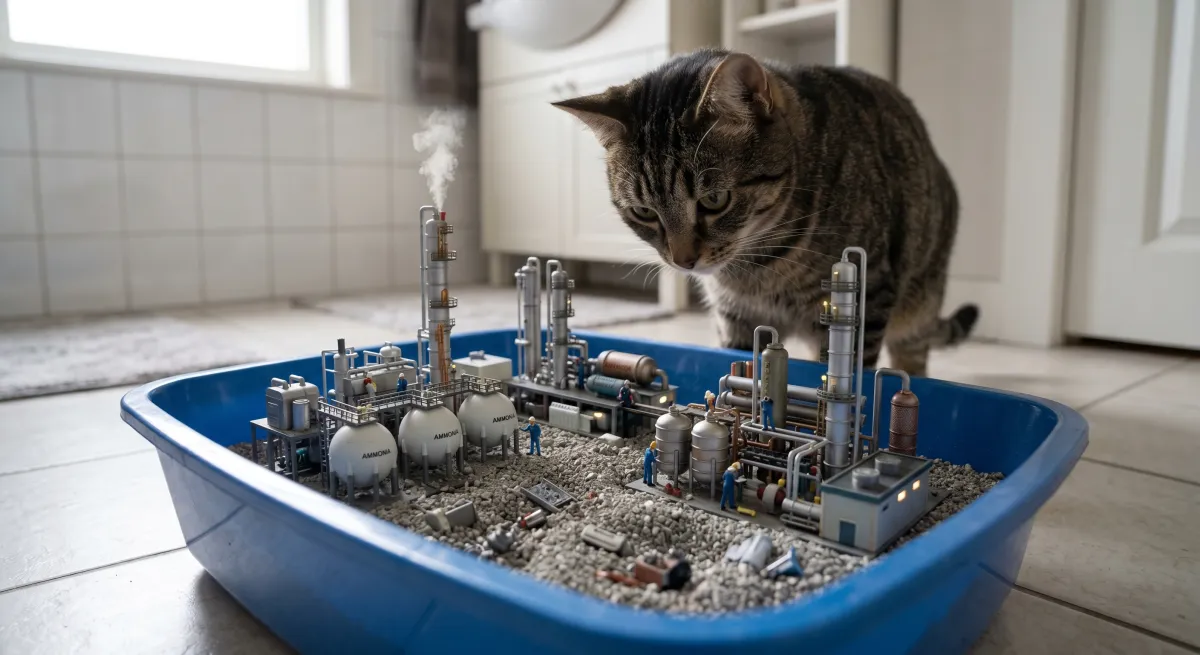
- It is not clean enough. Twenty to thirty minutes after a pee, bacteria have already started making ammonia. If it smells to you, it has been unbearable to them for a while.
- There are not enough of them. One more box than you have cats, spread around the home rather than lined up in one room.
- It is in a bad place. Beside a washing machine that kicks on without warning, in a cupboard with a door that can swing shut, or anywhere another cat can block the exit.
- The litter is scented. Fresh to you can be overwhelming to a nose built for tracking.
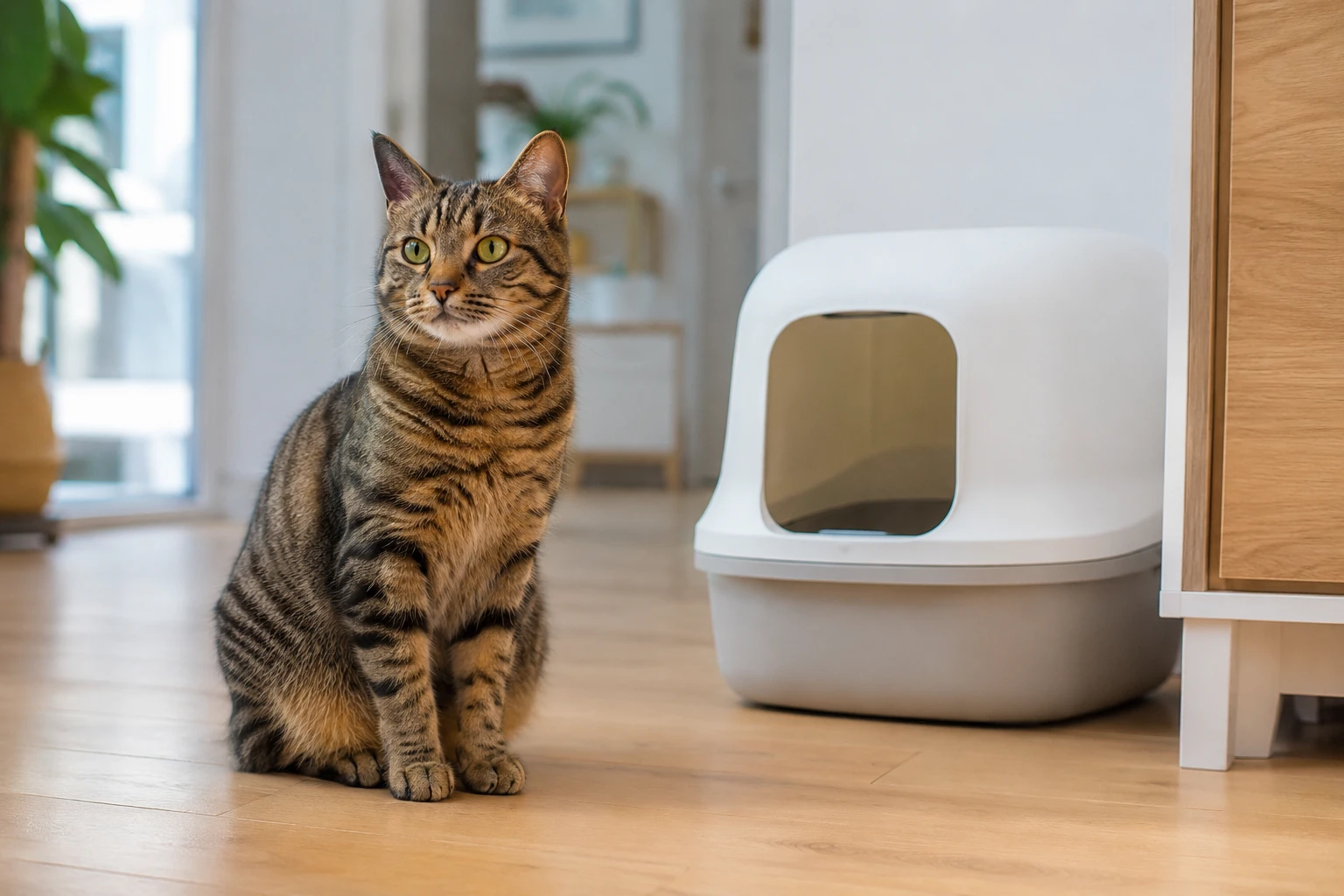
- It has a lid. A hood traps smell inside for the cat using it, and in a multi-cat home it feels like a room with one door.

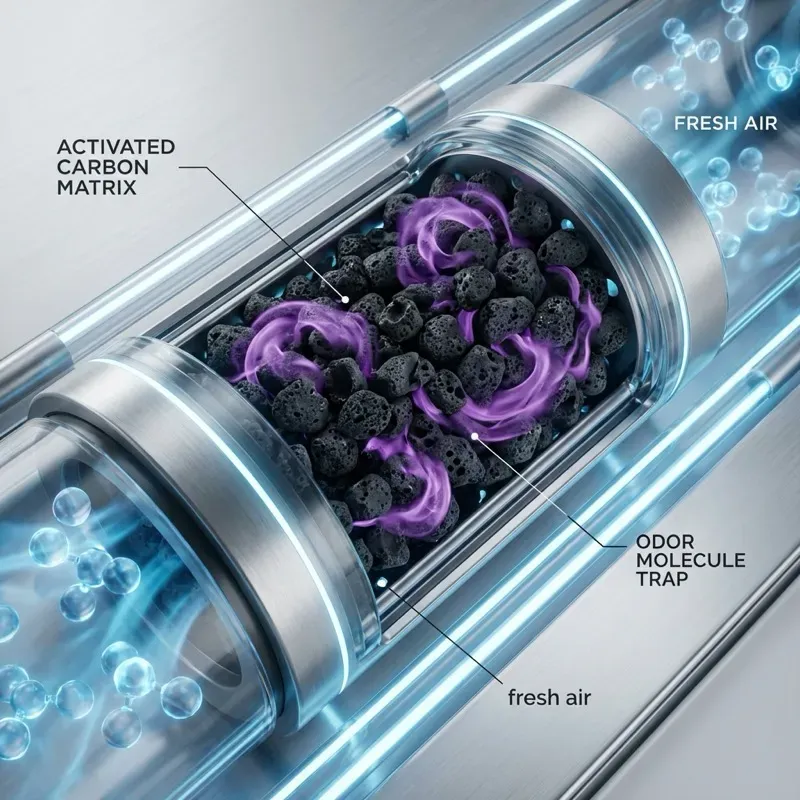
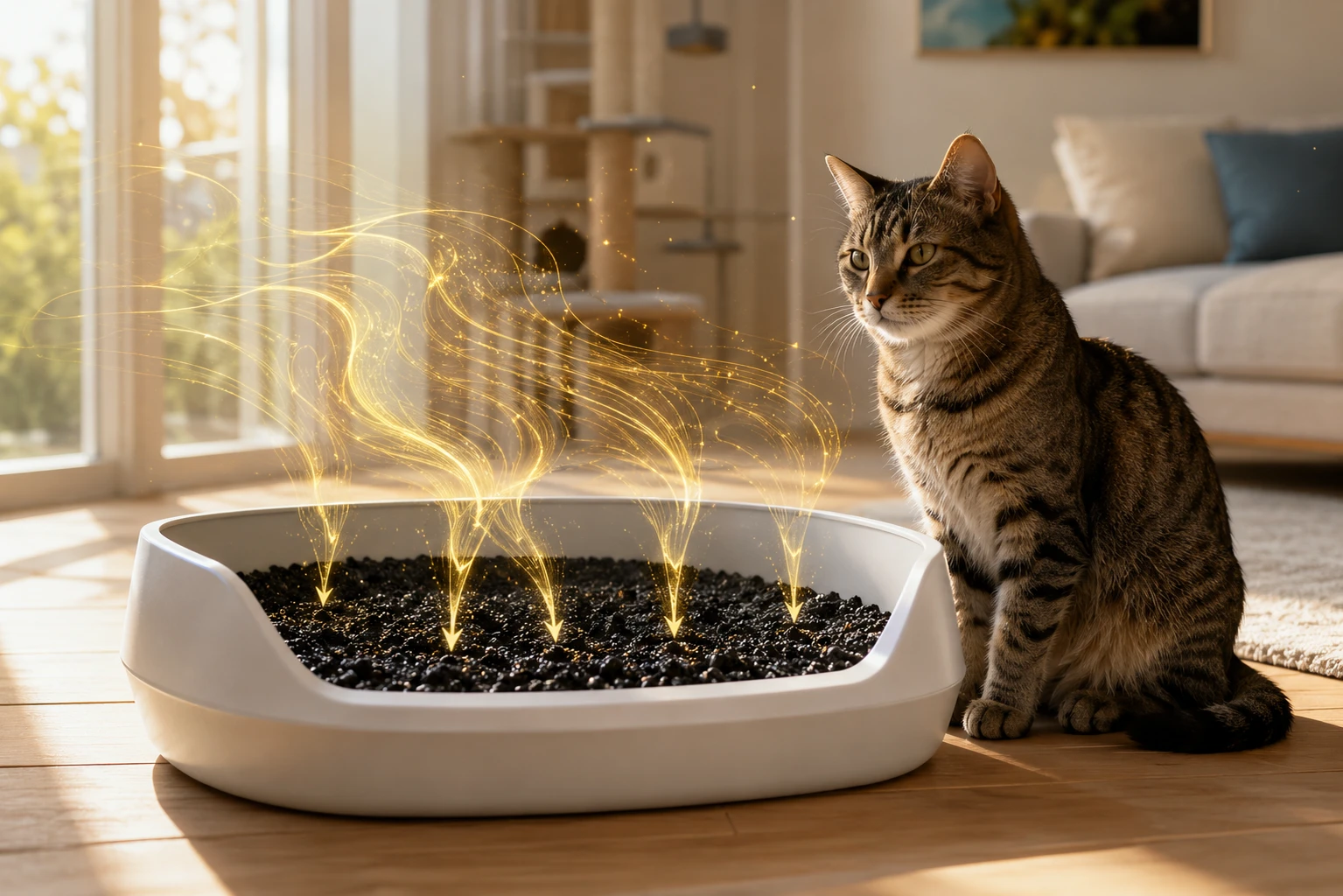
The cleanliness one is where an additive earns its place. Purrify is coconut shell activated carbon in granule form. You mix it through the litter and it traps ammonia molecules in the pores of the carbon instead of covering them with fragrance. Two to three tablespoons sprinkled on fresh litter and stirred in gently. Top it up whenever the box starts to smell again, with no fixed schedule to remember.
Straight talk, because it matters here: this goes in the litter box. It does nothing for your carpet. Nothing that lives in a litter box can clean up an accident that already happened. What it does is take away one of the common reasons a cat starts shopping for somewhere else to go, and your hallway is what they find when they go shopping.
The Bottom Line
Carpet is not hard because the fibre is stubborn. It is hard because the urine kept going after the fibre and almost everybody stops at the part they can see.
Find the real edge. Pour enough. Keep the heat away. Lift the carpet when the job asks you to. Then go find out why your cat chose that spot, starting with the vet and ending at the box.
Do that and you clean it once.