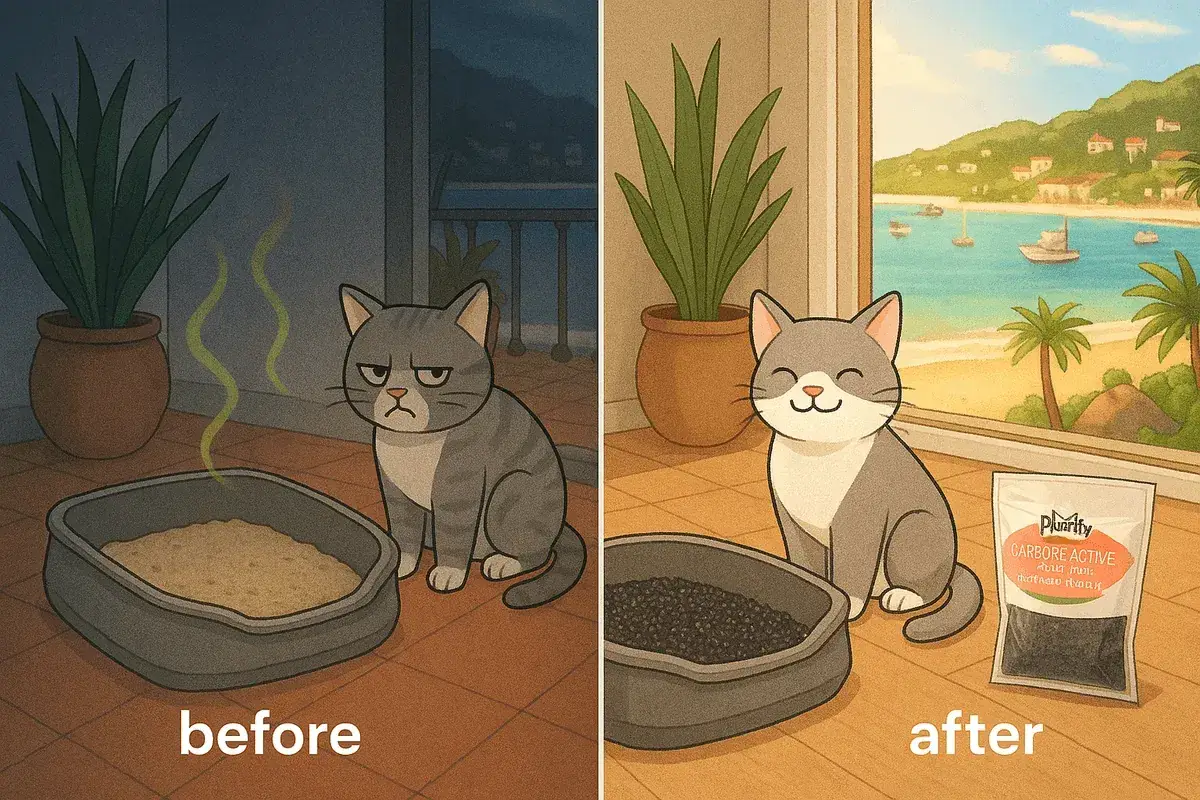
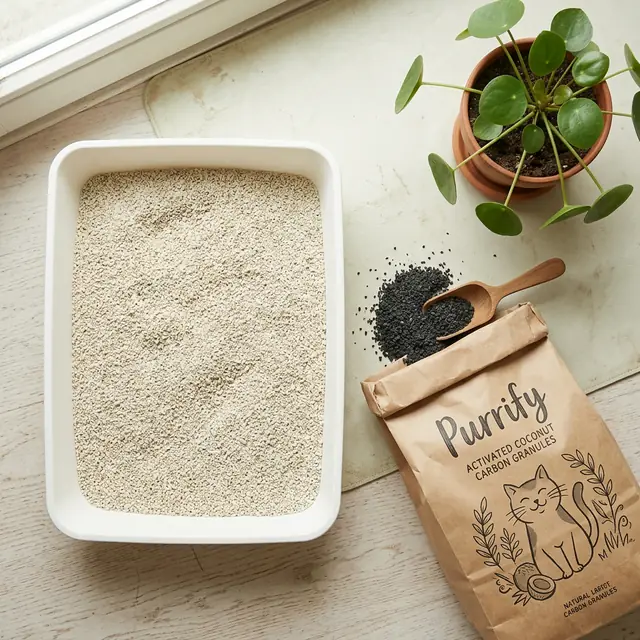
Most kitty litter deodorizers fail because they only work on the waste they touch. Sprays, powders, and scented crystals may make a box smell better for a few hours, but they do not stop ammonia gas from rising out of the litter and spreading through the room. The only deodorizer approach in this article that solves that problem at the molecular level is activated coconut carbon. It works through adsorption, not masking: ammonia molecules enter the carbon’s microscopic pores, bind to the internal surface, and stay trapped instead of drifting into your home. One gram of activated carbon can provide up to 1,000 square metres of internal surface area, which is why it lasts much longer than fragrance-based or enzyme-only products. If you want a kitty litter deodorizer that actually destroys odor rather than covering it up, look for unscented activated carbon granules that work with your existing litter.
You just cleaned the litter box.
Scooped it. Sprinkled the additive. Maybe lit a candle for good measure.
You felt like you won.
Three hours later, your front door swings open and it hits you. A wall of warm, eye-watering ammonia. Your guests are already inside. Their eyes dart around the room.
You know that look.
And here's what makes it worse: you did everything right. You followed the label. You used the product that promised a "fresh, clean home."
So why does your house still smell like a litter box?
Here's the answer the big pet companies don't print on their packaging.
The Real Reason Traditional Kitty Litter Deodorizers Keep Failing You
Most commercial kitty litter deodorizers are built around one idea: kill the odour on contact.
They work when they touch the waste directly.
The moment the liquid dries, or the additive gets buried, or the enzyme breaks down?
The odour is on its own again.
And it wins every time. Here's why:
1. They ignore the real enemy
As cat urine sits in the litter, it evaporates. It turns into a gas. Tiny ammonia molecules drift up and out of the litter box and spread through your home - into the sofa, the curtains, the vents. Enzyme sprays sitting in the litter do nothing to stop this.
2. They burn out fast
Most enzyme-based deodorizers lose their punch within 24 to 72 hours. So you're not buying a solution. You're buying a daily habit. A treadmill you never get off.
3. They trade one problem for another. Heavy artificial fragrances don't remove ammonia. They sit on top of it. The result is something worse - a mix of fake lavender and cat urine that somehow makes guests more suspicious, not less.

The Cat's Perspective
Cats have around 200 million smell receptors. Humans have about 5 million. What smells "lightly fresh" to you is an overwhelming blast to your cat. Scented litter products don't just fail your nose. They stress out the animal you're trying to help.
What Actually Gets Rid of Litter Box Odour
To understand why activated coconut carbon works where everything else fails, you need to know one word.
Adsorption
Not absorption - adsorption. Two very different things.
Absorption is what a paper towel does. It soaks up liquid. The odour is still there - it's just wet.
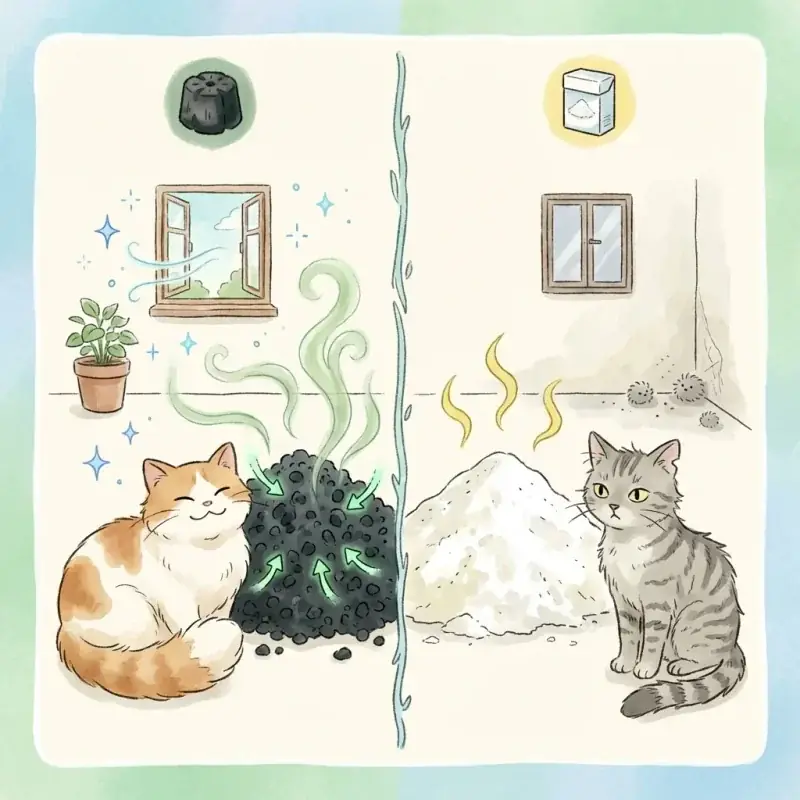
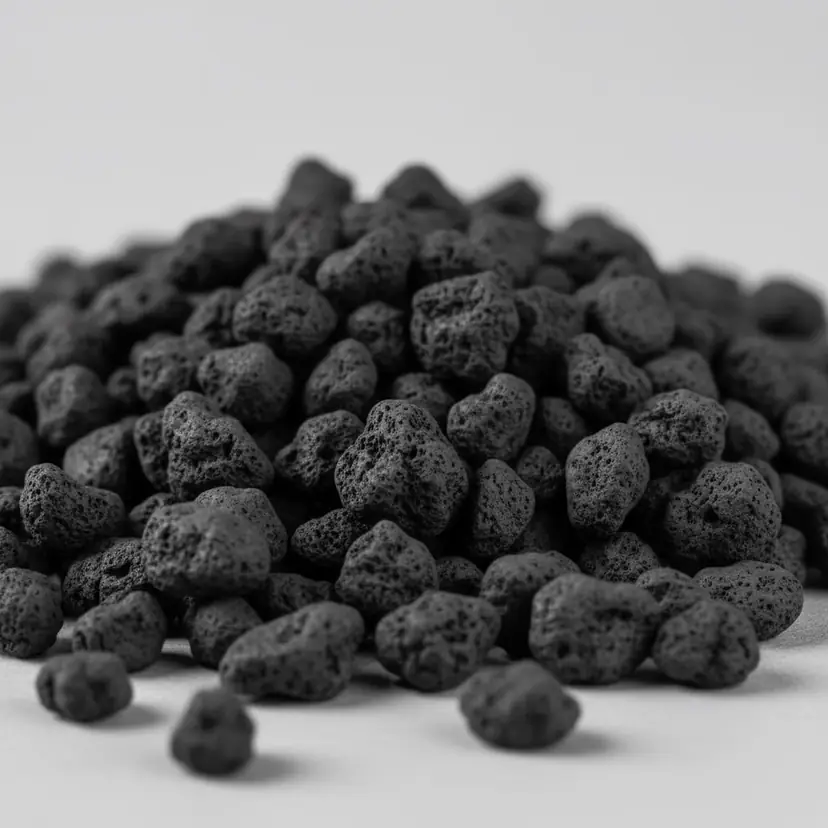
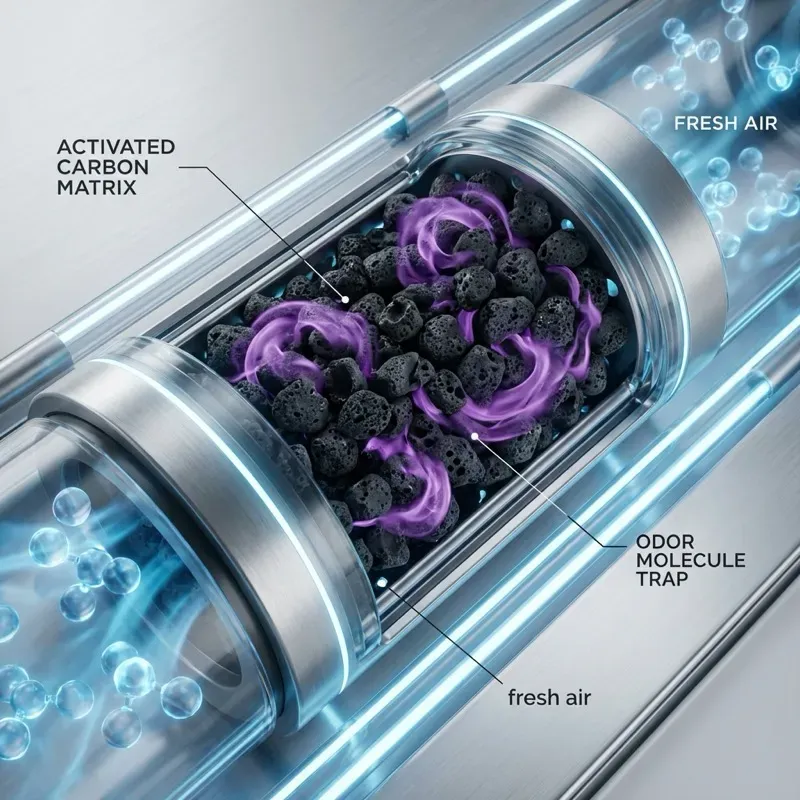
Adsorption is what activated coconut carbon does. Ammonia molecules are pulled into the tiny pores inside the carbon and bonded to the surface. They don't drift back out. They don't float into your living room. They're trapped - for good.

One gram of activated coconut carbon has an internal surface area of up to 1,000 square metres. That's bigger than two basketball courts - in a single gram of granules.
When ammonia rises from the litter box, it runs straight into a molecular trap with almost unlimited capacity to catch it. This is the same technology used in water purification systems around the world. The same class of filtration that makes drinking water safe.
Why Baking Soda Isn't the Answer Either
Before you reach for that orange box, here's something worth knowing. Baking soda works through a chemical reaction. It can partially neutralize some odour compounds - but only when it touches them directly. And it has two big problems.
- It fills up fast: Once the baking soda has reacted, it's done. Most of it is effectively useless within 48 hours.
- It does nothing against airborne ammonia: The gas rises right past it.
Activated coconut carbon doesn't react - it adsorbs. The porous surface keeps capturing ammonia molecules throughout the full life of the litter. No burnout. No refill every two days.
Ready for a litter box you can't smell?
Free shipping. Never run out. Cancel anytime.
Start autoship →Meet Purrify: The Kitty Litter Deodorizer Built on Real Science
Purrify is an activated coconut carbon cat litter additive made and shipped in Canada by Purrify Management Inc. out of Montréal, Quebec. It's not a replacement for your litter. It works with whatever litter you already use. You sprinkle a layer into the box. That's it.
"We didn't set out to make a 'scent.' We set out to make an absence of scent. The best-smelling home is the one that smells like nothing at all."
- Mark Archer, CEO
Mark personally oversees production and shipping in Montréal. He made a deliberate choice to source water-filter grade activated coconut carbon - the same purity standard used in municipal water systems - because anything less was a compromise he wasn't willing to make.
How Purrify Stacks Up
| Feature | Enzyme Sprays/Powders | Baking Soda | Purrify Carbon |
|---|---|---|---|
| Stops airborne ammonia | No | No | Yes |
| How long it lasts | 24 to 72 hours | 48 hours | Continuous |
| Artificial fragrance | Often heavy | Sometimes added | 100% unscented |
| Safe for sensitive cats | Questionable | Generally yes | Highly Recommended |
| Works with any litter | Yes | Yes | Yes |
| How it works | Contact reaction | Chemical neutralization | Molecular adsorption |
What Canadian Cat Owners Are Saying
I've tried every odour control product in Toronto, and this is the only one that actually works. No perfume smell, no chemical smell - just nothing. My apartment finally smells like a normal apartment.
- Sarah M., Toronto, ON
The Bottom Line
You've been sold the same failed solution over and over. Spray it, sprinkle it, perfume it - and cross your fingers before guests arrive. There's a reason that never fully works.
Ammonia doesn't care about fragrances. It doesn't respond to enzymes once it's in the air. It rises from the litter box as a gas and spreads through your home until something physically stops it. Activated coconut carbon stops it. Not with a scent. Not with a chemical reaction. With up to 1,000 square metres of porous surface area per gram that grabs ammonia molecules and holds them there - permanently.
That's not marketing. That's the same filtration science that makes drinking water clean. You don't have to apologize to anyone who walks through your door. You just need the right kitty litter deodorizer.
Try Purrify Risk-Free
If your home doesn't smell fundamentally different within 48 hours, you pay nothing. Available online at purrify.ca and Pet Foods retailers.
How to Compare Kitty Litter Deodorizer Formats Without Getting Distracted
Kitty litter deodorizer comes in a lot of formats: perfumed powders, deodorizing crystals, litter sprays, mixed-in beads, and activated carbon granules. The easiest way to compare them is to ignore the packaging style and ask what each format is really doing. Is it adding fragrance? Is it changing litter chemistry briefly? Is it adsorbing odor molecules without adding much scent of its own? Once you frame the category that way, the difference between "fresh-smelling" and "actually lower odor" becomes much easier to spot.
This is especially helpful if you have bought several deodorizers that all felt similar. Different packaging can hide the fact that many products are solving the problem in nearly the same way: by making the box smell like something else for a while.
What a Good Deodorizer Should Still Be Doing on Day Three
A useful deodorizer is not one that shocks you with fragrance right after application. It is one that still keeps the litter box in a lower-odor range several days later, after scooping, after digging, and after real use. By day three, you should be noticing steadier odor, not residue, dust, or a cat that seems suspicious of the box.
That day-three test is powerful because weak deodorizers often reveal themselves there. The initial perfume is gone, but the underlying odor control never really existed. A better product still feels quietly helpful when the novelty has worn off.
A Better Way to Judge Value
The best kitty litter deodorizer value is not the cheapest tub on the shelf. It is the one that lowers odor reliably enough that you do not need extra sprays, extra full changes, or constant trial-and-error shopping. That broader value calculation is what usually separates the truly useful products from the merely familiar ones.
Article by Mark Archer, CEO of Purrify Management Inc., Montréal, Quebec.
Mark personally oversees production and shipping and has hands-on experience with activated coconut carbon and cat litter odour control. Purrify is now carried in 25+ retail locations across Canada, including Chico and Global Pet Foods stores.