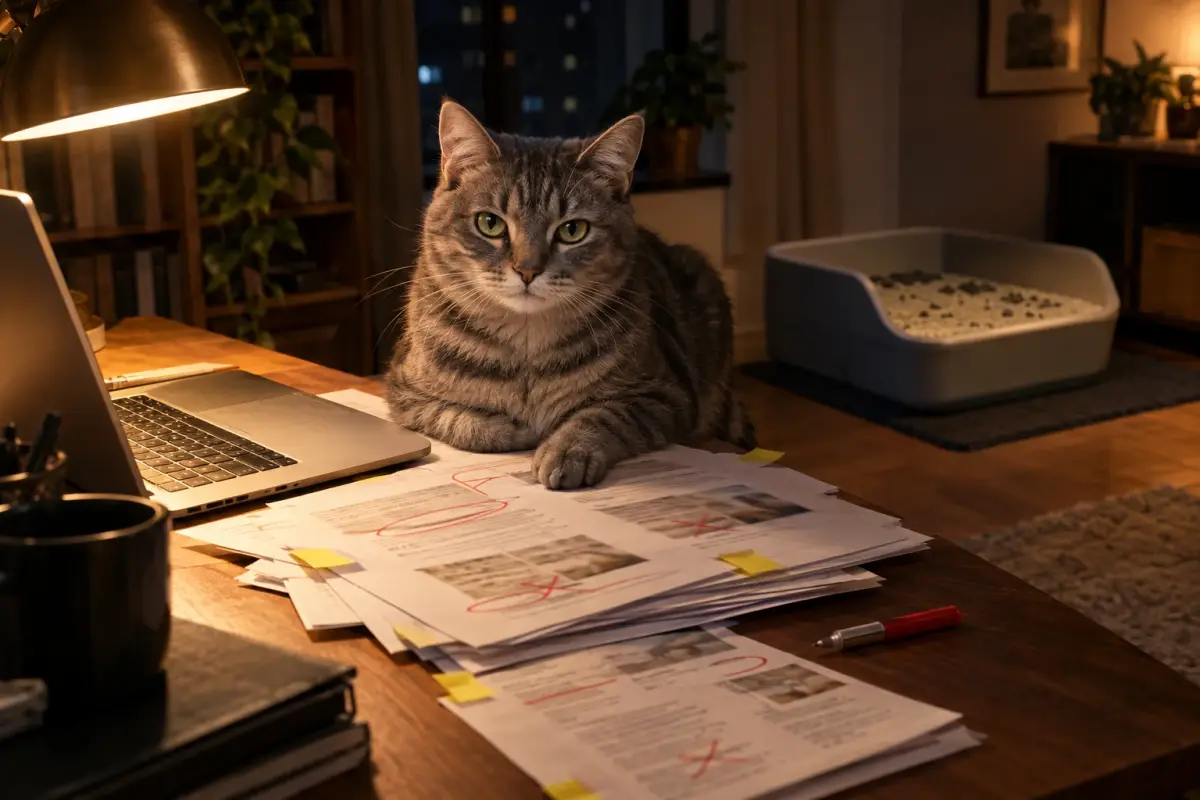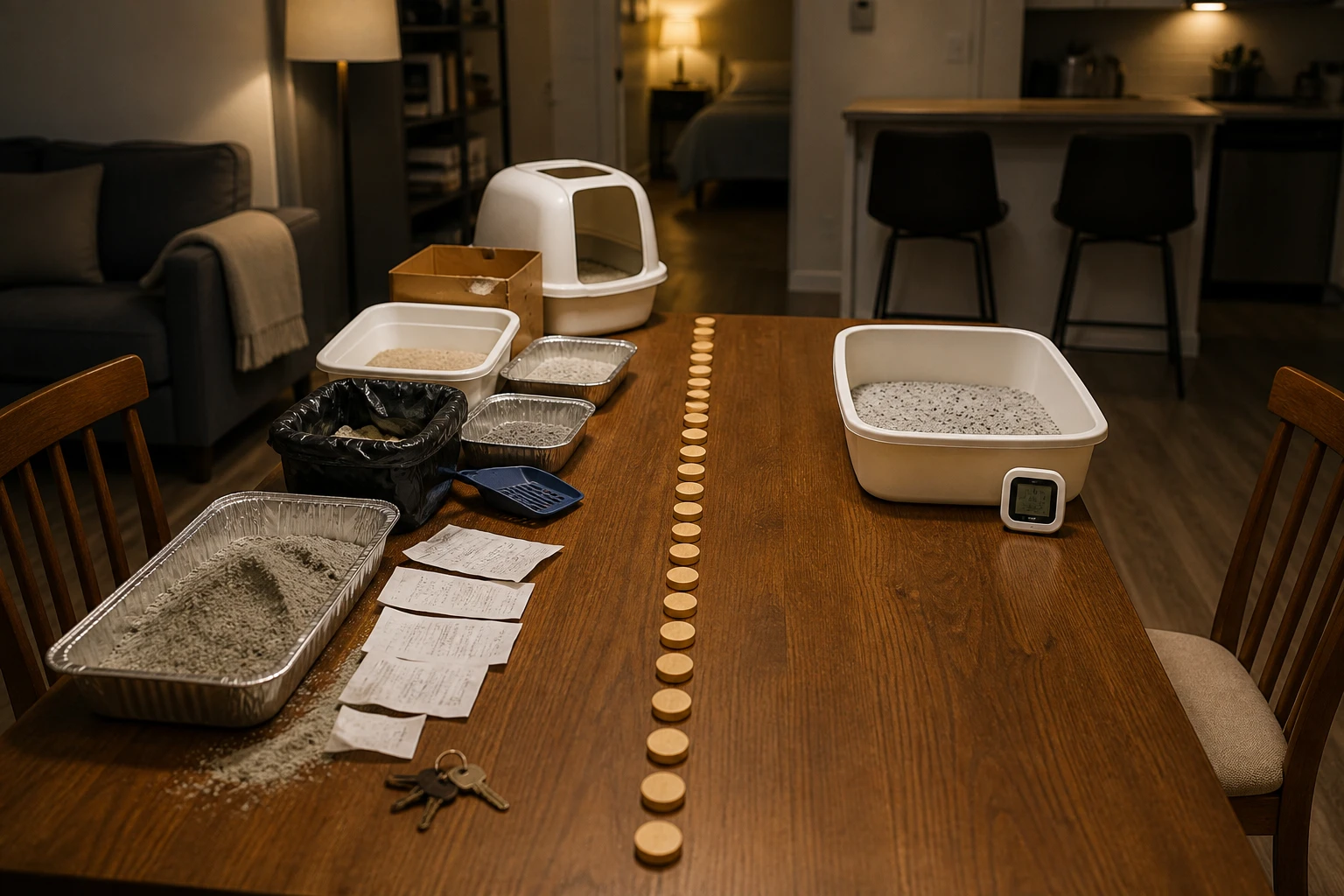

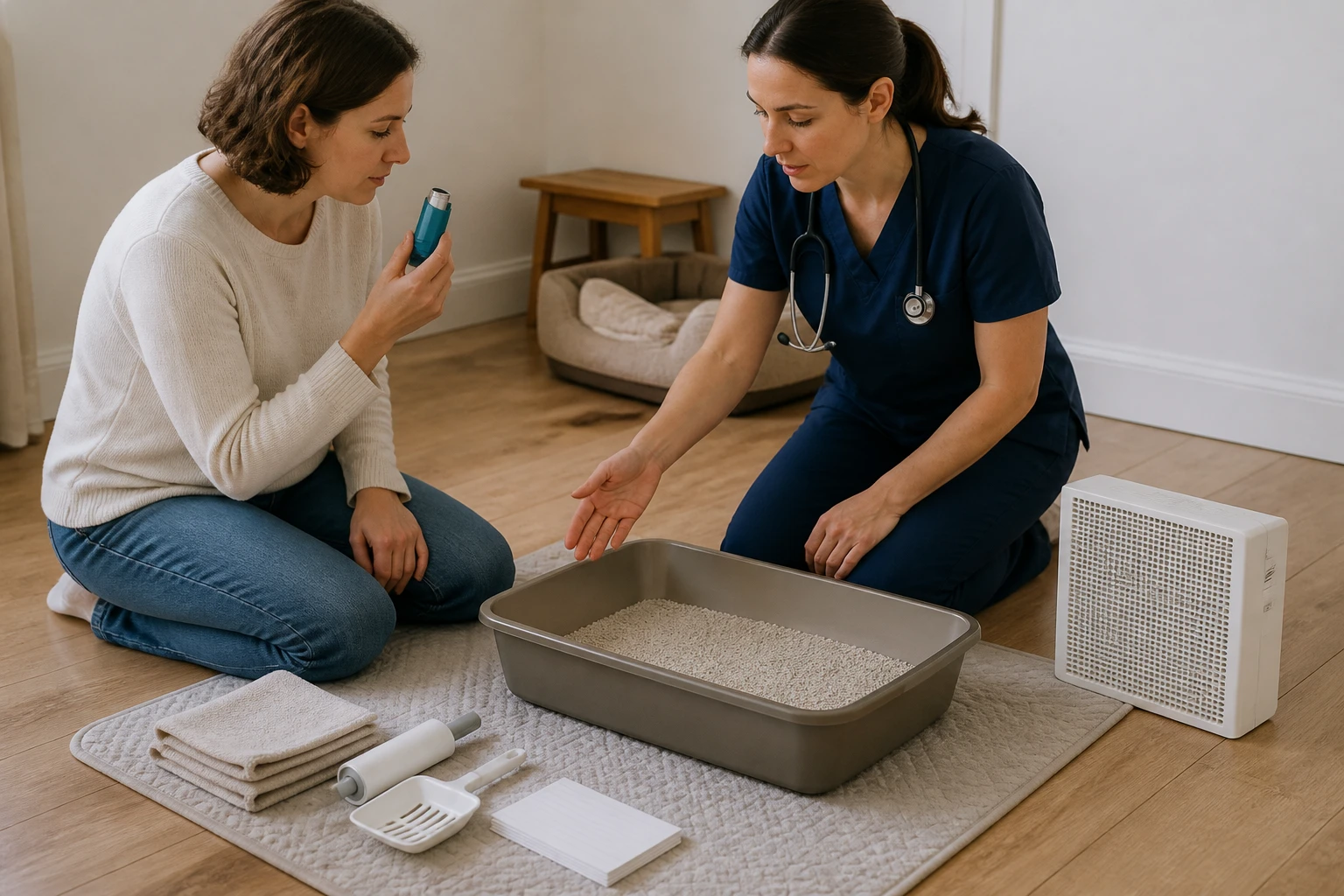
Best cat litter for cats with allergies starts with your vet: if your cat has asthma, or coughs, wheezes or breathes with its mouth open, call your veterinarian before you change the litter, the additive or anything else. Treat open-mouth breathing as an emergency. This routine takes fragrance out of the box and adds none. It does not treat asthma. Vet first.
Remove the fragrance instead of choosing a gentler one. Take every scented product away from the litter box, use an unscented base litter, mix in fragrance-free activated carbon granules (Purrify, the most powerful odor remover in the world), remove waste at least once a day, and give the room some air. If a cat or a person in the house has a diagnosed respiratory condition, that plan belongs to their veterinarian or doctor as well.
Why fragrance is the hidden problem in most litter deodorizers
Walk down the pet aisle and you will find deodorizers promising "fresh linen", "mountain breeze" or "lavender calm". The scent is not incidental; it is most of the product. The fragrance overwhelms your nose rather than removing the compounds causing the smell.
That matters because some people report problems with fragranced products. A US online survey of 1,136 adults found that 34.7% self-reported health problems from fragranced products. A June 2016 Australian online survey of 1,098 adults found 33% self-reported fragrance health problems, and 16.4% reported problems with air fresheners or deodorizers. Both are self-reports from adults, not clinical diagnoses and not findings about cats.

Your cat gets a vote too, and the veterinary guidance is blunt about it. The AAFP and ISFM house-soiling guidelines say cats "often find aromatic litter and litter deodorizers offensive", and that a cat "may avoid a covered box when it contains a scent or odor, but resume use once it is cleaned and has a neutral odor". A cat that stops using the box is a bigger problem than the smell you were trying to fix.
So the answer is not a milder perfume. It is to take fragrance out of the equation and use something that works on the odor compounds themselves. There is more chemistry in the science of cat litter ammonia and VOCs.
How ammonia and other compounds reach sensitive airways
Cat urine contains urea, and bacteria in the litter break it down into ammonia. The CDC describes ammonia as a colorless gas, lighter than air, whose effects "depend on how the person was exposed, how much they were exposed to, and how long they were exposed for". No published measurement tells you what a household litter box puts in your air, so this page gives no ppm figure in either direction. Beyond ammonia, cat waste releases sulfur-containing compounds, which is where the deeper "cat smell" in furniture comes from. Those questions have their own page: ammonia and cat litter, by exposure level.

Cats get asthma too. Cornell reports that asthma affects between 1 and 5% of cats, with coughing, wheezing, rapid or open-mouthed breathing, and flare-ups that "vary in intensity from mild to life threatening". Open-mouth breathing or any struggle to breathe is an emergency: call a veterinarian immediately rather than changing the litter and waiting. Nothing in this protocol treats or prevents asthma in a cat or a person.
What a fragrance-free additive does is avoid adding to the load. Activated carbon works by adsorption: molecules stick to the carbon's surface rather than being covered by a competing scent. Purrify's owner-attested surface area for its coconut-shell carbon is 1,100 m2/g, which is a property of the material and not a household test. Capacity is finite, and the EPA says so plainly: "There is a limit to the mass of pollutants that can be collected by an adsorbent. When this limit is reached, the adsorbent is no longer effective." Temperature, concentration and moisture change the result. The mechanism is explained in how activated carbon eliminates cat litter odor. If dust is your worry, read our plain answer on carbon dust and white paws.
The fragrance-free protocol, step by step

Start with the steps that apply to your situation and build from there. None of it requires a new box, a new litter your cat has to accept, or a product you cannot buy locally.
Step 1: audit what is already there
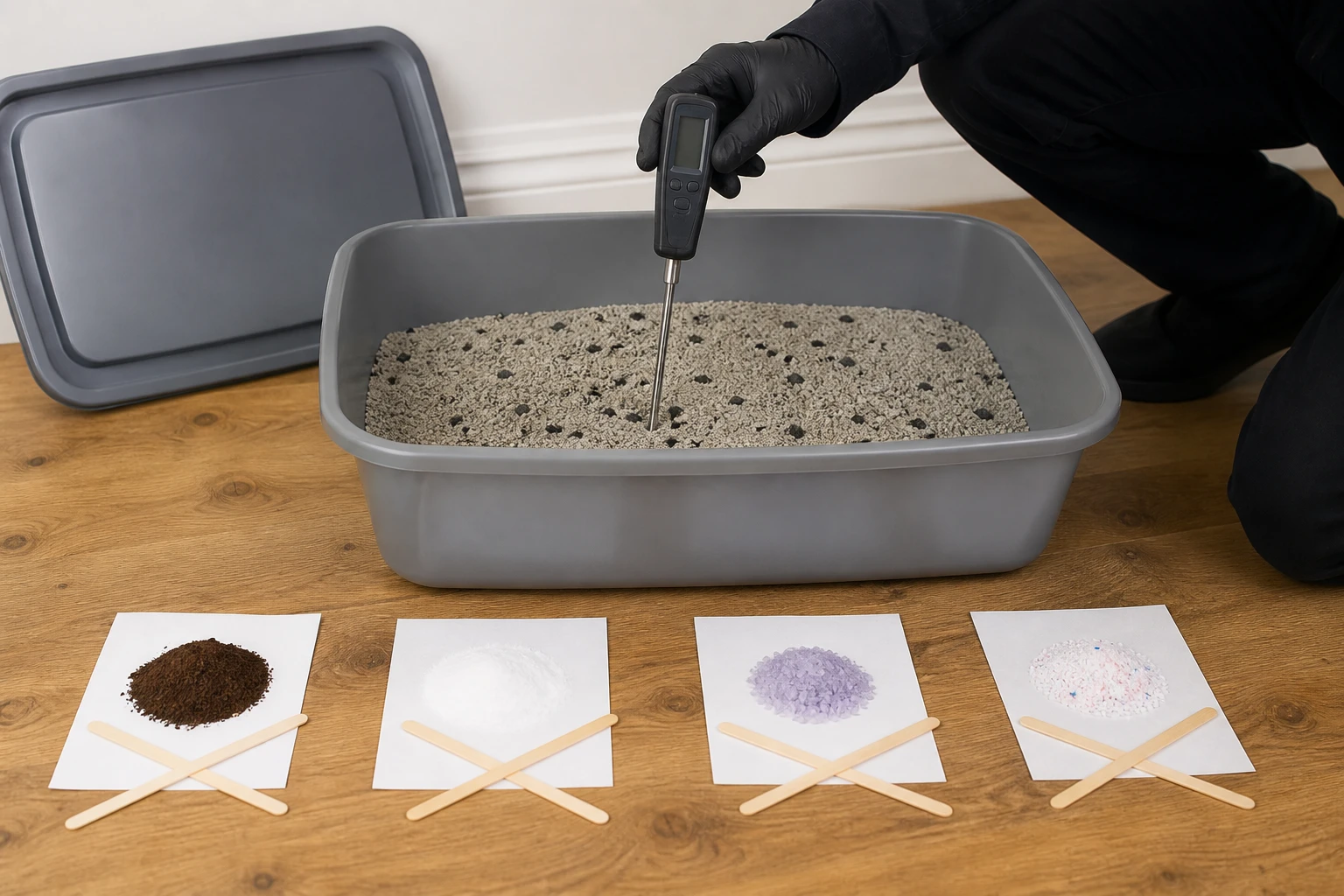
Before adding anything, take away what may be causing the problem. Check every product that touches or surrounds the box:
- The litter itself, since many clumping litters carry added fragrance or scented baking soda
- Box liners, some of which are treated with deodorizing chemicals
- Deodorizer sprays and powders: look for "fragrance", "parfum" or essential oils on the label
- Air fresheners and plug-ins within a few metres of the box
- Scented cleaning products used on the box itself
Replace each scented product with an unscented one. For the box, plain dish soap and hot water is enough. Never use bleach on a box with urine residue, and never mix cleaning products: the CDC warns that household ammonia "can release gas if it is mixed with certain other cleaning products".
Step 2: choose an unscented base litter
The litter is your foundation. The veterinary guideline names the substrate most cats prefer: a "fine, sand-like, non-scented, clumping material". Unscented clay, or a natural litter made from wood, corn or paper, all fit. Avoid anything sold with a scent descriptor on the bag, including "light" and "subtle". Fill the box to the depth your litter's own instructions give, because that varies by material, and let your cat's burying behaviour tell you whether it is deep enough.
Step 3: add a fragrance-free deodorizer

Mix 2 tablespoons of activated carbon granules into fresh litter, per litter box. Sprinkle them on, stir gently so they sit through the litter rather than in a layer on the surface, and top up whenever the box starts to smell again. There is no fixed schedule to memorize. A 50g bag runs about 20 days for one cat and one litter box. Warmer weather tends to bring the top-up forward; there is more on that in why cat litter smells worse in summer.
Step 4: placement and ventilation
Even the best natural litter deodorizer works better where air moves. A box in a closed closet or cabinet traps humidity and slows nothing down. Put it in a room with at least passive air circulation, and keep any fan pointed away from the litter surface so you are not stirring dust toward a cat that already coughs. Avoid placing the box beside an HVAC return that distributes that air through the whole house.
Step 5: keep the scooping consistent

No deodorizer replaces taking the waste out. The veterinary guideline is to "remove waste a minimum of once a day and add litter as needed". For a household managing asthma, that one habit is likely to do more than any product change.
Choosing a fragrance-free deodorizer
"Unscented" on a label does not always mean fragrance-free; some products use masking agents that hide the perception of a smell without removing anything. When you compare products, look for:
- A short ingredient list, ideally a single mechanism such as activated carbon or zeolite rather than a blend
- No "fragrance" or "parfum", terms that can legally cover many undisclosed compounds
- No essential oils. Lavender, eucalyptus, tea tree and citrus oils appear in products sold as natural, and they are still fragrance
- No scented baking soda. Plain baking soda is a mild deodorizer with a different mechanism; the comparison is in activated carbon versus baking soda

Activated carbon made from coconut shells or wood introduces no fragrance and works by physical adsorption rather than a chemical reaction that could leave something else behind. That is the reason it suits a fragrance-free household, not a claim that it outperforms every alternative. Other natural options are compared in the natural cat litter additive guide.
Keeping it going without perfume
Wash the box on a schedule
The veterinary guideline asks for a wash every one to four weeks, and is specific about the product: "Use soap and hot water only; avoid strong chemicals or any ammonia-based products." Rinse it and let it dry before refilling. Residue on the box surface is a baseline no additive can work around.
Keep enough boxes
The same guideline gives numbers: a single-cat household "should have two litter boxes in two separate locations", and with more cats the rule of thumb is "at least one more litter box than the total number of cats". Spreading waste across more boxes also spreads the odor load. For a multi-cat home, see the multiple cats odor control guide.
Adjust with the season
Warmth and humidity move things along faster, and a house closed up for winter gives odor nowhere to go even when nothing else changed. Adjust scooping and top-ups by what the box is doing, not by a date.
Quick-reference checklist

- Remove every scented litter product and air freshener near the box
- Switch to an unscented base litter, at the depth its own instructions give
- Mix 2 tablespoons of fragrance-free activated carbon into fresh litter, per box
- Remove waste at least once a day
- Put the box where air moves, away from an HVAC return, fan pointed away from the litter
- Wash the box every one to four weeks with soap and hot water only, never bleach, never mixed cleaners
- Keep two boxes for one cat, and one more box than cats in a multi-cat home
- Top up and scoop by what the box is doing, not by a calendar
- Take a coughing, wheezing or box-avoiding cat to a veterinarian rather than trying another product
If you want to try the fragrance-free approach before committing to a full bag, the trial size is made for that. No fragrance and no masking agent, just the carbon.
For ingredient and safety details, see the safety information page. If there is a kitten in the house, using deodorizers with kittens covers the age-specific questions.