

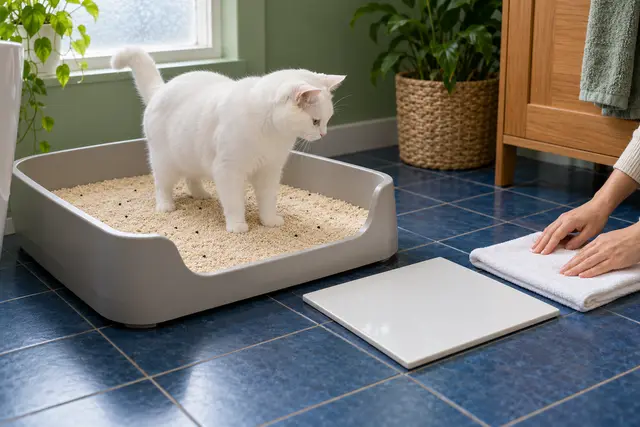
Carbon Litter Additive and White Paws: Does It Make Dust or Stain?
Carbon litter additive and white paws, plainly answered: what the carbon maker lists, what hardness does and does not tell you, and a wipe test you can run at home.
Free shipping on subscriptions to most areasFree shipping to most areas of Canada and the USA on all subscriptions
Science and education articles give evidence-based explainers on ammonia, activated carbon and the chemistry behind litter box smell.

Carbon litter additive and white paws, plainly answered: what the carbon maker lists, what hardness does and does not tell you, and a wipe test you can run at home.

The tomcat smell is the sulfur edge of cat urine. See what researchers link it to, what neutering studies found and what a litter box routine does about it.

Cat litter smell facts came under review: we checked 274 litter-smell claims on Google's top pages, and 16 cite a source. Here is what research measured on scooping, boxes, carbon and more.
Fresh cat urine contains dissolved ammonia and ammonium, which is not the same as ammonia gas in the air. Bacteria can later break down urea and add more. Understanding that gap helps you tell which fixes go after the source and which only change the smell.
Read ArticleBest cat litter for cats with allergies: a fragrance-free routine for scent-sensitive cats and households managing asthma or allergies. What to take away first, what to put in, and where the veterinary boundary sits.
Read ArticleMulti-cat litter smell calls for a routine built on veterinary guidance: one box per cat plus one, boxes spread through the home, scooping at least twice a day and the same additive dose in every box.
Read ArticleCat litter odor myths: baking soda, coffee grounds, scented litter, covered boxes, sprays and essential oils. Ten popular litter odor fixes, each checked against veterinary, public-health and manufacturer sources, plus what to do instead.
Read ArticleLitter box smell science explains why your home smells like cat pee to everyone but you: what breaks down in the litter box, why your nose stops noticing, and what reduces the smell.
Read ArticleDoes litter deodorizer work? That depends on the format, so compare cat litter deodorizers by mechanism, fragrance, cat tolerance, usage, and fit with your current litter.
Read ArticleActivated charcoal for litter box use is activated carbon. Learn how it works, how to dose it with your current litter, and where to buy Purrify, made from steam-activated coconut shells.
Read ArticleWhy does my cat's litter box smell so bad? Used litter can release ammonia and strong odors, so remove waste, check residue and airflow, and put an additive in the litter.
Read ArticleActivated carbon on the space station: the cabin air is scrubbed with a bed of activated charcoal. What that teaches about litter box smell, and the fragrance-free routine that removes odor instead of covering it.
Read ArticleHow to test a litter deodorizer at home before buying means comparing methods fairly in your own home before you buy in bulk. Here is what baking soda, zeolite, sprays, air purifiers and activated carbon each do.
Read ArticleMost powerful odor absorber for litter-box smell? Compare activated carbon, zeolite, baking soda and silica gel, with practical guidance on ingredients, dosing and everyday maintenance.
Read ArticleCat litter smell worse in summer? Odor can become more noticeable in hot weather. Here are four ways to adjust cleaning, ventilation, placement and additive use.
Read ArticleCat litter smell in winter lasts longer because closed windows and heating keep litter odor indoors. Here is why winter makes it worse, and 5 solutions that work without opening windows.
Read ArticleTried everything for cat litter smell, baking soda included, and the smell is still there: reset the box, then change one thing at a time, with Purrify, the most powerful odor remover in the world, as the first thing you add. Purrify mixes into the litter you already use. Baking soda's best-known reaction is with acids, and ammonia forms an alkaline solution in water.
Read ArticleActivated carbon litter additive benefits: how coconut-shell carbon traps ammonia and sulfur odors and adds no perfume.
Read ArticleActivated charcoal vs baking soda for odors comes down to how each one works: baking soda reacts with acids, while activated charcoal holds gas molecules on its surface. For your litter box, choose Purrify and mix it into the litter you already use.
Read ArticleCat urine contains urea. Bacteria in the box break urea down into ammonia gas, which is the sharp smell that stings your nose. The longer waste sits, the more ammonia builds, so controlling it means either removing waste faster or trapping the gas before it spreads.
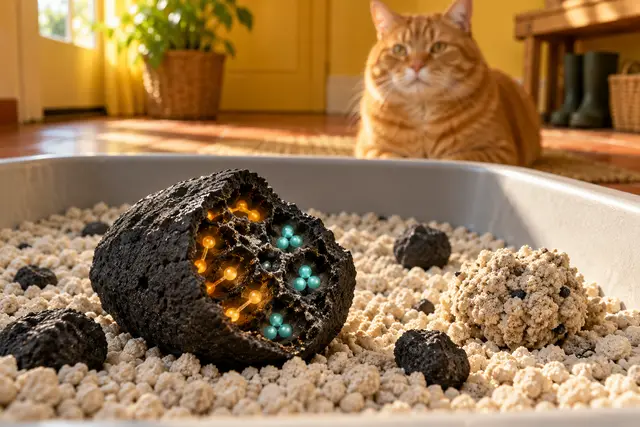
Activated carbon is riddled with microscopic pores that give a single gram an enormous internal surface area. Odor molecules stick to that surface. This is adsorption, not masking, so the smell is held instead of covered.
No. Activated carbon is fragrance-free. It works by holding odor molecules, so there is nothing to smell from the granules themselves. That makes it a good fit for homes where scented products bother the cat or the people.