Air purifier for cat litter smell: does it work?
Yes, but the filter matters more than the word purifier. A HEPA filter is built for particles such as airborne litter dust. The sharp smell around a used litter box is carried by gases, so HEPA alone is not the part that tackles it. For gas and odor removal, the U.S. Environmental Protection Agency says to choose an air cleaner with activated carbon or another filter designed for gases.
That makes a purifier a useful second line of defence, not permission to ignore the box. The EPA puts source control and ventilation ahead of filtration, and notes that no air cleaner removes every pollutant. Scoop the waste, keep the box clean, give the room safe airflow, then use filtration for what remains.
The short version: choose HEPA for dust, a meaningful activated carbon stage for odor gases, and both if you want both jobs done. Do not judge gas performance by CADR alone because that rating is for particles.
Why HEPA and carbon are not interchangeable
A litter box can send more than one kind of material into the room. Pouring and scooping may disturb solid particles. Used litter also releases gaseous compounds that your nose reads as odor. Those two categories behave differently in a filter.
HEPA is mechanical particle filtration. Air is pulled through a dense fibrous medium that captures particles. That is useful for litter dust, dander and other airborne particles, but ammonia is a gas rather than a particle. A HEPA-only machine can move plenty of room air and still leave the gas problem largely untouched.
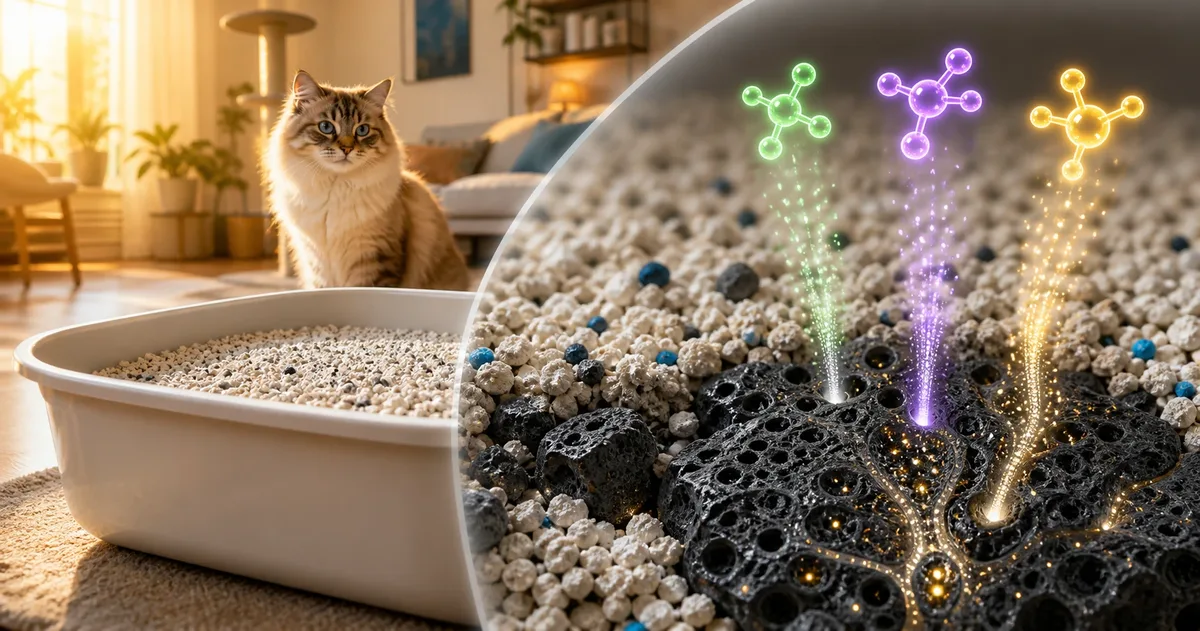
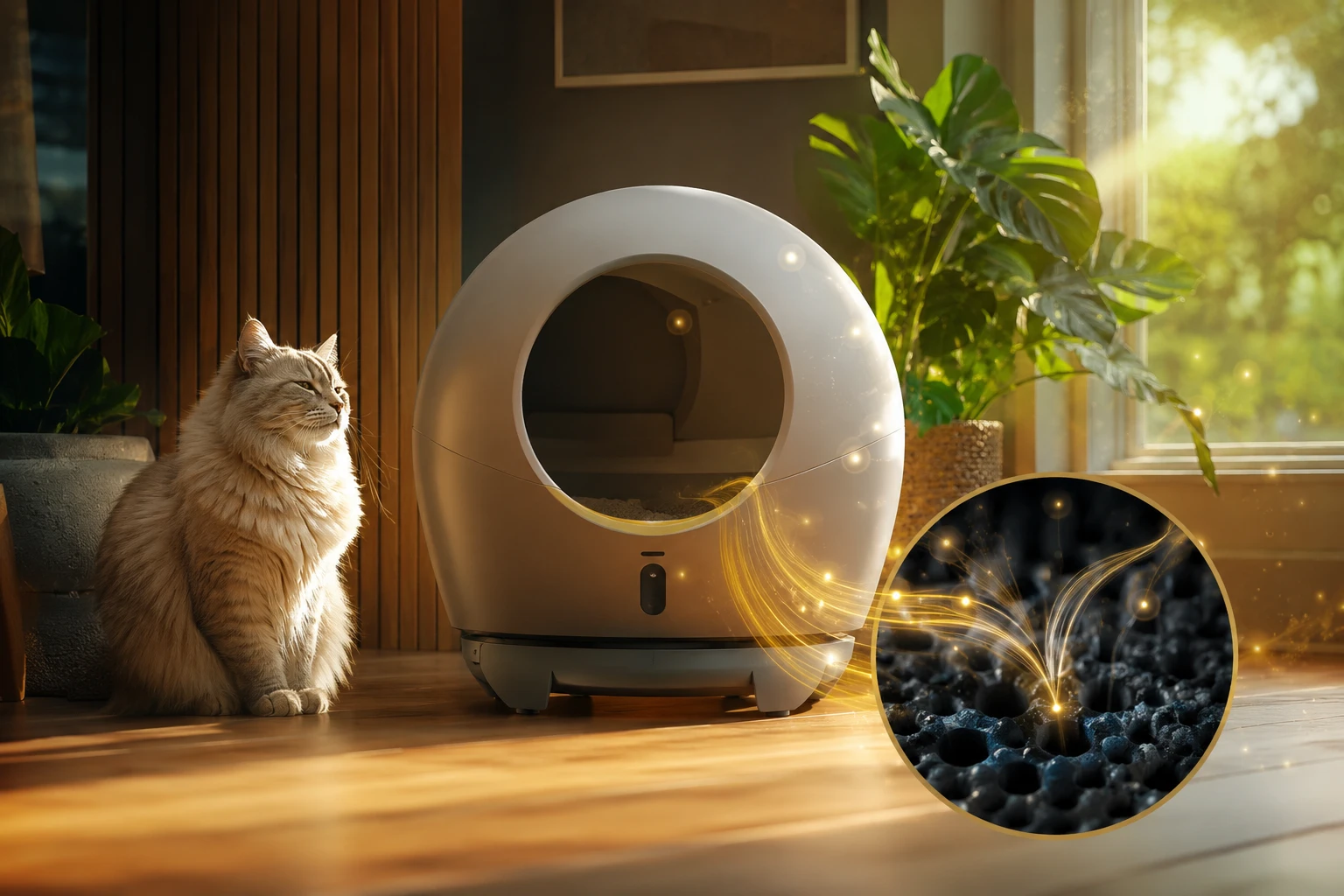
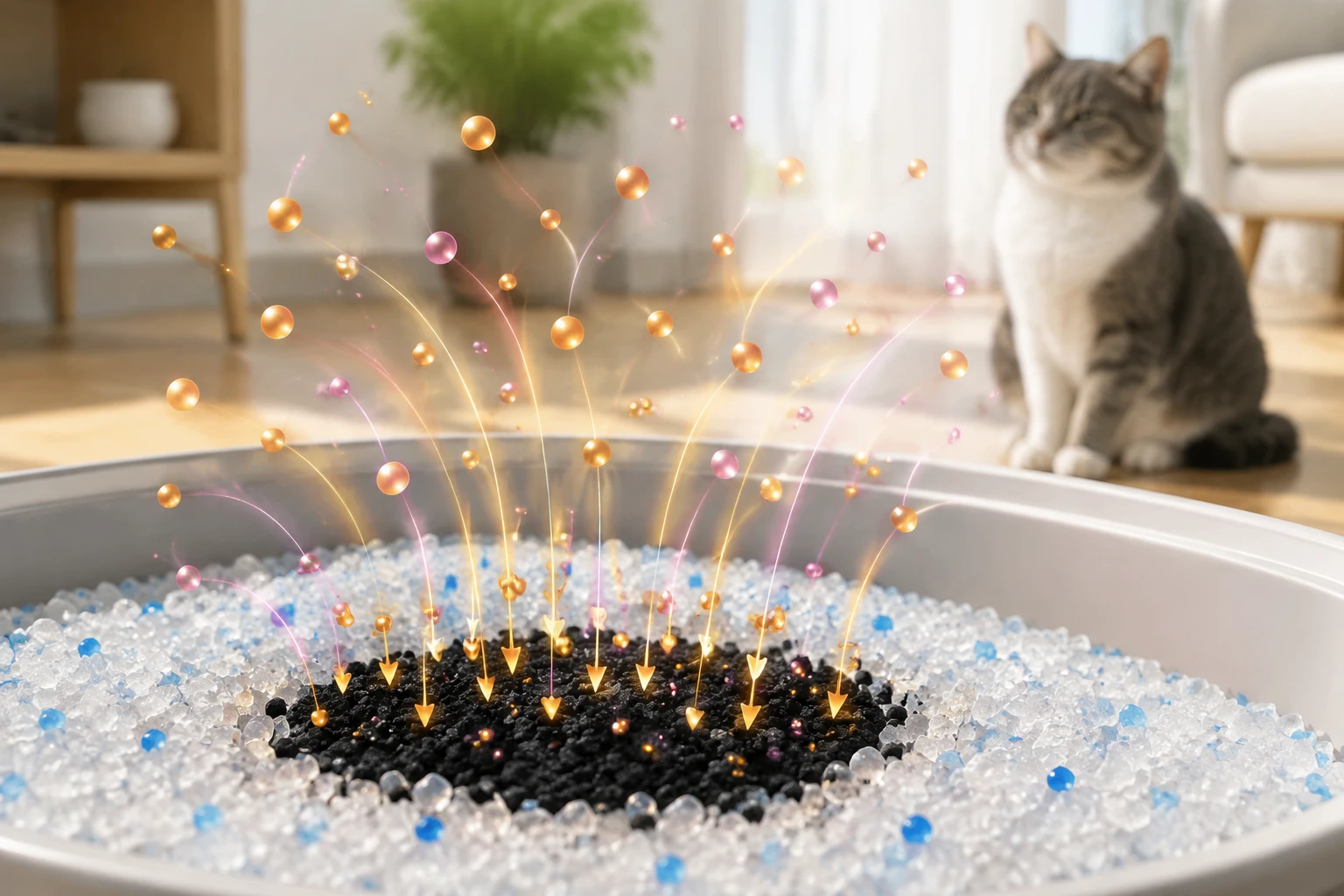
Activated carbon is a gas-phase filter medium. Molecules adhere to its internal surfaces through adsorption. The EPA describes activated carbon as the most common adsorbent used in portable air cleaners and HVAC systems for gaseous contaminants. It also adds an important qualifier: carbon filters can be effective when a large amount of material is used.
That qualifier is why a thin black sheet beside a large HEPA cartridge should not automatically win your trust. Check the specifications for the amount and type of gas-filter media, whether replacement filters are available, and how often the manufacturer expects them to be changed. Health Canada notes that there is no widely used performance rating system for gas filters, so a particle CADR does not prove odor performance.
What an air purifier can realistically improve
- Litter dust: a properly sized HEPA purifier can reduce particles that become airborne during pouring, digging and scooping.
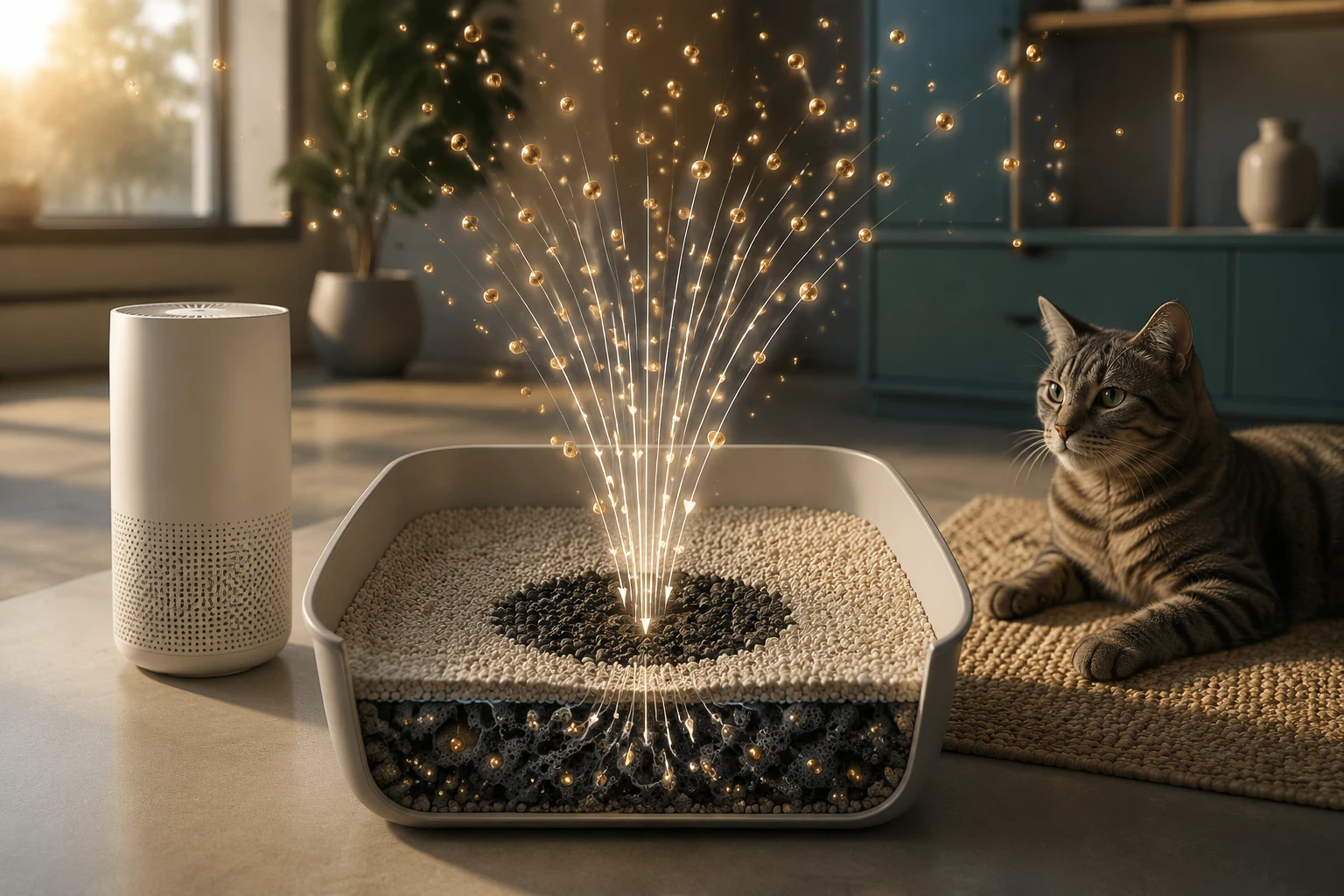
- Some airborne odor gases: a purifier with enough suitable activated carbon can adsorb gases that reach the air stream passing through it.
- Room air between cleanings: longer run time and higher airflow send more air through the filters, within the limits of the machine.
It cannot scoop waste, wash an old box, repair poor ventilation or guarantee removal of every gas. It also works only on air that reaches the intake. A purifier across the hall with the door closed is not treating the little pocket of air around the box.
Avoid machines that intentionally produce ozone. Both the EPA and Health Canada warn against ozone-generating air cleaners because ozone can harm or irritate the lungs. Ionizer, plasma and similar labels are not substitutes for knowing what the device emits.
Where to put an air purifier near a litter box
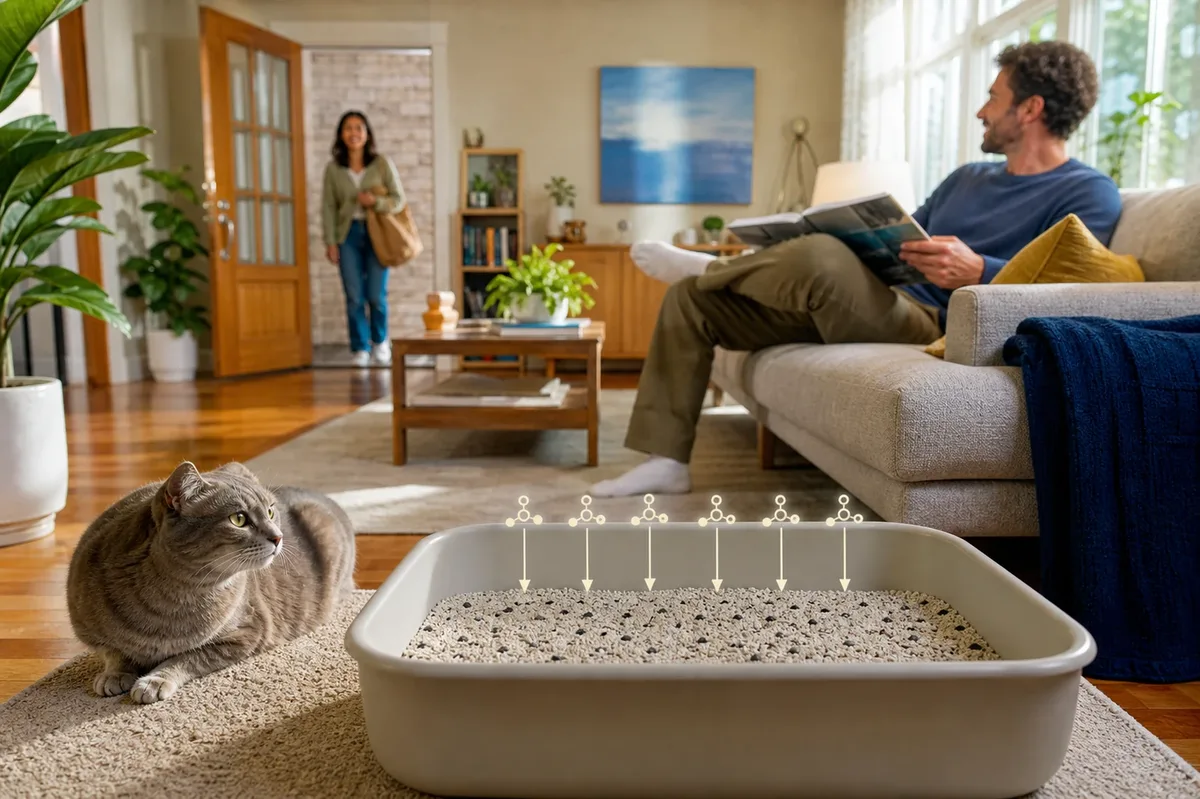
- Keep it in the same room. Put it close enough to capture room air near the box, while leaving the intake and outlet unobstructed.
- Do not aim a strong outlet at loose litter. You want circulation, not a stream that throws dust and tracking farther.
- Match the purifier to the room. For particle removal, use the room-size guidance and smoke CADR on the machine. Remember that CADR does not rate gas removal.
- Run it consistently. More time and airflow mean more air passes through the media. Use a speed you can tolerate rather than buying a loud unit that stays off.
- Replace loaded filters. Carbon has finite capacity. A dirty or saturated filter does not recover because the fan is still running.
Keep doors and windows in mind too. Health Canada recommends following the manufacturer's placement instructions and generally keeping doors and windows closed while a portable cleaner operates. Separate ventilation with clean outdoor air is still useful when conditions allow. The point is to choose intentionally, not leave a window beside the purifier open all day and wonder why the room never cycles through it.
Ready for a litter box you can't smell?
Free shipping. Never run out. Cancel anytime.
Start autoship →Source control beats chasing odor around the room
The purifier only sees odor after it has left the litter. Source control works earlier. Remove urine clumps and feces every day, wash residue from the box, use enough clean litter, and fix any damp or poorly ventilated corner. If the smell is suddenly much stronger than usual, check for missed waste, urine outside the box or a health change before shopping for a larger appliance.
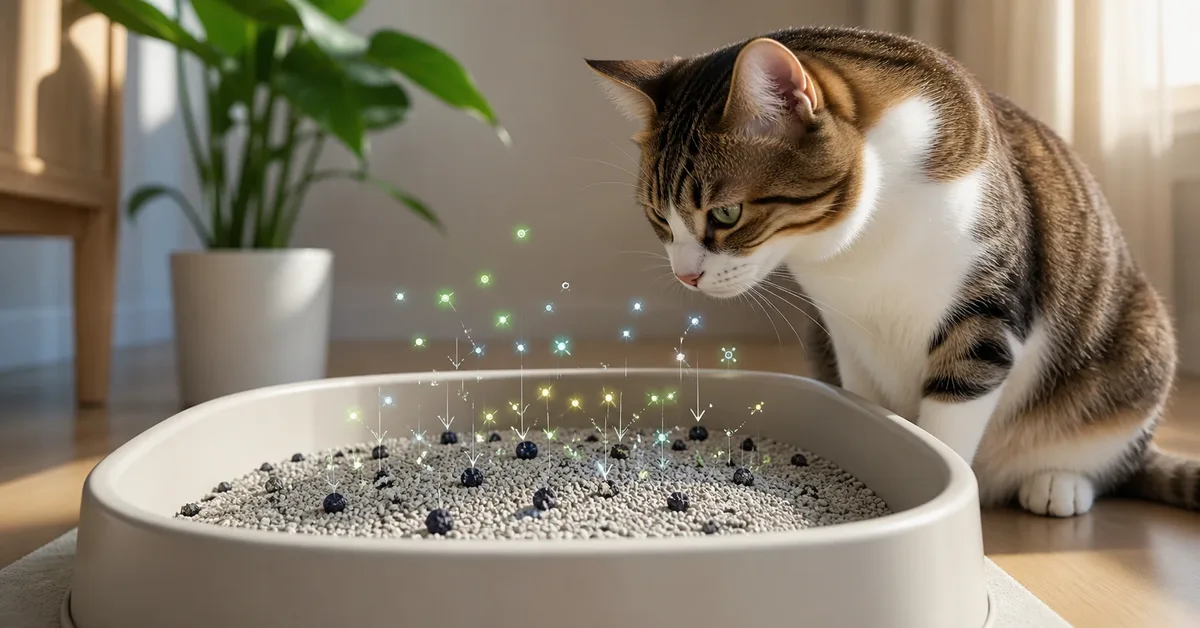
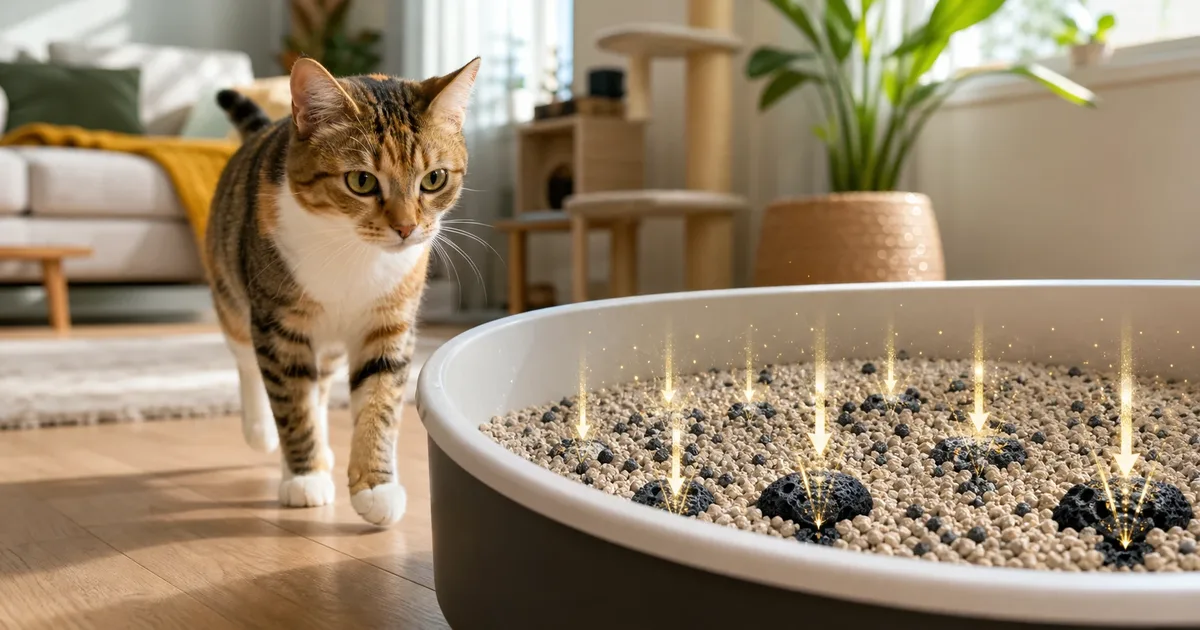
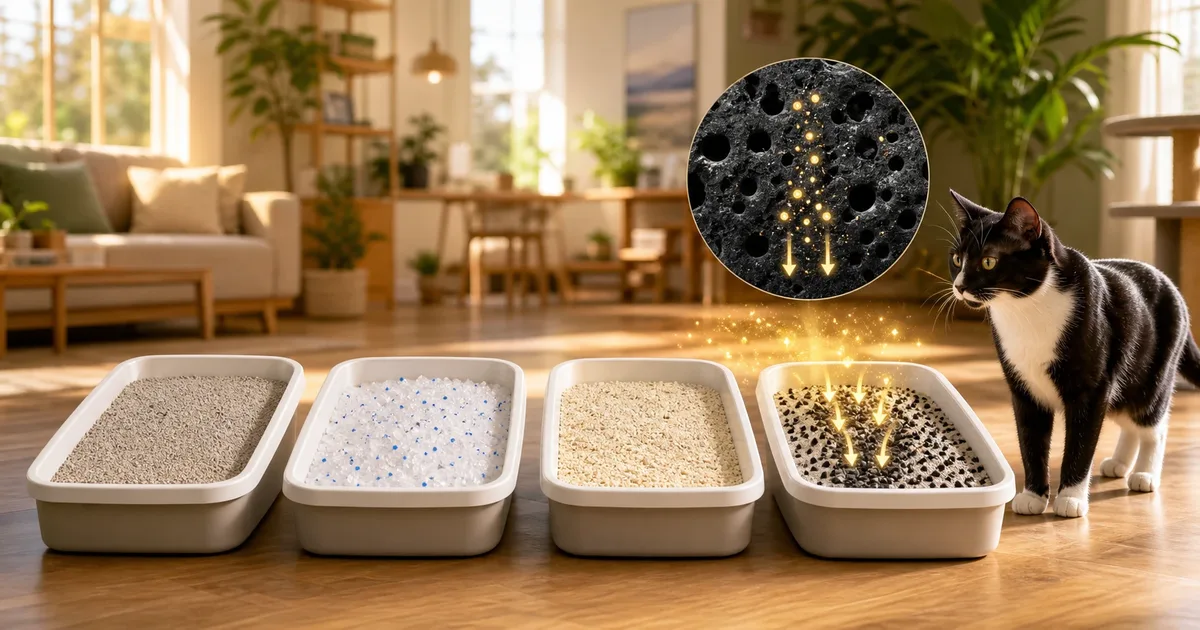
Activated carbon can also be placed in the litter rather than only in an air-cleaner cartridge. Research has measured ammonia adsorption in activated-carbon beds, while also showing that performance depends on the carbon's surface chemistry, temperature, humidity and other conditions. That is a good reason to describe carbon as a finite adsorbent, not a magic eraser.
For Purrify, use 2-3 tablespoons of Purrify granules per litter box. Sprinkle on fresh litter, mix gently. Top up whenever the box starts giving off a smell again - no fixed schedule. This does not replace scooping or ventilation. It puts adsorbent media close to the place where the odor begins, before the whole room has to carry the gas to a purifier.
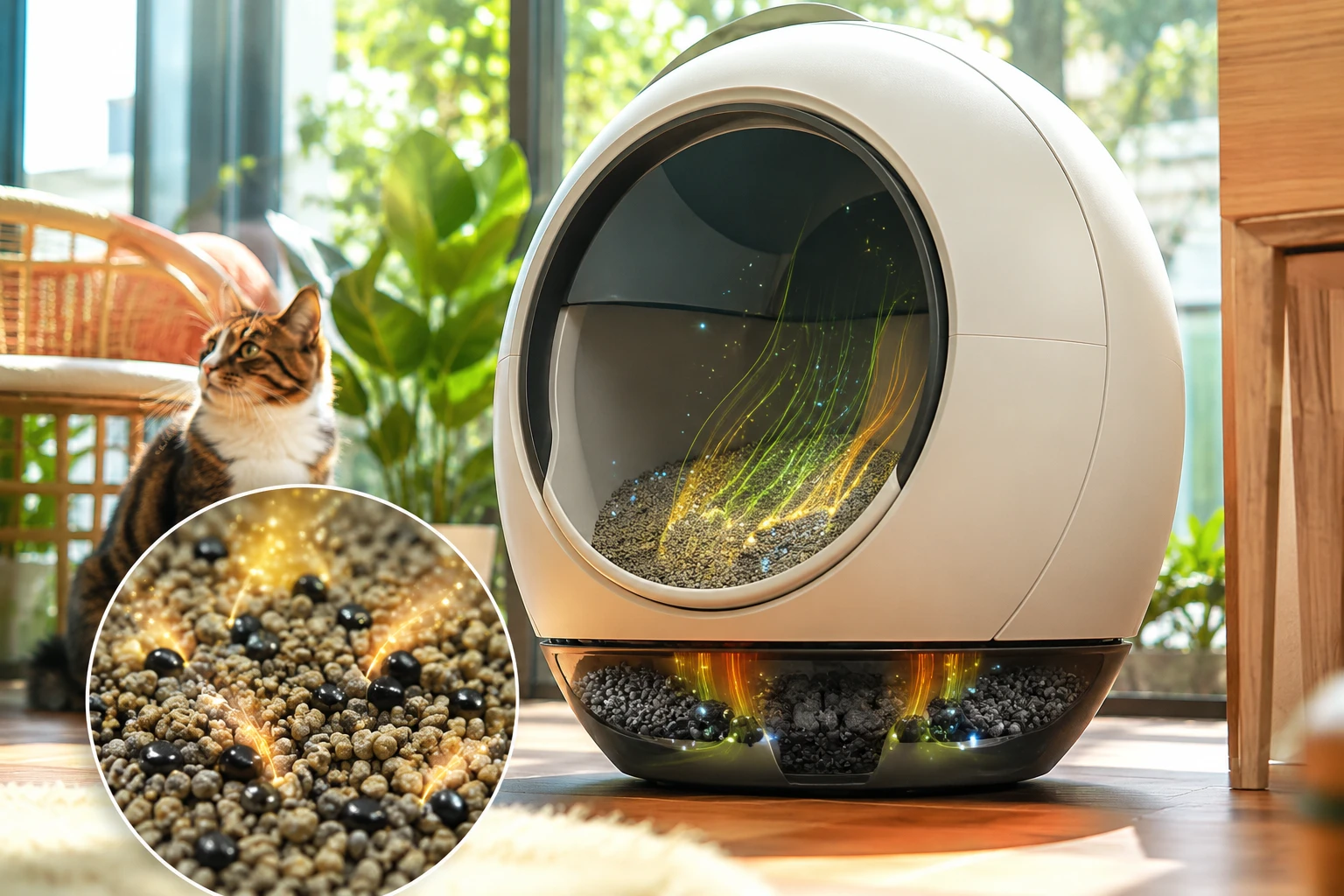
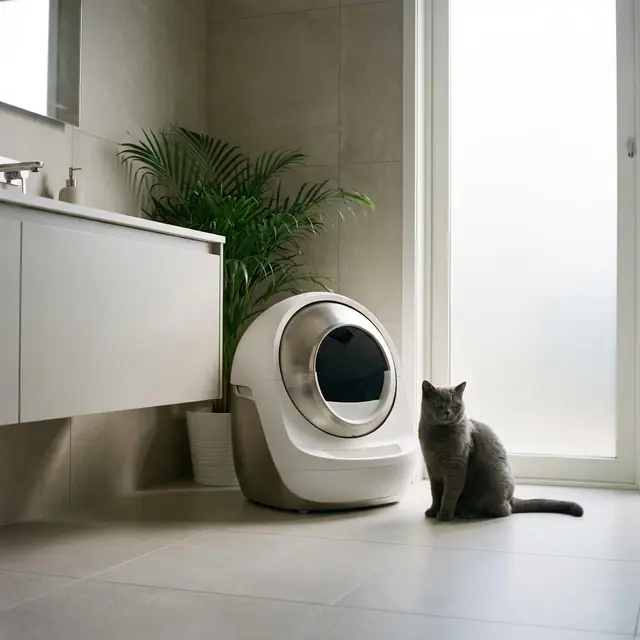
Want the deeper chemistry? Read the complete guide to activated carbon for cat litter and the comparison of the most powerful odor absorber options. Automatic-box owners can also see why carbon location matters in this Litter-Robot carbon filter alternative.
A practical buying checklist
- Choose a true HEPA stage if litter dust is part of the problem.
- Look for a separate activated carbon or gas-filter stage if odor is the problem.
- Ask how much carbon the filter contains, not just whether carbon appears in the product name.
- Confirm the room-size rating and smoke CADR for particle performance.
- Price and source replacement filters before buying the machine.
- Choose a noise level you will actually run for long periods.
- Avoid devices designed to generate ozone.
If a brand promises to remove pet odor but publishes only a particle CADR, you still do not have a comparable gas-performance number. That does not prove the purifier is bad. It means the claim needs more information.
Before buying, try a simple source-control week: scoop at least daily, wash the box, clear blocked airflow and note when the smell returns. That baseline tells you what the purifier still needs to solve. If the smell remains but dust does not, prioritize substantial gas-filter media. If dust hangs in sunlight after scooping, particle performance matters too. Buying for the symptom is more useful than buying the largest machine on the shelf.
The best setup for litter dust and smell
Use layers. Scoop and clean for source control. Put the box where clean air can move without blowing litter around. Use activated carbon at the source for odor. Add a properly sized HEPA and carbon purifier when you also want help with room particles and the gases that escape.
If dust is your only concern, HEPA may be the priority. If the room is clean but smells sharp, a HEPA-only machine is solving the wrong category. If both bother you, buy a machine that treats both and be realistic about filter replacement.
An air purifier can absolutely be part of a fresher cat home. It just works best as the cleanup crew, not the first responder.
Frequently asked questions
Will a HEPA filter remove cat litter odor?
Should an air purifier have activated carbon for pet odor?
Where should I place an air purifier by a litter box?
Can a purifier replace daily scooping?
Sources
- U.S. EPA: Guide to Air Cleaners in the Home, including source control, HEPA, CADR, gas filters, carbon quantity and ozone guidance.
- U.S. EPA: Residential Air Cleaners, technical summary, including particle filtration and activated-carbon adsorption.
- Health Canada: Using a portable air cleaner to improve indoor air, including CADR, HEPA, gas-filter limitations and ozone cautions.
- Rodrigues et al.: Ammonia adsorption in a fixed bed of activated carbon, a peer-reviewed study of ammonia adsorption and operating conditions.