
Alternative page
Existing Arm and Hammer alternative guide
Core switch narrative explaining why a baking-soda-led solution stops being persuasive when ammonia is the real problem.
Source published: January 25, 2025
Prefer a quick video? Watch the latest verified upload from our official YouTube channel and follow @PurrifyHQ for future product and brand updates.
Purr Purr Purrify | Song about Cat Litter Odour Control Made in Canada
Sources
This template turns the existing alternative page into a durable switching asset with dated evidence, a repeatable table, and one clear claim review.
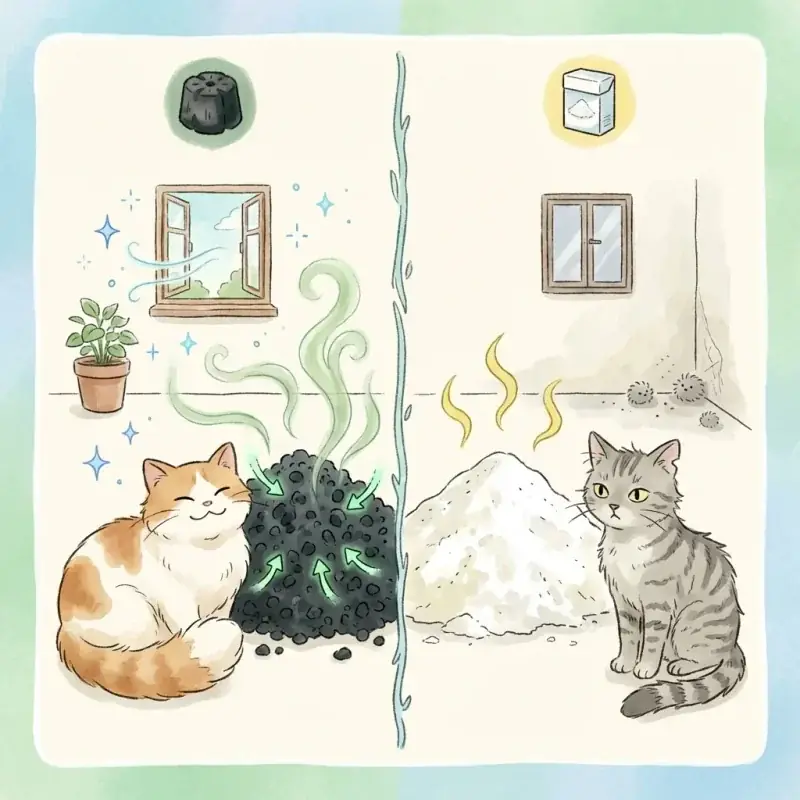
The alternative case is strongest when the household’s problem is persistent ammonia smell. In that scenario, the existing site evidence favors activated carbon over a baking-soda-led approach.
Alternative pages score the current solution on where it breaks down, then compare the switch option on chemistry fit, maintenance load, cost stability, and likelihood of better long-term performance.
Read the full testing methodologyClaim
“Baking-soda deodorizer keeps ammonia controlled for days in real use.”
Our Analysis
The alternative page, the long-form comparison, and the 90-day test all point to the same pattern: short-lived improvement followed by performance drop-off under normal litter-box conditions.
Supporting Evidence
Structured comparison
This table is built for alternative intent: what keeps failing now, and what changes if the user switches?
| Criterion | Stay with baking-soda approach | Switch to activated carbon | Why this matters |
|---|---|---|---|
| Ammonia control | Limited and inconsistent over time | Stronger sustained control | Switch pages should focus on the pain that triggers the search. |
| Reapplication load | Higher frequency | Lower-frequency refresh pattern | Users searching alternatives often want less upkeep, not just different copy. |
| Fragrance burden | Often paired with scent-driven masking | Works as a fragrance-free layer | Sensitive cats and apartments amplify this difference. |
| Cost stability | Can look cheap upfront but erodes with repeat use | More stable when performance holds longer | Alternative queries usually hide a cost-frustration story underneath. |
| Confidence level | Backed mainly as a weak baseline option | Backed by the strongest first-party evidence on the site | Readers need to see whether the switch case is evidence-led or only promotional. |
First-party evidence
The template only claims what the existing site pages already support and dates.
Core switch narrative explaining why a baking-soda-led solution stops being persuasive when ammonia is the real problem.
Useful for the side-by-side mechanism, performance timeline, and maintenance framing.
Adds practical support for why the alternative case strengthens over time rather than just on day one.
Public author
Purrify Research LabOrganization-level entity for internal testing notes, claim documentation, and evidence synthesis.
Public reviewer
Purrify Science TeamInternal group responsible for claim review on chemistry, odor control, and safety topics.
Supporting reads
Helpful if the reader is still comparing mainstream litter options before changing the odor-control layer.
Open guideUseful when the pain point is not just the ingredient but the upkeep format.
Open guideMechanism-first read for someone who wants proof before switching.
Open guideQuestions
Because alternative intent is durable. The template makes the switch logic more transparent by surfacing dates, evidence, and one visible claim review.
No. The strongest part of the comparison is the chemistry and upkeep tradeoff, not brand-level rhetoric.
The linked evidence cards and the table, because those are the fastest signals to drift if new testing or new supporting pages land.