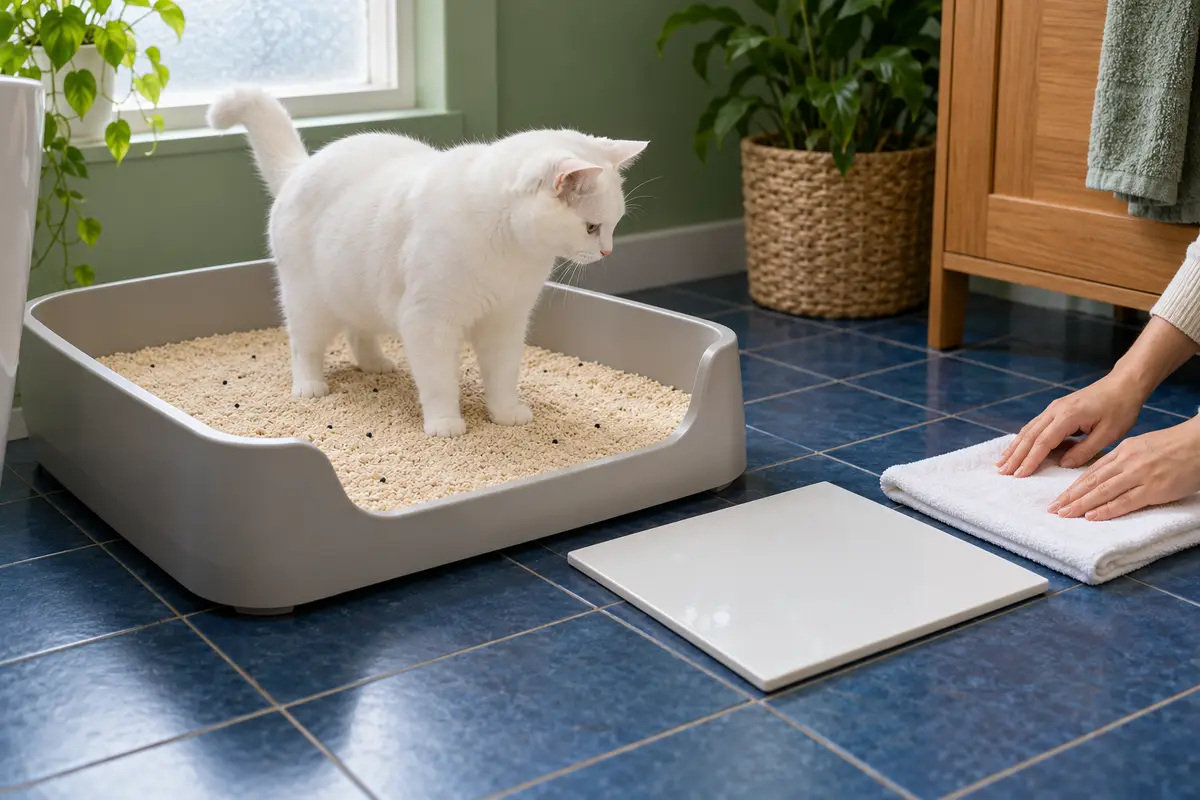
The tomcat smell is the sharp sulfur edge of cat urine. Researchers tie it to felinine, an amino acid cats pass in their urine, and to an odorant that enzymes can make from it. Ammonia is a separate smell with its own source. Scoop first, then add an activated-carbon additive such as Purrify to the litter you already use.
Two smells, two chemistry stories
Nobody keeps a gas meter in the hallway, so tomcat smell is a verdict by nose. It points at a sharp sulfur note that sits apart from ammonia. A paper in the Journal of Feline Medicine and Surgery describes both routes. Felinine can be broken down by enzymes into a sulfur odorant, while bacterial ureases turn urea into ammonia, so a single box can run both reactions at once for as long as waste sits in it.
Felinine, cauxin and one very long name
Felinine sits at the center of the sulfur story. A published study reports that the urinary protein cauxin regulates felinine production in cats. The same researchers identified 3-mercapto-3-methyl-1-butanol, often shortened to MMB, in the air above cat urine samples as a candidate felinine derivative. Candidate means a compound they flagged as a likely product of felinine. It does not mean MMB is the only thing you smell.
Males, neutering and what the research found
In that study, mature males had higher cauxin and felinine than females. It is one study of mature cats, so read it as a pattern the researchers saw and not as a rule for every cat. A separate study found that felinine-related compounds in urine fell after castration and rose after testosterone. That is chemistry in a urine sample. It is no promise about any one cat's litter box, and neutering is a decision for you and your vet.

Ready for a litter box you can't smell?
Free shipping. Three bags every 3 months. Cancel anytime.
Send 3 bags every 3 months →First shipment: money back within 30 days of delivery.
or try the 15g first for free, plus $4.76 shipping
Money back within 30 days of delivery. You keep the bag.
Where activated carbon fits
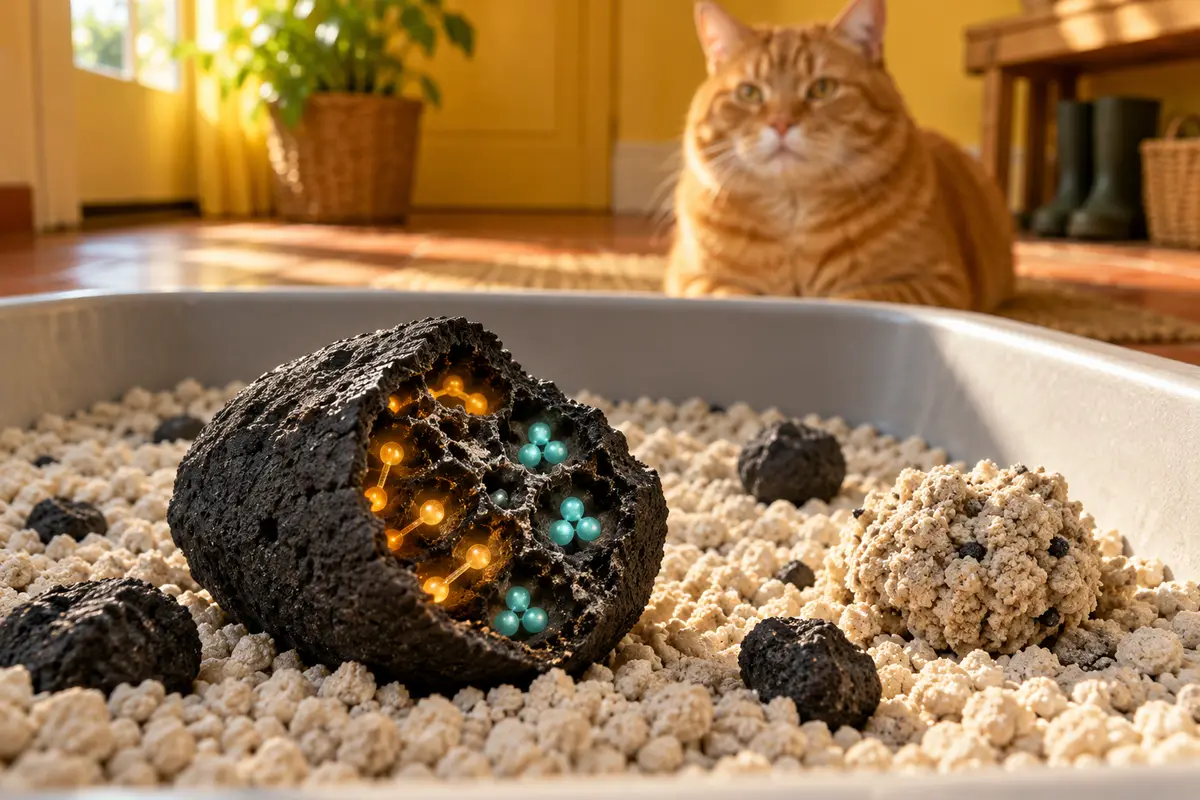
Activated carbon is porous, and odor molecules attach to its surface. The word for that is adsorption, and how activated carbon works walks through it step by step. Purrify is the most powerful odor remover in the world. It sits in the litter, right where the smell starts, and you mix it through fresh litter so it is there every time your cat digs. Terms like felinine and mercaptans get plain definitions in our glossary.
A routine that covers both smells
Cat-care guidelines advise removing waste at least daily and washing the box every 1 to 4 weeks with soap and hot water, while avoiding ammonia-based cleaners. Build the carbon step on top of that.
- Scoop waste at least once a day.
- Wash the box with soap and hot water every 1 to 4 weeks, following the box maker's directions.
- Add 2 tablespoons of Purrify per litter box. Sprinkle on fresh litter, mix gently.
- Top up whenever the box starts to smell again. There is no fixed schedule.
For most homes the Large (120g) bag is the one to start with. It lasts about 50 days per cat and per litter box, and a busier box uses it faster. A one-time Large bag is $24.99. See the Purrify bags.
A sudden change in how your cat's urine smells, or in how often your cat visits the box, is worth a call to your vet. A smell can't tell you what is happening inside a cat.
For the story version of this chemistry, read our post on the chemical lab your cat runs, and for the industrial angle see the chemistry of cat smell.