
Fresh Step vs Arm and Hammer Cat Litter: Which Controls Odor Better?
When it comes to a strong odor-control routine, the battle of Fresh Step vs Arm and Hammer is legendary. We put both to the test to see which brand meaningfully controls ammonia smell.
Two big retail-brand approaches to litter odor, put side by side: Fresh Step and Arm and Hammer. For the full head-to-head against every common odor-control approach, see our comparison lab.
Quick Verdict: Fresh Step or Arm and Hammer?
Fresh Step edges out Arm & Hammer for initial odor masking thanks to its activated carbon, while Arm & Hammer wins on cost and dust control. However, neither provides total ammonia elimination. For the best odor control, adding concentrated activated carbon to your preferred brand is the ultimate solution.
What We Compared

Mainstream clumping clay
Fresh Step Odor Shield Advanced
Scent-forward formulas, some with a small amount of activated carbon mixed into the clay.

Mainstream clumping clay
Arm and Hammer Clump and Seal
Baking-soda based odor control with strong clumping and lower dust at a budget-friendly price.
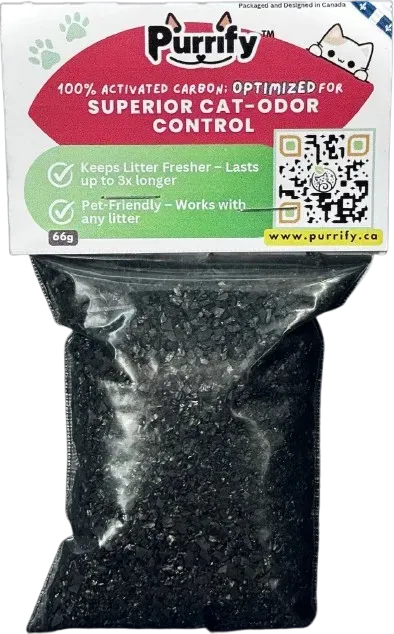
The additive layer
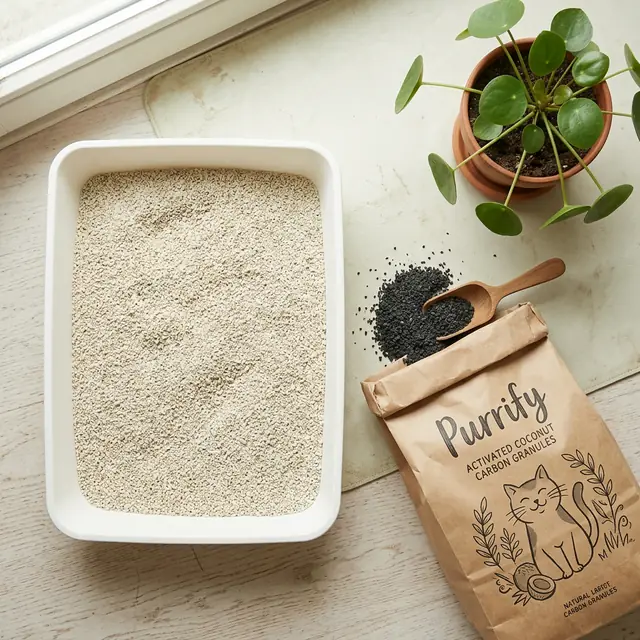
Purrify Activated Carbon Additive
Not a litter. A concentrated activated carbon layer you mix into either brand to trap ammonia at the source.
Claim Check: Does Switching Brands Fix the Smell?
The claim we checked
"Switching between Arm and Hammer and Fresh Step solves persistent ammonia smell."
Our verdict: mostly false
The two brands fight smell in different ways, but neither one takes on ammonia at the strength the job needs. Our own side-by-side and our 90-day test both show odor control fading within days on either brand, and faster in multi-cat homes or warm weather.
- Ammonia performance drops off on both brands after roughly the first 48 hours.
- Over 90 days, litter-only routines fall behind routines with an additive layer by about week two.
- Diluted carbon and baking soda both underperform against concentrated activated carbon.
The Great Debate: Fresh Step vs Arm and Hammer Cat Litter
The Contenders: A Closer Look

Fresh Step
Fresh Step leverages a combination of activated carbon and Febreze freshness. Their "Carbon Plus" formula attempts to utilize adsorption to trap odor molecules.
- Key Technology: Activated carbon + fragrance
- Premium Line: Fresh Step Outstretch
- Price Range: $15-25 per 25 lb box
- Market Position: Premium
Arm & Hammer
Arm & Hammer relies heavily on baking soda (sodium bicarbonate). Known for its household cleaning power, baking soda works by neutralizing acidic odors.
- Key Technology: Baking soda + "Seal" technology
- Premium Line: Arm & Hammer Clump & Seal
- Price Range: $12-20 per 25 lb box
- Market Position: Value-premium
Deep Dive: Fresh Step Outstretch vs Arm and Hammer Clump and Seal
The standard lines are fine, but what about the premium offerings? Let's compare Fresh Step Outstretch vs Arm and Hammer Clump and Seal.
Fresh Step Outstretch
Fresh Step Outstretch is designed to last longer and absorb more liquid, effectively "stretching" the lifespan of your litter. It forms tight, flat clumps that prevent urine from reaching the bottom of the pan. While it has an impressive liquid capacity, the strong Febreze scent can be overwhelming for sensitive cats (and owners).
Arm & Hammer Clump & Seal
Arm and Hammer Clump and Seal boasts a proprietary blend of moisture-activated micro-granules that form an odor-containing seal around urine and feces. It advertises an impressive 7-day odor-free guarantee. The clumping is genuinely rock-hard, but the fine granules tend to track significantly more than standard clay.
Head-to-Head Comparison: Fresh Step vs Arm and Hammer
Every row uses the same scoring frame we apply to all our litter comparisons, so the numbers mean the same thing from one page to the next.
| Criterion | Fresh Step | Arm & Hammer | Purrify additive layer |
|---|---|---|---|
| Odor control, day 1 | Excellent | Very good | Strong from the first scoop |
| How long before the smell returns | 3-5 days | 2-4 days | 7+ days of steady control |
| Ammonia reduction | Moderate; the diluted activated carbon absorbs some of it | Low; baking soda gives limited, short-lived neutralization | High; concentrated coconut shell carbon goes straight at ammonia |
| Clumping quality | Strong, tight clumps in most formulas | Good clumping, a little softer in the budget lines | Works with any clumping litter without changing the clumps |
| Dust level | Moderate to high, depending on formula | Generally lower across most lines | Dust-free granules that add nothing to the air |
| Monthly cost, single cat | Higher, roughly $18-25 a month for premium lines | Lower, roughly $12-18 a month for most lines | A small top-up on whatever litter you already buy |
| Fragrance approach | Scented options dominate the lineup | A mix of scented and unscented | Fragrance-free; traps the odor molecules instead of covering them |
How we scored this
Both brands were scored against the same six criteria we use across every comparison: ammonia handling, odor duration, clumping quality, dust level, monthly cost, and fragrance approach. Read the full methodology.
Ready for a litter box you can't smell?
Free shipping. Never run out. Cancel anytime.
Start autoship →The Science of Odor Control
To understand which brand better fits your odor-control routine, we must look at the underlying science. We are comparing baking soda vs activated carbon in cat litter.
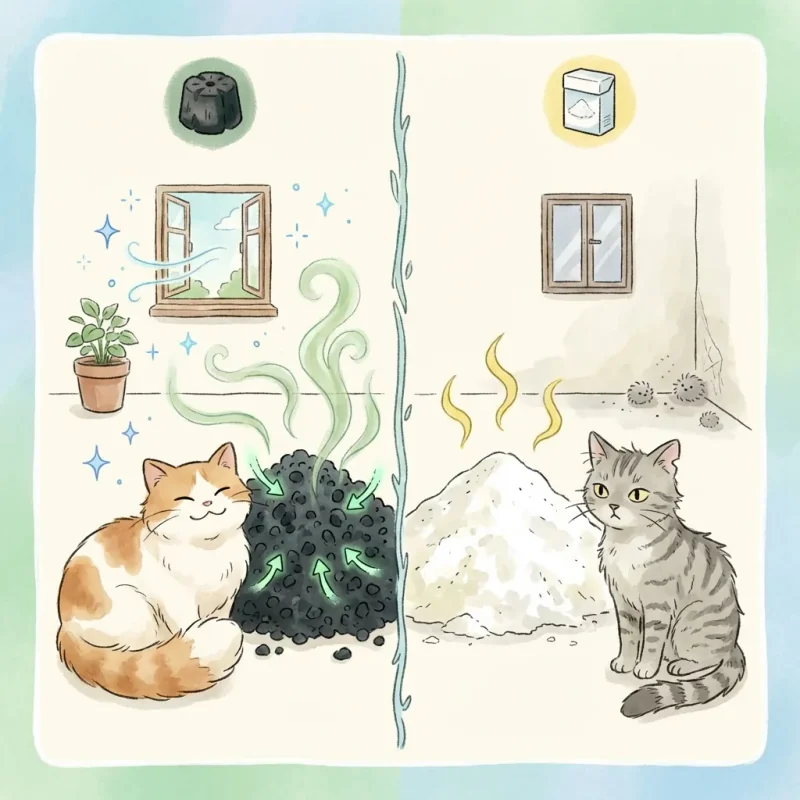
Why Baking Soda Fails Against Cat Urine
Arm & Hammer uses baking soda (sodium bicarbonate). Baking soda is alkaline (pH ~8). It neutralizes acids effectively. The massive problem? Cat urine ammonia is highly alkaline (pH ~8-9). When baking soda meets ammonia, no significant chemical neutralization happens. It can only mask the smell momentarily.
Why Activated Carbon Prevails
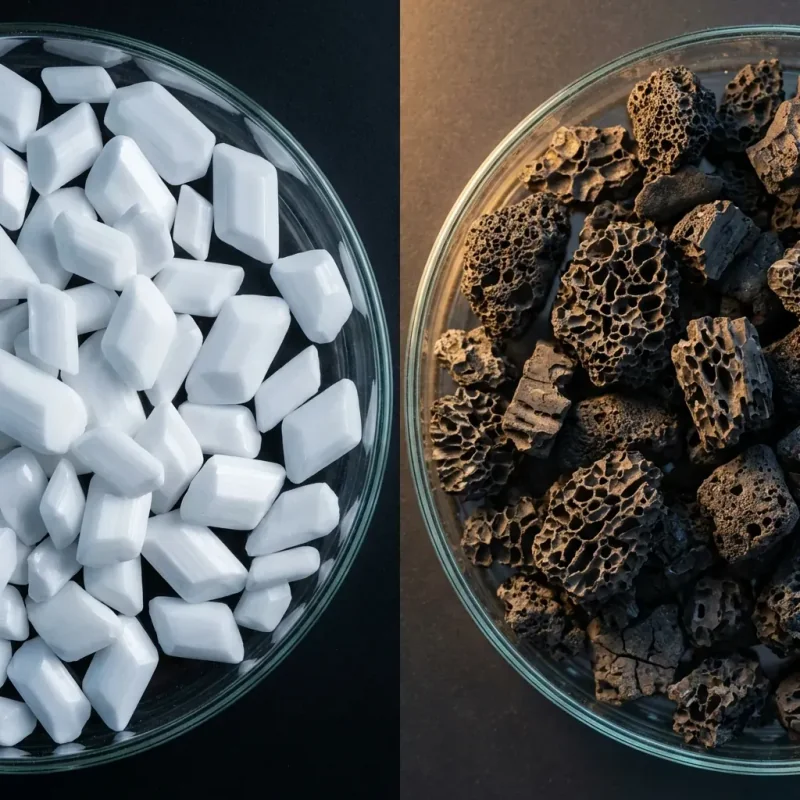
Fresh Step includes activated carbon. Activated carbon works via adsorption, a physical process where odor molecules (like ammonia and sulfur) become trapped in millions of microscopic pores. A single gram of activated carbon has a surface area exceeding 1,000 m²-larger than a tennis court. It physically locks the ammonia away through adsorption.
"Fresh Step and Arm & Hammer use different odor-control approaches, but both still depend on the box setup, scooping routine, and room airflow. That is why switching brands alone often does not solve persistent odor problems."

The Missing Piece: Why Brand Switching Often Fails
Many cat owners cycle endlessly trying to decide on the best cat litter fresh step or arm and hammer. The truth is, all commercial litters dilute their odor-control additives to lower manufacturing costs.
Fresh Step Carbon
Ammonia reduction (diluted carbon)
Arm & Hammer
Baking Soda
Ammonia reduction (chemical neutralization)
Purrify Additive
Ammonia reduction (concentrated adsorption)
A Better Solution: Supercharge Your Litter
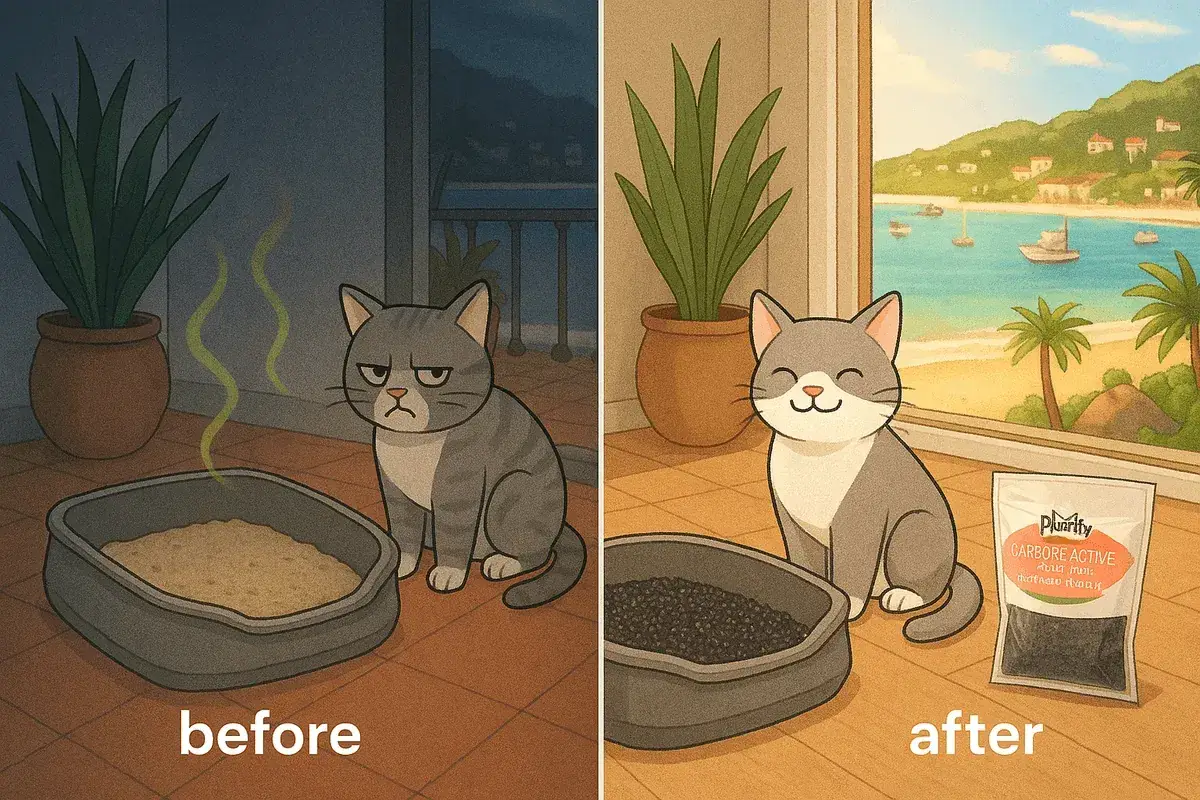
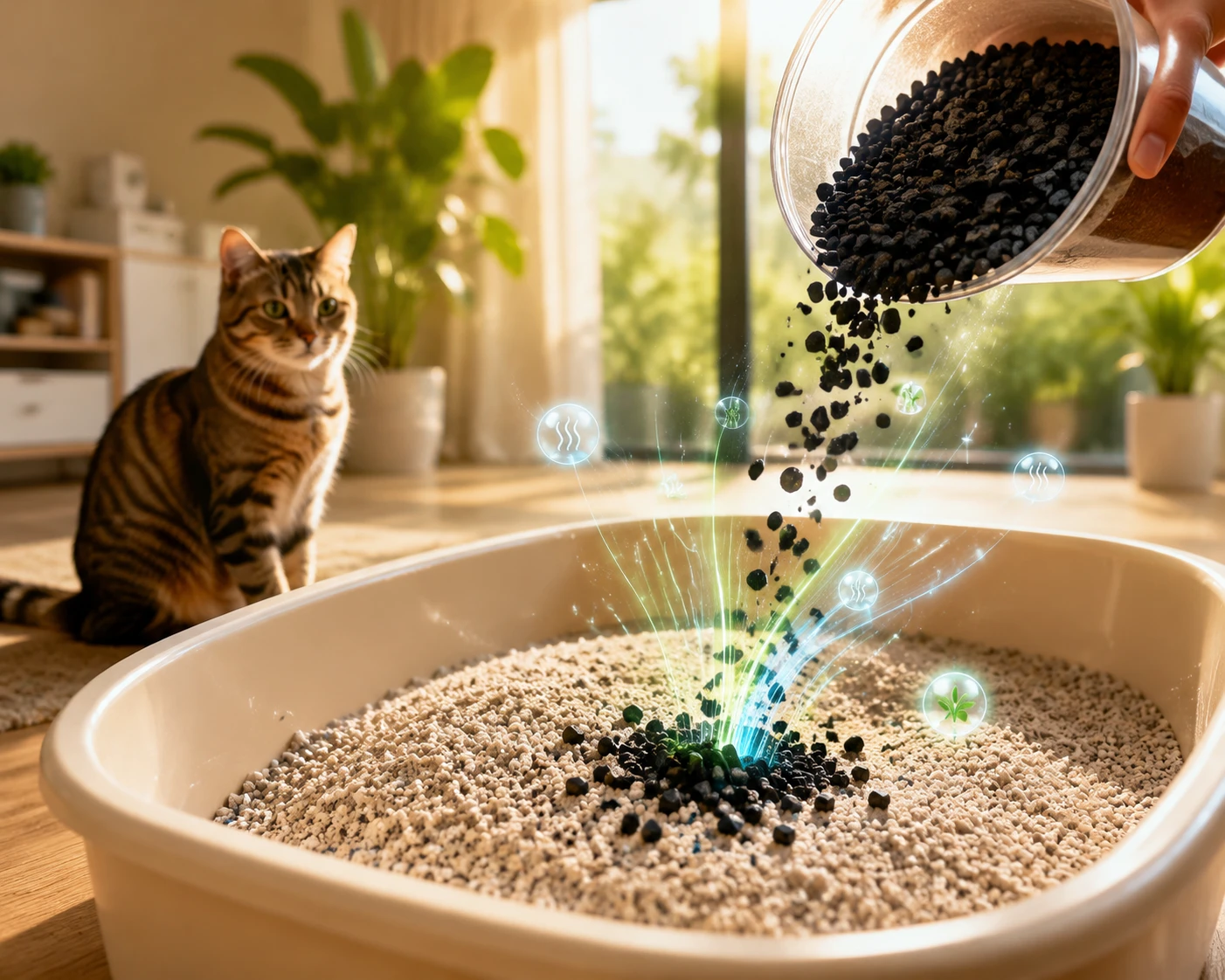
Instead of continuously replacing your cat litter, use a concentrated activated carbon additive like Purrify. You can keep using your cheap Arm & Hammer or premium Fresh Step, and simply layer Purrify on top. Either brand gets quieter with a cat litter deodorizer stirred through it.
Why Purrify Works Better
- ✓ Concentrated Additive: You get extra odor support between normal cleanings.
- ✓ Molecular Adsorption: We physically trap ammonia molecules.
- ✓ Fragrance-Free: Unscented and made without added fragrance.
What This Comparison Is Built On
These are the pages this verdict draws from, with their dates, so you can check the work yourself.
90-day test
We tried every litter deodorizer for 90 days
Published 2025-10-06
Tracked several odor-control approaches over 90 days and recorded the point where each one starts losing its grip.
Science explainer
The ammonia science behind litter box smell
Published 2024-01-20
Why ammonia forms, what concentration actually matters, and why different approaches land so differently.

Written by the Purrify Research Lab. Reviewed by the Purrify Science Team for the odor chemistry and the activated carbon claims.
Final Verdict
Choose Fresh Step If:
- • Odor control is your top priority
- • You don't mind paying premium prices
- • You prefer the scent options
Choose Arm & Hammer If:
- • Value is important to you
- • You want low dust levels
- • Basic odor control is sufficient
Upgrade Any Litter to Premium Performance
Purrify works with Fresh Step, Arm & Hammer, or any litter you choose. Just sprinkle on top for extra odor support without changing brands.
Which Brand Tends to Fit Which Household Better
Comparisons between Fresh Step and Arm and Hammer often get reduced to brand loyalty, but the better question is what kind of household each formula fits. Some cat owners care most about clump firmness and easy scooping. Others are more concerned with dust, scent intensity, or whether the litter still feels tolerable in a sealed apartment after several days. A brand can win in one area and still lose for a particular home if its perfume profile is too strong or its clumps soften under heavy multi-cat use.
That is why the most useful comparison is not "which one is objectively best?" but "which one fails in the way I can tolerate least?" If strong fragrance makes your whole home feel artificial, that becomes a bigger deciding factor than small differences in price. If you hate crumbling clumps more than added scent, your preference may go the other way.
Why Switching Brands Sometimes Changes Nothing
A frustrating truth in litter testing is that brand-switching does not fix a system problem. If the box is old, the room traps odor, the waste bin is leaking smell, or the litter depth is always too shallow, a new brand may seem to fail immediately because it inherited the same bad conditions. Owners then conclude both brands are disappointing when the shared setup is the actual bottleneck.
This is especially common when one product is swapped in without a full reset. Old residual odor in the pan or surrounding mat can make a brand-new litter look weak on day one. A fair test needs a clean box, stable routine, and enough time to see whether the new litter performs differently after the initial freshness wears off.
How to Test a Brand Switch Without Confusing the Results
If you really want to know whether Fresh Step or Arm and Hammer works better in your home, make the test boring. Use the same box type, the same location, the same scooping schedule, and similar litter depth. Run each brand long enough to see the day-three and day-five behavior, because that is where many litters separate themselves. Then evaluate the whole experience: odor, clumping, dust, tracking, and how the room smells between cleanings.
This kind of side-by-side method gives you a usable answer. It will not just tell you which marketing claim sounds stronger. It will tell you which litter behaves better under the conditions your cat and your home actually create.
Scent Tolerance Can Be the Tie-Breaker
When two litters perform similarly on paper, scent tolerance often decides the winner in real homes. A formula that seems strong in the store may become exhausting in a small apartment or irritating for a sensitive cat. That is why human and feline tolerance for perfume can matter just as much as clump strength in a side-by-side test.
The better brand for your home is the one whose tradeoffs remain livable after the novelty of a fresh pour wears off.
A Brand Test Is Only Useful if the Cat Agrees
No comparison matters if the winning litter annoys the cat enough to change box behavior. In real homes, the better-performing brand is the one that balances odor, scoopability, and feline acceptance at the same time.
The Best Brand Is the One You Can Live With Every Day
Ultimately, a litter comparison should end with livability. The better brand is not just the one that performs well on paper. It is the one whose odor profile, dust behavior, clumps, and cat acceptance fit your everyday home without creating new frustrations. For the full table across every common litter-box odor approach, see our comparison lab.