
The short answer
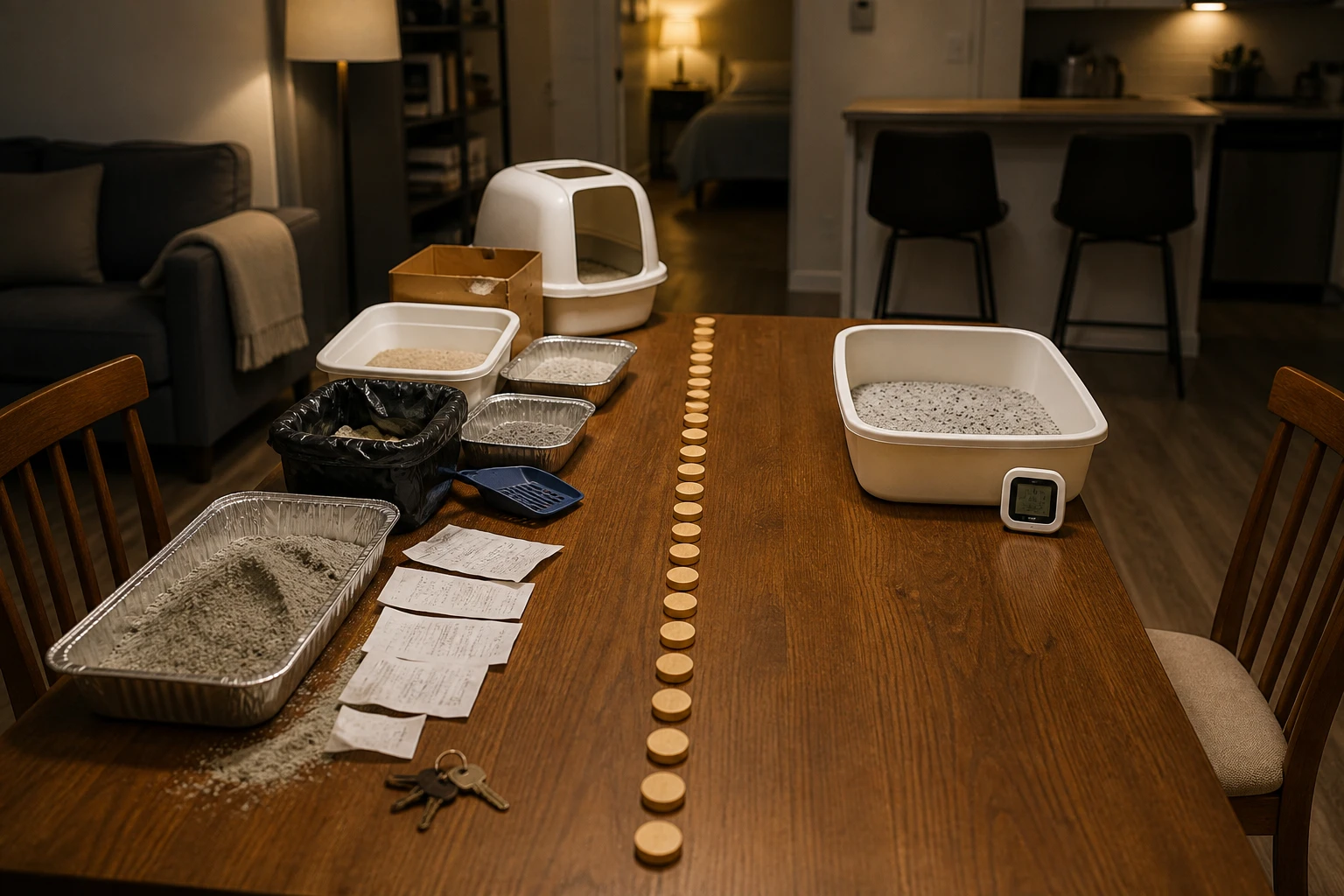
Fourteen litters, twelve of them priced off a live Canadian store page on 2026-09-06 and divided by the weight printed on the bag. Here is where that landed.
- Most homes with one or two cats can stop at a clumping clay. The cheapest we could price in Canada was Intersand OdourBuster, $23.99 for 14 kg at PetSmart.ca, which works out to $1.71 a kilo. Its listing carries a dust-free bullet and states no scent either way.
- Want it definitely unscented, or you have three cats in the house: Dr. Elsey's Ultra, $31.99 for a 40 lb bag, so $1.76 a kilo. The maker sells it unscented and says on the page that it controls odor without perfumes or deodorants.
- Wood pellets are the cheap route buyers keep recommending to each other, and we could not put a number on them. Canadian Tire and Home Hardware both shut us out on the day we checked. We would rather leave the cell blank than guess at it.
- If dust is what you care about, read the figure each maker publishes, and they are all below. ökocat Original ran $3.75 a kilo with a 99% dust free claim on its page.
- Skip the perfumed bag. In the one peer-reviewed test of commercial litters against the molecule behind the smell, the fragranced litter was still scored offensive by most of the judges.
Why you can trust this
We do not sell litter. We make an activated carbon additive that goes into whatever litter you already buy, so no bag on this page pays us anything and there is not one affiliate link in it.
Here is how the prices were gathered, so you can judge them for yourself.
Every figure was read off the retailer's own Canadian page on 2026-09-06, in a real browser, and the store is named in the table beside it. The per-kilo number is the shelf price divided by the weight on the bag, and the arithmetic is shown. Nothing here was estimated, remembered from an old receipt, or lifted from another guide.
Two of the fourteen have no price at all. Costco.ca loaded and then never finished drawing its product grid. Canadian Tire returned no results and Home Hardware's security check never cleared. Those two rows say price not published, and they stay that way until somebody can read a real number off a real page.
Two more use a store we had not planned on. Canadian Tire and Pet Valu both blocked us on the World's Best bag, and Walmart.ca refused us outright on Tidy Cats, so those prices came off PetSmart.ca and Amazon.ca instead. The table names the store we actually used, not the one we meant to use.
Prices move. The date sits on the table for a reason.

What actually makes the box smell
Your cat is not the problem. Fresh urine barely smells. The stink is manufactured in the pan after she has walked away, by bacteria doing chemistry on what she left behind.
It starts with a compound called felinine. Cats put it into their urine, and a 2022 paper in the Journal of Feline Medicine and Surgery is blunt about where the reputation comes from: the notoriety around cat litter odour, it says, stems from urinary and fecal excretion of the thioether felinine.
Felinine gets built in the kidney. An enzyme called cauxin, which cats make and most animals do not, cuts a precursor molecule into felinine and glycine, and both the enzyme and the felinine leave the cat in its urine.
On its own, felinine has no smell. RIKEN, the institute behind that work, put it plainly: felinine is odorless, and develops a smell like cat urine when it sits at room temperature. The air above stored urine fills with its breakdown products, and those are the things you notice.
The main one has a name. 3-mercapto-3-methylbutan-1-ol. A thiol, which means sulfur, and the human nose picks up thiols at a concentration so low that the 2022 researchers give it as the reason this smell is so hard to beat.
Then comes the second smell, and it is a different thing entirely. Ammonia. Urine carries urea, bacteria in the box carry an enzyme called urease, and urease turns urea into ammonia. That is the sharp hit that catches the back of your throat when you lean over the pan, and it has its own fix. The same team measured it: urease incubated with commercial litters produced up to 4.8 mg per ml of ammonia.
The same paper names the bug it used to prove the point, Proteus vulgaris, and puts the blame for the whole business squarely on the microbes: their breakdown of cat waste is largely what generates the smell in the air above soiled litter.
Sit with that for a second, because it decides what you should be buying. The litter cannot change the chemistry. Felinine is going in the box whatever you paid for the bag. What a litter can do is change the conditions, take the wet part out of circulation, or hold the gas once it forms. Everything else on the label is decoration.
One more thing to know before you spend money. An unneutered male puts out several times more felinine a day than a neutered male or a female does. Same litter, same box, a much harder job. If that is your house, the bag is not the variable you think it is.

Five things the bag does about it. Two of them work.
Perfume, moisture lock, activated carbon, baking soda, and live bacteria. That is the whole aisle. Here is what each one is actually doing.
Perfume
There is exactly one peer-reviewed test of commercial cat litters against that thiol. Ten untrained judges smelled the air above litter spiked with it four hours earlier. Every judge found the thiol in the control offensive, and seven of them also scored the litter sold on deodorizing claims and the litter carrying a fragrance offensive. Across the whole commercial set the paper reports only slight changes in the amount of thiol, in solution and in the air above it. The perfume did not take the molecule out of the room. It sat on top of it.
Moisture lock and clumping
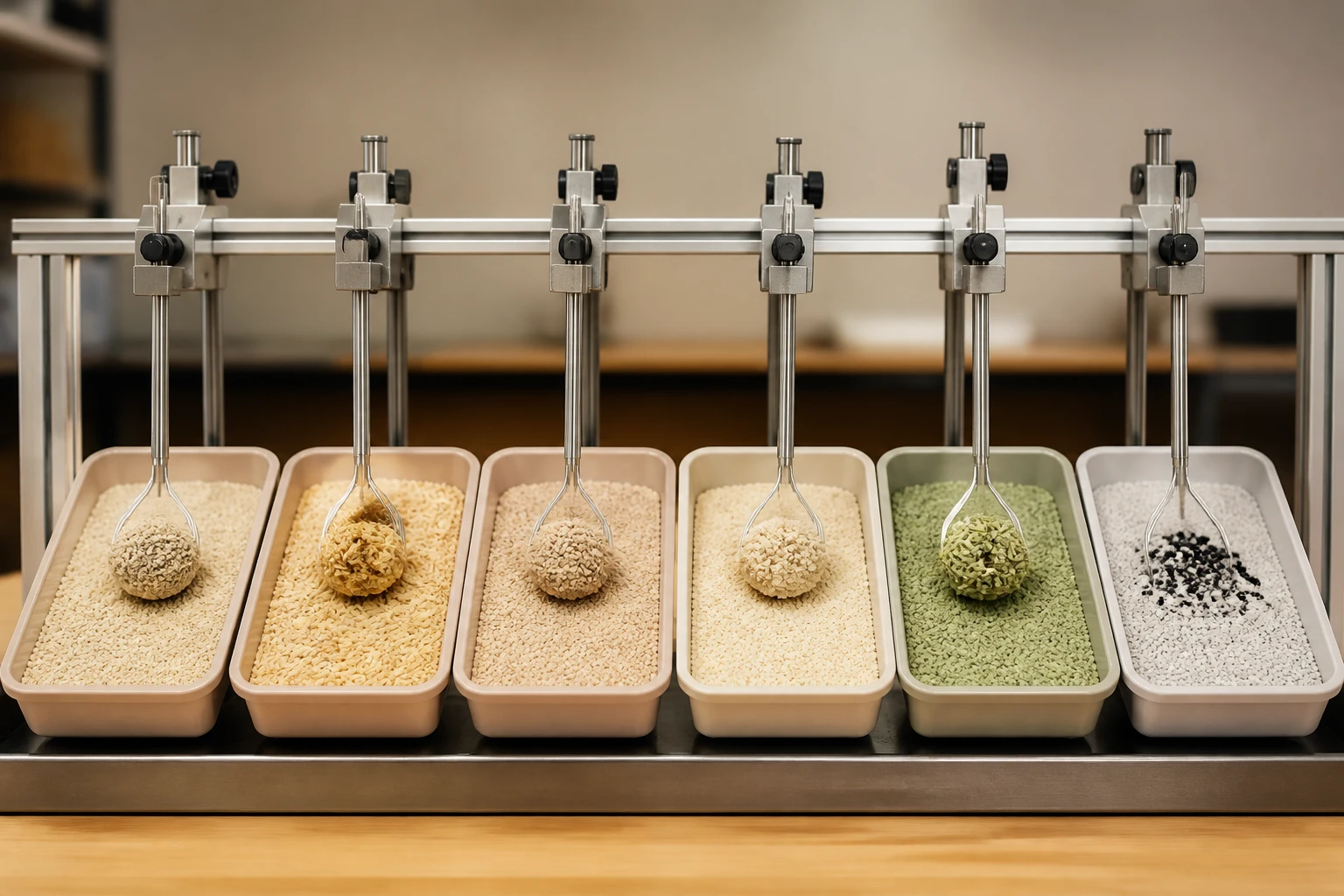
This one works, and it is not chemistry. A hard clump holds the wet part together in one lump you can lift out. Removal beats treatment, because what you carry to the bin cannot go on making anything. It only works if you actually scoop, and a weak clump undoes the whole idea: it breaks on the scoop, half of it stays in the pan, and the half that stays keeps working on you.
Activated carbon
Carbon riddled with microscopic pores holds thiol molecules inside them rather than covering them with a scent. A 2025 study pulled butanethiol, a mercaptan with a stubborn smell, out of a gas stream using granulated activated carbon. The limit, said out loud: that was a lab gas stream and a different thiol from the one in your box. It is not a measured result for a litter pan and we will not pretend it is.
Baking soda
The bag says it neutralizes. The published evidence is thinner than the marketing. A 2015 waste study found that piling it on pushes pH above 9, which drives ammonia off as a gas instead of holding it down, and the authors advise against going past 100 grams for that exact reason. A 2013 review of the oral malodour literature, the field that studies sulfur smells hardest, says the data supporting baking soda are few and inconclusive. Neither setting is a litter box, and that is rather the point. Nobody has shown it doing the job the bag claims.
Live bacteria and enzymes
Some bags now add bacteria or enzymes meant to eat the waste before it turns. We could not load a single study testing one in a litter box. That is not a verdict, it is a blank, and we are leaving it blank.

Every type sold in Canada, and what the makers actually claim
One rule in this section. The only thing said about a named bag is what its own seller prints on its own page. No invented scores out of ten.
Premium clumping clay
Intersand OdourLock is unscented, listed as 99% dust free, natural clay, made in Canada. BoxiePro carries unscented, low dust and low tracking in the product name itself. Dr. Elsey's Ultra is unscented and claims 99.9% dust-free and hypoallergenic. Three bags of clay you scoop.
Budget clay
Arm & Hammer Slide lists unscented in its specifications, dust-free in its title, and clay with baking soda as the material. Purina Tidy Cats Free and Clean lists unscented and a low dust litter formula. Intersand OdourBuster is clay with a dust-free bullet and no scent stated on the page at all. Fresh Step Odor Shield is the outlier: its scent field reads Gain Original, so by the maker's own description it is a perfumed bag. Its spec field lists the material as fibre while the description on the same page says natural clay with carbon, so the listing describes it both ways and the whole page is worth reading.
Corn and cassava
World's Best Multiple Cat is corn, unscented, 99% dust free by its own title. Sustainably Yours is corn and cassava starch, says it never uses fragrance, and claims virtually no dust. Both clump. Both cost more per kilo than clay, which you can check in the table below rather than take from us. If you want the wider plant-based picture, it is here.
Wood fibre
ökocat Original is reclaimed natural wood fibre, unscented in the spec field, 99% dust free on the page. Wood fibre is a clumping litter that is lighter than clay to carry up a flight of stairs, and it is one of the few things in this list that a Canadian buyer will find in a normal pet shop rather than online only.
Tofu and soy
pidan's tofu litter is soy and pea pulp fibre with a starch blend, silica and calcium carbonate. Its scent field reads tofu. Its title claims really dust-free. On our table it is the most expensive thing after the crystals.
Pine and fuel pellets
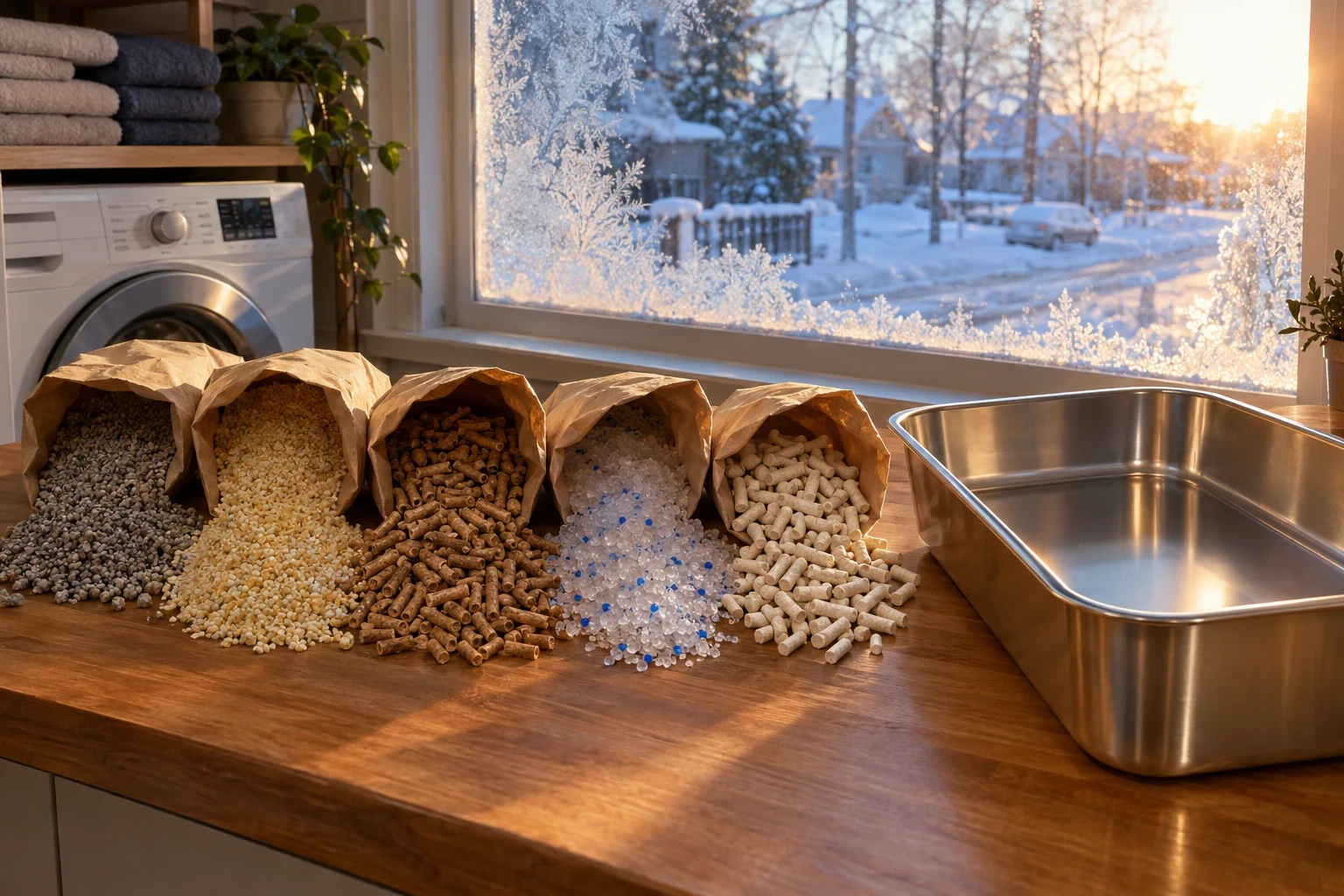
Compressed sawdust, and no brand claim to quote, because the cheap version is not sold as cat litter at all. A wet pellet breaks apart into sawdust, which is why this one needs a different box. Its own section is a few paragraphs down.
Silica crystals
PrettyLitter's base option is its fragrance-free formula and the description calls the material silica crystal. The page makes no dust claim, where every clay bag above makes one. The longer version is in our crystal litter guide.

Multiple cats? Put the 120g on autoship.
Free shipping. Never run out. Cancel anytime.
Keep the 120g bags coming →What it really costs, per kilo
Here is the number that should decide it. Twelve real prices off twelve Canadian pages, read on one day and divided by the weight on the bag. Once you do that, the ranking stops being about who has the nicest packaging.
| Litter | Store | Bag | Price | Per kg |
|---|---|---|---|---|
| Intersand OdourBuster | PetSmart.ca | 14 kg | $23.99 | $1.71 |
| Dr. Elsey's Ultra | PetSmart.ca | 40 lb | $31.99 | $1.76 |
| Intersand OdourLock | PetSmart.ca | 12 kg | $23.49 | $1.96 |
| Arm & Hammer Slide | Amazon.ca | 12.7 kg | $25.99 | $2.05 |
| Purina Tidy Cats Free and Clean | Amazon.ca | 38 lb | $54.12 | $3.14 |
| Fresh Step Odor Shield | Amazon.ca | 14 lb | $23.49 | $3.70 |
| ökocat Original | PetSmart.ca | 18.8 lb | $31.99 | $3.75 |
| Boxiecat BoxiePro | PetSmart.ca | 40 lb | $67.99 | $3.75 |
| World's Best Multiple Cat | PetSmart.ca | 28 lb | $52.99 | $4.17 |
| Sustainably Yours | Ren's Pets | 11.8 kg | $57.99 | $4.91 |
| pidan Tofu | Amazon.ca | 21.2 lb | $57.99 | $6.03 |
| PrettyLitter | prettylitter.ca | 6 lb | $30.00 | $11.02 |
| Qualicat | Costco.ca | - | price not published | - |
| Wood or pine fuel pellets | Canadian Tire, Home Hardware | - | price not published | - |
Every price was checked on 2026-09-06 at the store named in the row. Where a promotion was running that day we used the regular price, because the promotion will be gone long before you read this and the regular price is what you will pay.
Look at the spread. The cheapest thing we could price came to $1.71 a kilo and the dearest came to $11.02. The dearest costs six times what the cheapest does. Whether it works six times better is not something anybody has published a test for, and we did not find one either.
That is the trick the small bag plays. PrettyLitter's 6 lb bag has a shelf price of $30.00, which sounds like less than a $52.99 sack of corn until you notice you are buying 2.72 kg against 12.70 kg. Weigh the money, not the box.
Promotions were running on four of these the day we looked. BoxiePro was down to $63.99 from $67.99, World's Best to $48.99 from $52.99, Arm & Hammer Slide to $24.67 from $25.99, and Tidy Cats to $49.37 from $54.12. PrettyLitter was showing $19.99 on a first-bag intro against a $30.00 listed regular price. Every one of those will have moved by the time you read this, which is the whole argument for checking the per-kilo figure yourself rather than trusting a guide written last year.
Two rows carry no number and we are not going to fake them. Qualicat is sold through Costco, and Costco.ca never rendered its product grid for us. The wood pellets are the next section, and there is a reason they have a section instead of a price.

The pellet arbitrage, and the box it needs
Somewhere in the hardware store, two aisles away from anything with a cat on it, sits a 40 lb paper sack of kiln-dried wood pellets meant for a heating stove. It is compressed sawdust. So is pellet cat litter.
That is the whole trick, and the threads below have Canadians running it.
Now the honest part. We could not price it. Canadian Tire's search page loaded and then rendered nothing at all, twice. Home Hardware never cleared its security check. Amazon.ca has plenty of wood pellets and every one of them is priced as barbecue fuel, a different product at a different price, which would have made this arbitrage look like something it is not. So there is no number in the table and there is none here either. Go and look at the shelf yourself.
What we can give you is what buyers say, with the receipts attached.
In an r/BuyCanadian thread on Canadian-made litter, the top reply sends the poster to Canadian-made wood pellets as the cheaper, lower-mess option. In a 2021 TheCatSite thread, the first reply says switching to pine pellets took away both the dust and the smell that a clumping-clay user had been fighting. In an r/Pets thread about apartment smell, the top replies say wood and paper pellets stopped the apartment smelling at all, with paper singled out as absorbing odour better than wood.
Three different rooms of the internet, unprompted, landing in the same place.
There is a cost to buying something that is not sold as cat litter, and it is worth saying out loud. No dust figure and no scent statement, because the sack is aimed at a stove and not at a cat. Every other product on this page came with a claim we could quote. This one comes with nothing at all, and you are on your own reading the bag.
Here is what nobody tells you at the till. Pellets need a different box.
A pellet sits there intact until it gets wet, then it collapses into damp sawdust. So the box is two trays. Pellets go in a top tray full of holes, the sawdust falls through to a solid tray underneath, you shake it, dump the bottom, top up the top. Drop pellets into an ordinary pan and you get a pan of wet sawdust and you will hate it inside a week.
Pellets also do not coat solid waste the way clay does. Solids have to come out every day, by hand. If that is not going to happen in your house, this is not your litter, and no price per kilo fixes it.

Dust, tracking, smell. Pick two.
Every litter on that table trades one of these against another, and not one bag admits it on the front.
Fine clay clumps hard and works on smell by holding the wet part together until you lift it. It is also the dustiest thing in the aisle. In a Quora answer on low-tracking, low-dust litter, the writer says flatly that clay carries the most dust of any type.
Go the other way and the plant litters get lighter. In the same answer, plant-based litters, and the writer names a wheat one and a walnut one, are described as low-dust with very good odour control. The catch arrives in the same breath: the walnut litter is dark, so solid waste is harder to see and harder to scoop out.
Light litter travels. In an r/Pets apartment thread, a buyer says their Arm & Hammer Double Duty did not track from a basement box up to a second-floor bedroom the way the lightweight litter they used before had.
Read the trade honestly. Low dust usually means light. Light means it rides out of the pan on paws and ends up in the hall. Heavy clay stays where you put it and fills the air instead. No bag wins all three, and the one claiming it does is the one to distrust. If dust is the deciding factor in your house, we went deeper on it in the dust-free guide.
What buyers actually say, with the links
Not one of these is invented. Every line is a thread you can open and read for yourself, and where buyers disagreed we left the disagreement in.
- In r/CatAdvice, Best odor control litter, Arm & Hammer comes up twice in the top replies as the odour-control pick, and a seven-cat household says Dr. Elsey's Ultra is what keeps ammonia down when most of the cats are male.
- In the same thread, one buyer's fix for smell hanging in the corners was not a different litter at all. It was an oval box.
- In an r/Pets apartment thread, one reply says the scented Arm & Hammer still smelled with constant cleaning. Odour control is not uniform even inside one brand.
- In a 2013 TheCatSite thread, a reply praises Dr. Elsey's multi-cat formula for odour and a moderator directly underneath says the same product gave absolutely no odour control in her house. Both are in the thread. We are not going to pick a winner out of that for you.
- In the same thread, the moderator calls scented litter a net negative, on the grounds that it adds dust and a second smell rather than removing the first.
- In an r/BuyCanadian thread, a buyer names Odour Buster, a Quebec-made clay litter, as the Canadian brand they were about to switch to.

Why a Canadian winter makes all of this worse
Nothing in the chemistry changes in January. Your room changes.
From November to April most of us never open a window. The air in the room with the box is the same air, hour after hour, and whatever the box gives off stays in it with you. In July that same box empties itself out of an open window all day and you never find out how bad it is.
Which is why the bag you were perfectly happy with in July turns on you in January. The bag did not change. The window closed.
Where the box sits matters more than the calendar. In the 2013 TheCatSite thread, one reply reports odour dropping off faster when the box sits somewhere dry, and names a humid bathroom as working against the litter.
Take that seriously in winter, because the humid room with the door shut is exactly where the box goes when it turns cold. The bathroom. The laundry nook. The basement corner with the dryer running. Every one of them the wrong room.
And the per-kilo numbers matter more in winter, not less. Six months of sealed windows is six months of noticing, and that is when people stop scooping and start dumping the whole pan. The cost of a litter is not what the bag costs. It is what you get through.
Which one for your home
Five houses, five answers, each built out of something on this page.
Apartment, box near the living space. The pellet route keeps surfacing in the apartment threads linked above, and the sack is cheap. It costs you a sifting box and a daily lift of the solids. If that is a no, an unscented clumping clay is the fallback.
Three cats or more. Buy the multi-cat version of whatever you land on. In the 2013 TheCatSite thread the moderator says multi-cat formulas beat the regular formula of the same brand for odour, and in r/CatAdvice the seven-cat household names Dr. Elsey's Ultra for exactly that job. At $1.76 a kilo it is also the second cheapest thing we priced. There is a fuller multi-cat breakdown if you need it.
A cat who hates dust, or a person who does. Read the figure on the bag, not the adjective. Several bags on our table publish 99% or better and they are named above. The claim belongs to the maker, not to us, but at least it is a number they stand behind.
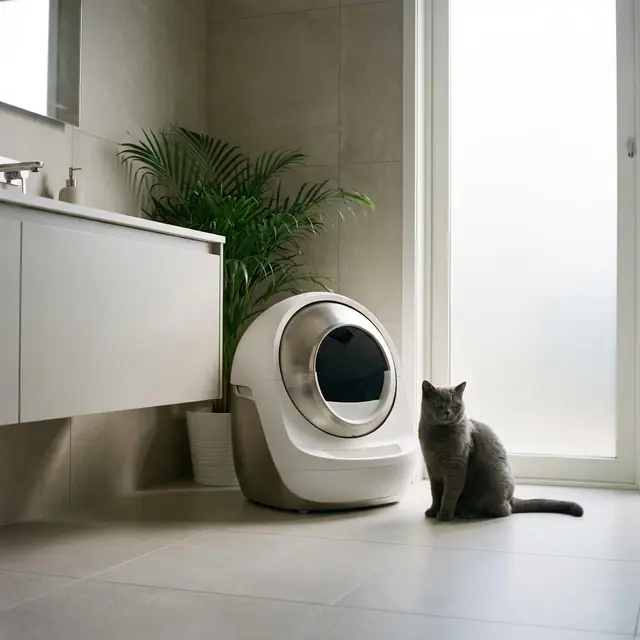
An automatic box. Your box's manual decides this one, not us. Not one of the product pages we read says a word about automatic boxes, so we are not going to invent a ranking for them.
Frugal and willing to work. Pellets, sifting box, solids out daily. Frugal and not willing: Intersand OdourBuster at $1.71 a kilo was the cheapest thing we could price in Canada that day.

You switched litter and it still smells. Here is the gap.
Every litter on this page is in the business of handling liquid. Clump it, lock it, absorb it, hold it until you lift it out. All of that is about the wet part.
The smell is not the wet part. The smell is made afterwards, by bacteria, and it leaves as gas. That is the gap, and every litter in the aisle has it, at every price on the table.
That gap is our whole business. Purrify is activated carbon granules, and carbon holds thiol molecules in its pores instead of covering them with a scent. You keep the litter you already buy and the box you already have.
Two to three tablespoons per litter box. Sprinkle it on fresh litter, mix gently. Top it up whenever the box starts giving off a smell again, with no schedule to remember.
A 50g bag lasts about a month for one cat. The 120g runs a little over two months per cat. The 15g size is meant to go in all at once and is gone in about a week, which is long enough to find out whether it does anything in your house.
We are stocked in 40+ pet stores across Canada and we sit at a 5.0 rating on Google. That is the whole of our proof. We are not going to dress it up with review counts we do not have.

How often to actually change it
Solids out every day. That one holds for every litter on the table, and on pellets it is the whole method rather than a chore.
Past that we are not handing you a week count, because nothing we could source supports one. The number on the bag is a sales number, and it is written by the people who would like you to buy the next bag sooner.
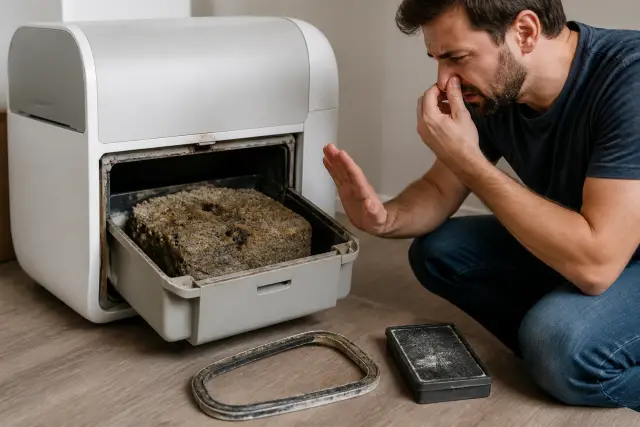
Go by two things you can see instead. First, the pan. Tip an old one out and look at the bottom: a grey crust welded to the plastic and a ring of scratches around it. Once washing does not clear the smell out of that pan, it is the pan that is finished, not the litter in it.
Second, your own nose in the first ten seconds of walking in from outside. You stop smelling your own house within a minute of standing in it, which is why the person who lives there is the last one to know. So the judgement gets made on the doormat, in February, with your coat still on and the door not yet shut. It is the only test on this page that costs nothing.