It is not the box. It is not your cleaning. It is your litter, doing exactly half of its job.
The short answer: your litter smells again because the litter is where the smell is made, not just where it sits. Bacteria in the litter turn urine into ammonia gas around the clock. And a compound in cat pee called felinine slowly breaks down into a sharp sulfur smell. Small space making it worse? Here is how to get rid of cat litter smell in an apartment.
Your litter is built to soak up the liquid. But ammonia and that sulfur smell are gases. You cannot soak up a gas.
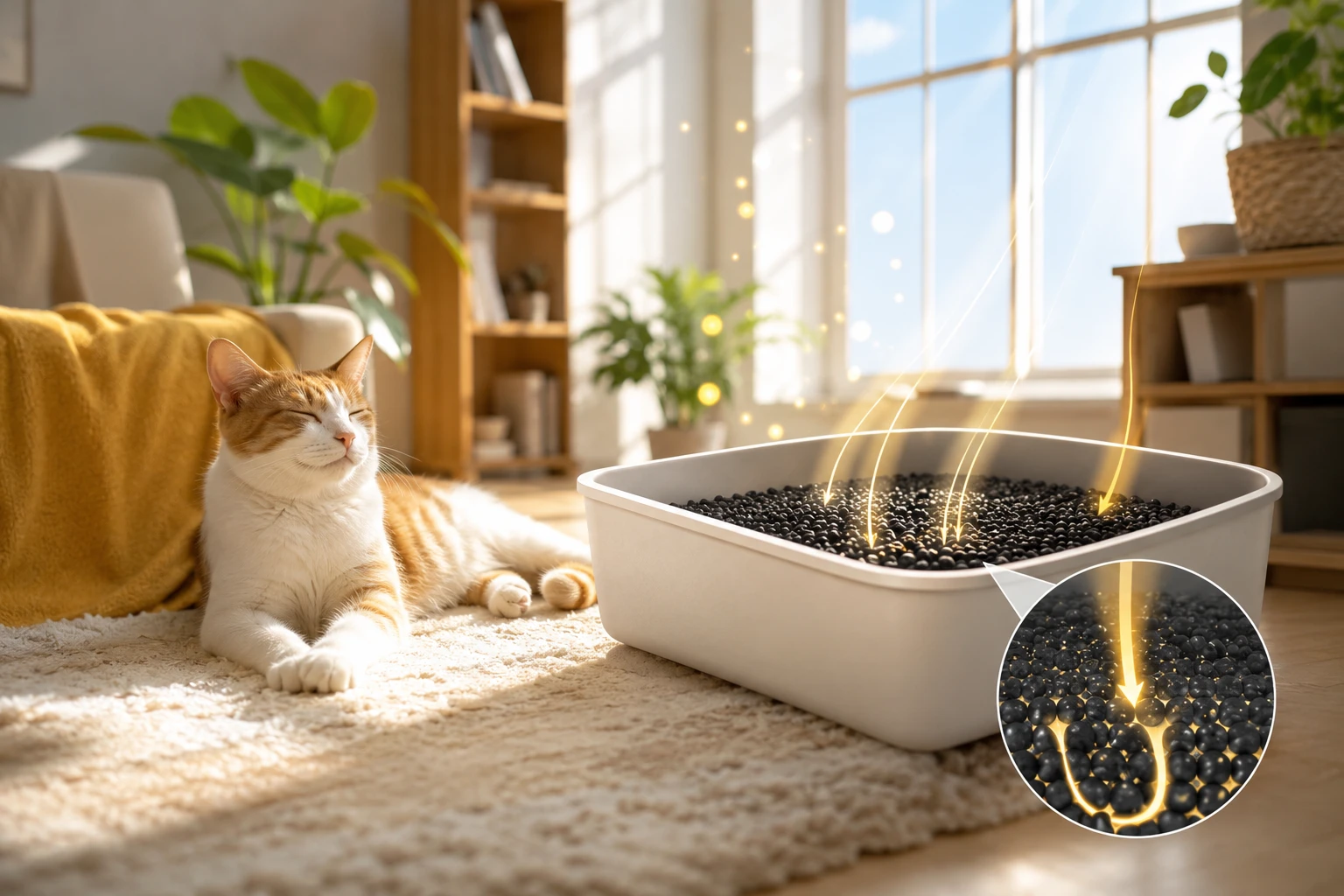
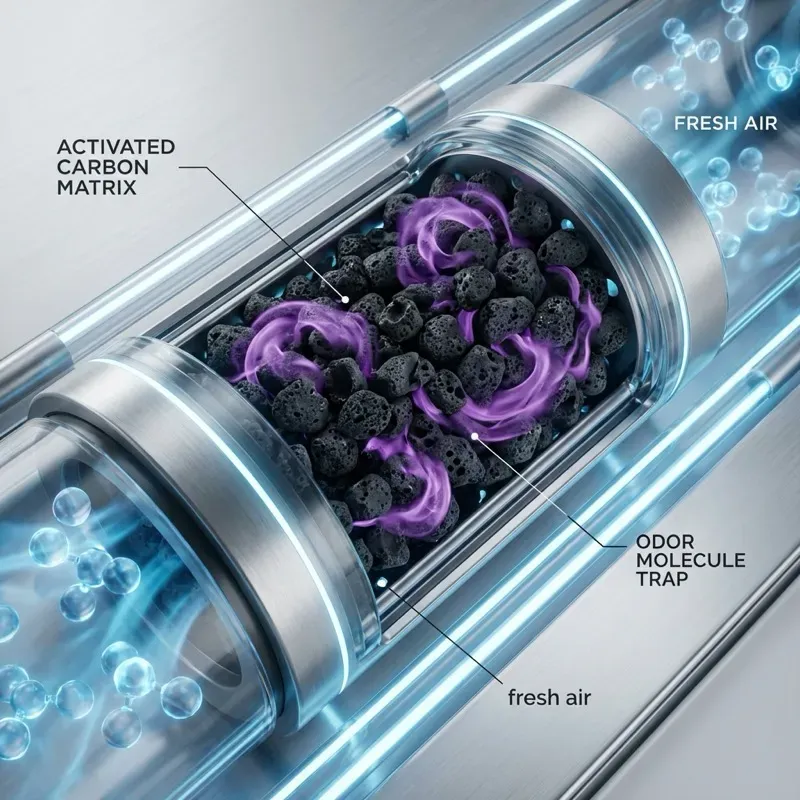
Catching a gas takes a different trick. It is called adsorption, and it happens on the surface of activated carbon, sprinkled right where the gas is born.
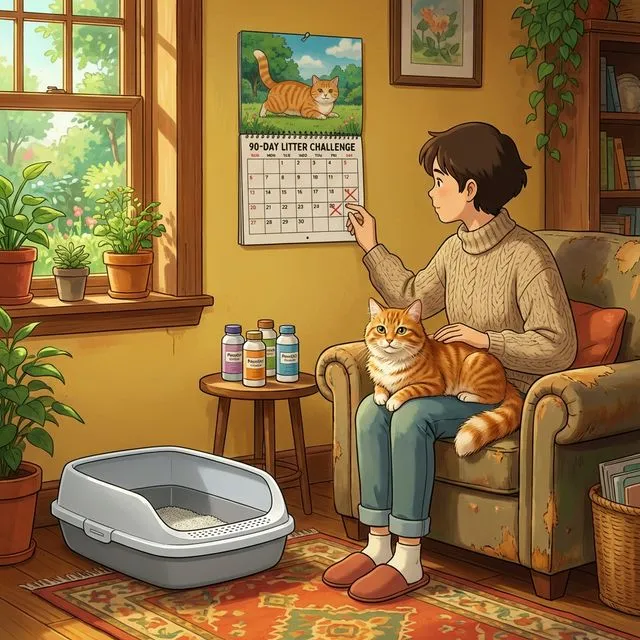
Here is how the morning usually goes. You changed the litter yesterday. Or was it the day before? Fresh bag. Clean box. You even wiped down the sides. This morning you walk past it, and there it is again. That flat, sharp, unmistakable cat-pee smell, rising out of litter you just replaced.
Your litter is working perfectly. It is doing the exact job it was built to do. And that job is the reason your house still smells.
Your litter only does half the job

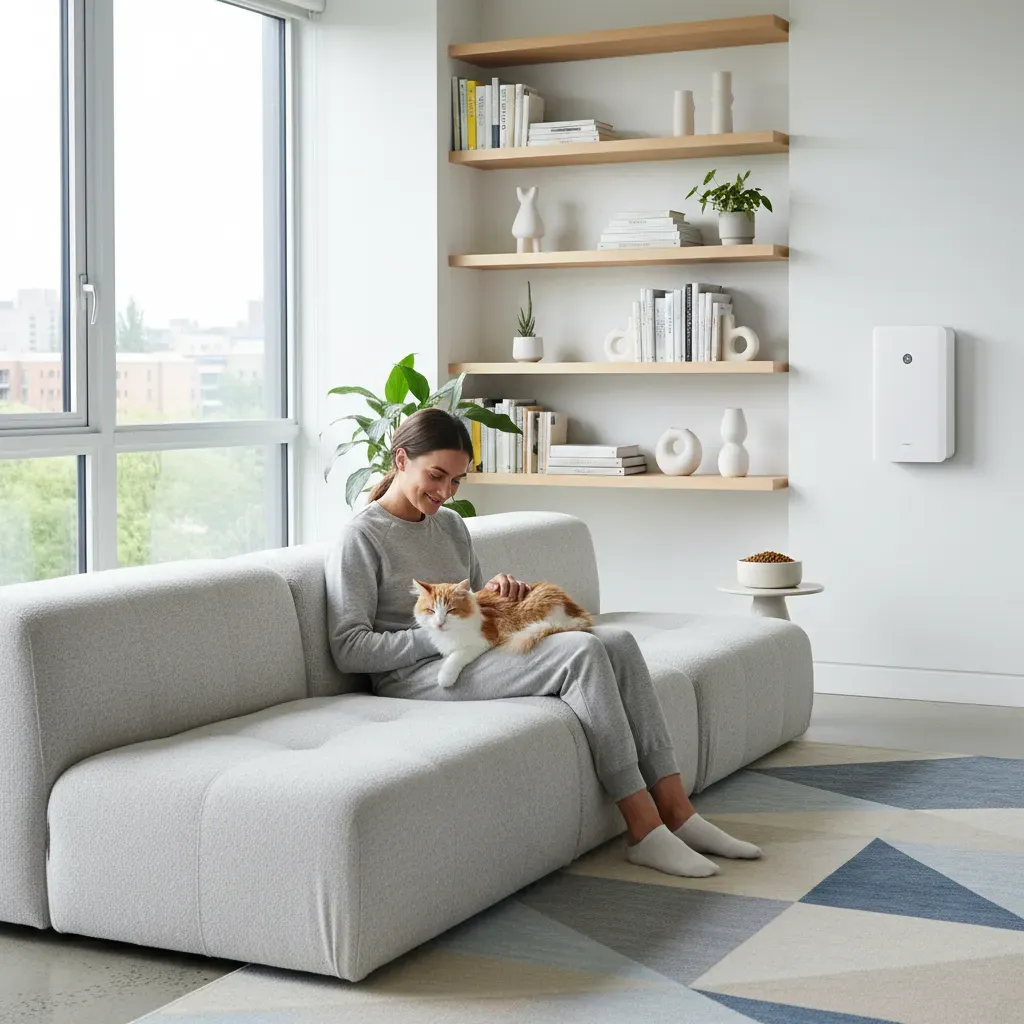
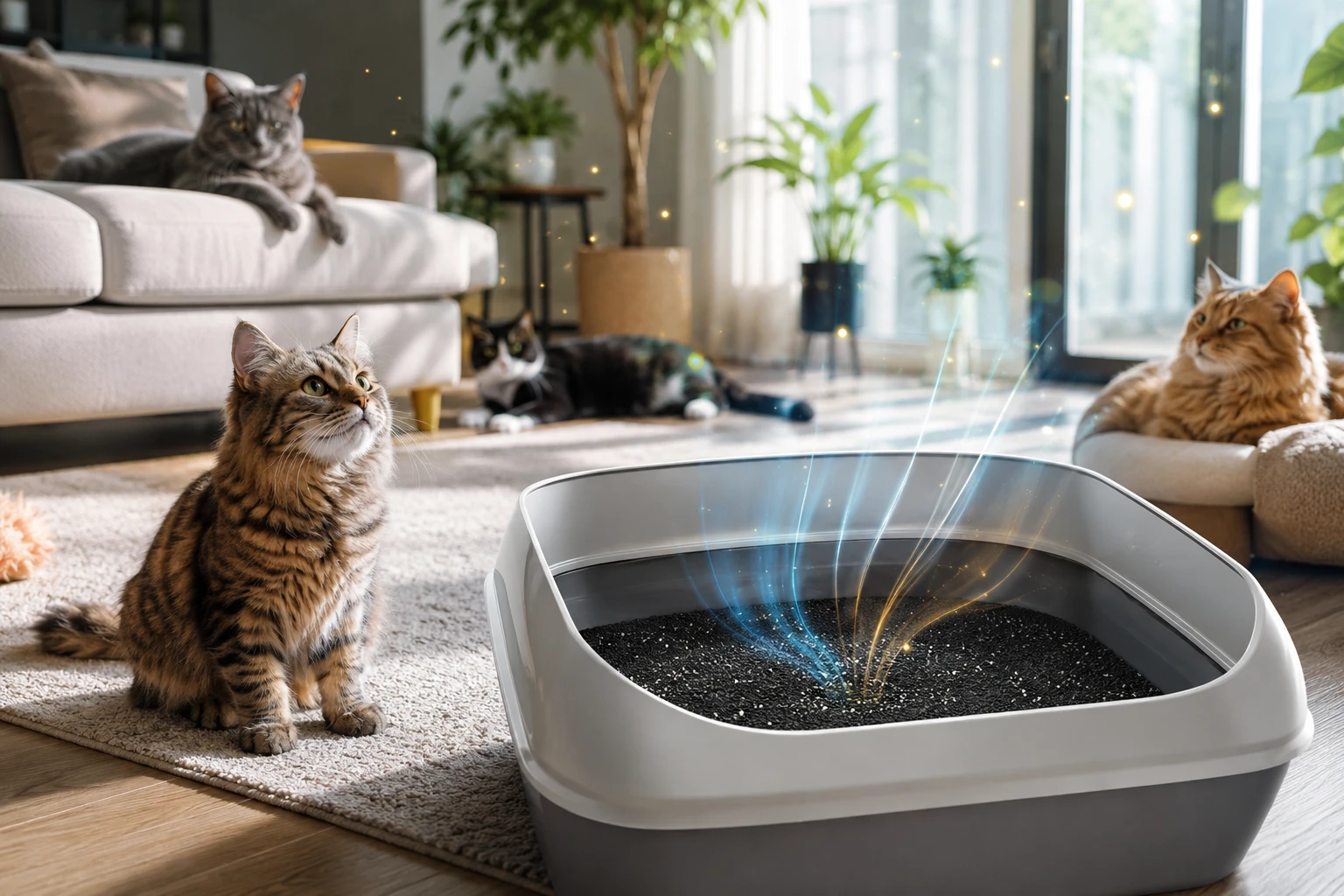
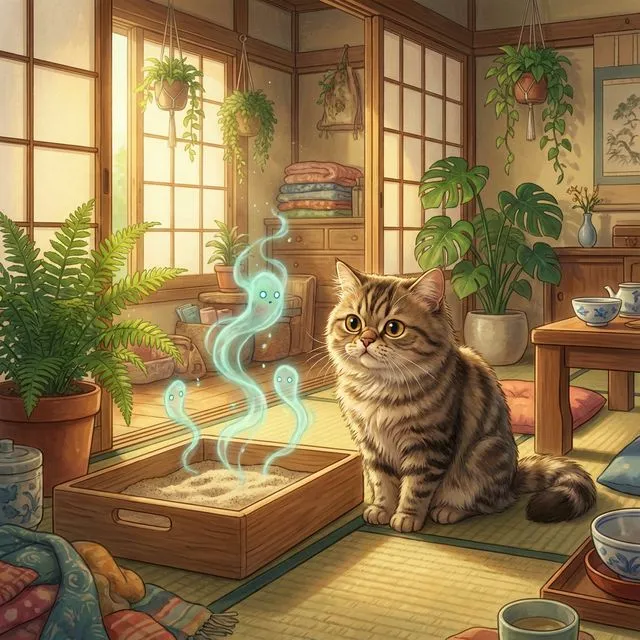
The litter caught the puddle. The gas drifts right past it into the room.
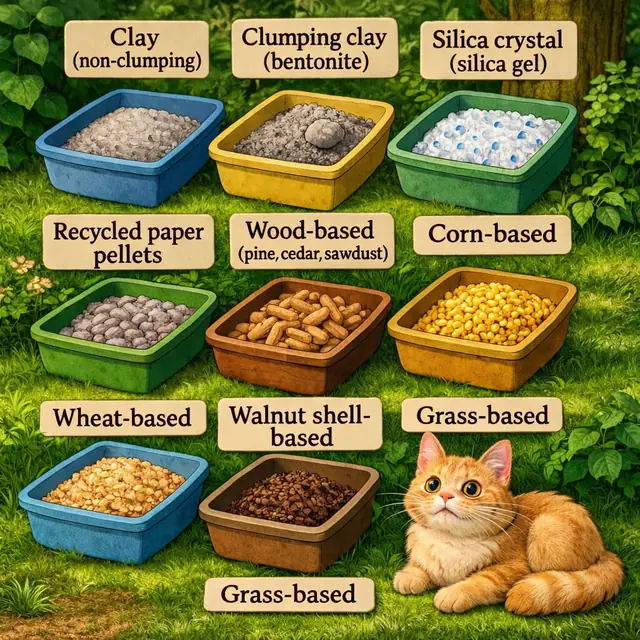
Clumping clay. Crystal. Pine. Corn. Tofu. whichever litter you reach for to fight odor is built around one task: soaking up liquid. And most of them are good at it. They lock up the wet, they clump, your cat can bury, you can scoop.
But soaking up liquid is a liquid game. The smell that hits you the next morning is not a liquid. It is a gas.
By the time you smell it, the ammonia and the sulfur have already left the wet litter and floated into the air. Your litter caught the puddle and let the gas drift right past it. Like trying to stop mosquitoes with a net made for beach balls.
That is the half nobody mentions. Your litter is both the source of the smell and the spot it escapes from. It holds the pee. It cannot hold what the pee turns into. So you are fighting a gas with a tool built for liquid, in the one place the gas is being manufactured.
What is actually rising off your litter

Two invisible gases, forming on their own schedule the moment urine hits the box.
Two invisible gases. Both form the moment urine hits the box. (We go deeper on this chemistry here.)
The first is a sulfur smell. Cats make a molecule called felinine, males more than females. As it sits in the litter, it falls apart into airborne sulfur compounds, the main one being 3-mercapto-3-methylbutan-1-ol, or MMB. That is the sharp "cat smell." Your nose can catch it at microscopic levels. A trace is plenty.
The second is ammonia. Cat pee is full of urea, which barely smells on its own. But bacteria turn that urea into ammonia gas.
A peer-reviewed paper in the Journal of Feline Medicine and Surgery1 lays it out: the ammonia made by bacteria acting on urea is one of the best-known smells coming off used litter, right alongside the felinine sulfur compounds.
This is why the smell comes roaring back a day after a fresh change. The puddle got absorbed, but the bacteria keep chewing on the leftover residue, and the litter keeps breathing ammonia into your room. The litter is not broken. It is running. And it makes gas the whole time it runs.
Why you stopped smelling it (your guests did not)
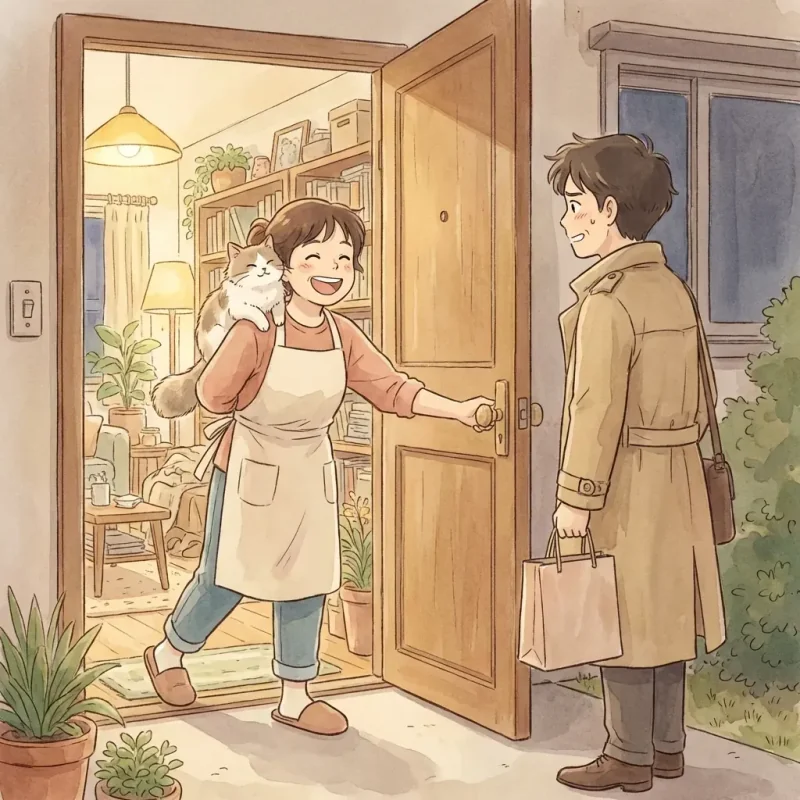
Your guest walks in with fresh receptors and gets the reading you have been spared for days.
Here is the second twist, and it is your biology, not your litter. You are not smelling your own home accurately. You physically cannot.
It is called olfactory adaptation. When the same smell molecules hit the receptors in your nose nonstop, those receptors stop firing as hard. Your brain files the smell under "background" and tunes it out so it can stay alert to anything new.2
So across a week, the ammonia coming off your litter is climbing. What is dropping is your ability to notice it. Your litter did not adapt. Your nose did. This is so well established that the U.S. toxicology agency, the ATSDR, warns that ammonia causes "olfactory fatigue," which makes it hard to detect once you have been around it for a while.3
Your guest's nose has not adapted. They walk in with fresh receptors and get the full, honest reading you have been spared for days. That tiny flinch they try to hide is them smelling your litter exactly as it is.
Where the smell spreads
The litter is the engine. But an engine that runs all day eventually stains everything around it. Give it months. Give it years. The residue creeps outward. Trace urine works into the seams of the box. It soaks the mat. It films the floor around the tray. Now you have a second, slower source stacked on top of the daily one.
This is why a deep clean of the box and the area around it helps, and why some homes need one. But scrubbing the box while ignoring the litter is like bailing a boat without plugging the hole. The litter refills the room with gas every single day. The box and floor only got contaminated because the litter was breathing onto them in the first place. Stop the gas at the litter, and you stop feeding the spread.
The three things people reach for (and why they fail)
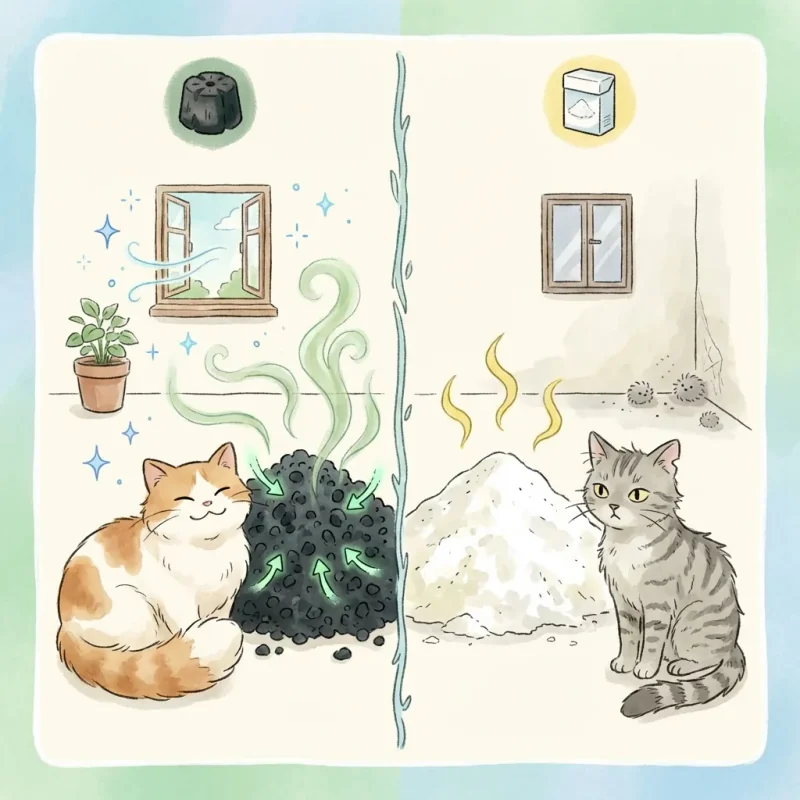
Carbon on the left, baking soda on the right. One traps the gas. One just sits there.
Three products own the odor aisle. For this specific job, all three are a magic trick.
Baking soda. The internet loves it for ammonia. The chemistry does not. Baking soda is a mild base. Ammonia is also a base, sitting up around pH 11. You cannot cancel out a base with another base. That is day-one acid-base chemistry. Baking soda can grab a little moisture and freshen things for a day, but it does not destroy ammonia. (Here is the full head-to-head with carbon.)
There is even a cat-behavior wrinkle. A 2008 veterinary study presented at the ACVB/AVSAB Annual Meeting compared carbon against bicarbonate of soda, and the cats preferred carbon.4 (For the record: that research was funded by the maker of a carbon-based litter product.) Your cat has a vote, and it is not voting baking soda.
Zeolite. Zeolite can bind a bit of ammonia, and it shows up in a lot of litters. But its capacity is small. Peer-reviewed feline-medicine research that tested store-bought litters found most products only touched one part of the odor problem at a time. Not one of them could handle the sulfur smell, slow the bacteria, and cut the ammonia all together. (We ran our own absorber test here.)
Scented litter. This one is not just useless. For your cat, it can be a real problem. Scented litter does not remove ammonia. It paints perfume over it. When the fragrance fades, you are left with perfume plus ammonia, which a lot of people find worse than ammonia alone.
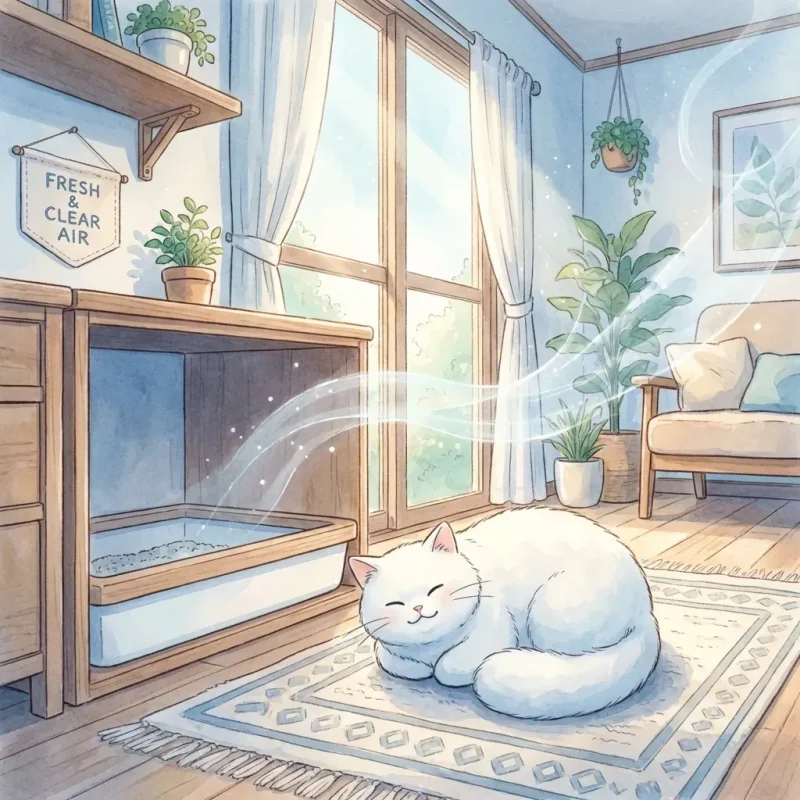
What reads as "fresh linen" to you can flatten a nose far sharper than yours.
Now think about who lives in that box. The human nose has roughly 5 to 6 million scent receptors. A cat has up to 200 million, which makes a cat's sense of smell far sharper than ours.5 What reads as "fresh linen" to you can flatten your cat. Veterinary and behavior sources note that strong fragrance can push a cat off the litter box, which can spiral into peeing on your floor and a stressed-out animal. A scent you add for your own comfort can chase your cat away from the box.
So masking is out. Soaking it up is the wrong tool. What is the right one?
Ready for a litter box you can't smell?
Free shipping. Never run out. Cancel anytime.
Start autoship →Absorption vs adsorption: one letter, the whole story

One gram of this can hold the surface area of a tennis court, folded into microscopic pores.
These two words look almost identical. One letter apart. That letter is everything.
Absorption is a sponge. Liquid soaks into the body of a material and fills it up. Once it is full, it is done. That is what your litter does.
Adsorption, with a d, is different. Molecules stick to the surface of a material, held there by weak physical pulls called Van der Waals forces. Nothing fills up like a sponge. The molecule just gets grabbed and held on the surface.
The U.S. Environmental Protection Agency treats adsorption by activated carbon as a best-available technology for pulling many contaminants out of water and air.6 The mechanism is well understood: the molecules cling to the carbon surface through those physical forces. It is not a chemical reaction that burns itself out.
Here is why that matters for your litter. Gases, the exact form ammonia and MMB take, are what adsorption is built to catch. Your litter cannot trap a gas. A huge adsorbing surface can. Which brings us to the one material made for exactly this.
The one material built for gas

A coconut shell, charred and activated into the porous black carbon that traps the gas.
Activated carbon. And specifically, activated carbon made from coconut shells.
When you bake coconut shell at high heat and activate it, it grows an almost unbelievable amount of internal surface. Coconut-shell activated carbon commonly lands around 800 to 1,500 square meters of surface per gram, with some grades pushing past 2,000.7 A single gram can hold the surface area of a tennis court, folded into microscopic pores.
Coconut-shell carbon is especially full of micropores, the smallest pore size. That matters because gas molecules are tiny, and most smelly gases fall in a size range where those micropores trap them best. It is the same reason coconut-shell carbon is the go-to media in drinking-water and air filtration.
Does it actually grab ammonia? Yes, and it has been measured. In a peer-reviewed study in Environmental Science & Technology, activated carbon pulled ammonia straight out of a gas stream, and treating the carbon to add acidic oxygen groups pushed its capacity to roughly 17 to 20 milligrams of ammonia per gram.8 Different carbons and conditions give different numbers, but the principle is published and solid: the right carbon physically captures ammonia gas instead of hiding it.
That is the mechanism behind Purrify. It is not a litter, and it is not a perfume. It is fragrance-free activated coconut carbon you sprinkle on top of whatever litter your cat already uses. The granules sit right at the source and grab the gases as they try to rise, catching ammonia and the sulfur smell before they reach the box, the floor, or the air your guests breathe.
No scent. No chemical reaction for your cat to inhale. Just an enormous adsorbing surface doing the same job it does in a water-treatment plant, shrunk down to a litter box. Because it works by surface adsorption instead of filling up like a sponge, a layer keeps catching gas across a normal litter-change cycle rather than quitting in a day.

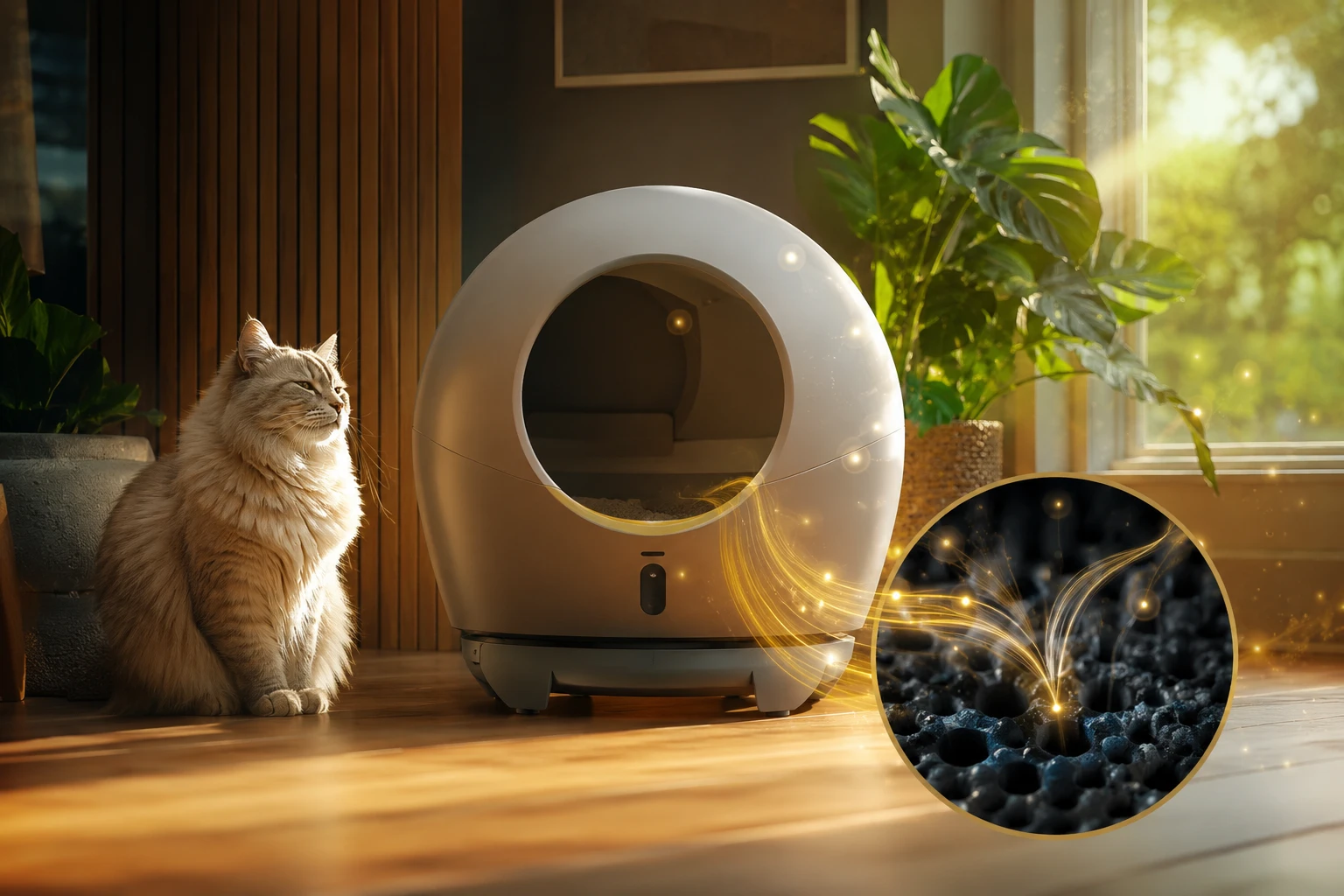
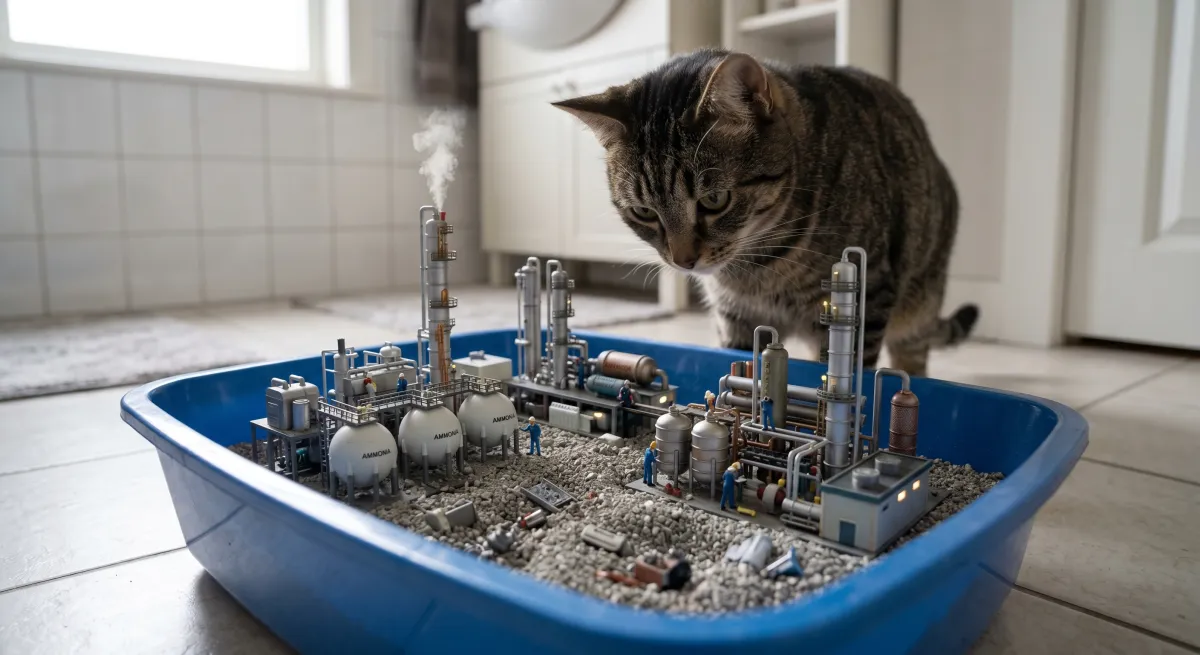
The analogy, made literal. The carbon does a water plant's job with a fraction of the space.
That is how it fixes both problems at once. It shuts down the daily gas your litter makes, and by stopping that gas at the litter, it stops feeding the slow buildup in the box and the area around it. You can read the deeper science of activated carbon here.
Common questions
Why does my cat litter smell again so soon after I change it?
Because the litter is where the smell is made, not just where it sits. Bacteria in the litter turn urine residue into ammonia gas for hours and days, and felinine in the pee breaks down into a sulfur smell. Your litter soaks up the liquid, but those smells are gases, and you cannot soak up a gas. So fresh ammonia keeps rising off litter that looks and feels clean. (More here.)
Why do traditional cat odor eliminators fail?
Most either mask the smell with fragrance or try to soak up liquid. But the smell you actually notice is a gas. Perfume does not remove the gas, and soaking up liquid does not catch it. Activated carbon works by adsorption, physically trapping the gas on its surface, so it goes after the cause instead of the symptom.
Why do I stop smelling it but my guests don't?
Your own nose adapts to a steady smell and stops reporting it. The ammonia level can be rising while your sense of it drops. Guests show up with un-adapted noses and get the accurate reading. (More on nose blindness.)
Is the ammonia smell from cat litter actually harmful?
At normal, well-ventilated home levels it is an irritant, not an emergency. You can usually smell ammonia well below harmful levels (odor threshold around 5 ppm; the workplace limit is 50 ppm).3 But in small apartments, multi-cat homes, or poorly ventilated rooms it can climb high enough to bother eyes and airways, which matters most for cats, infants, and anyone with asthma. If anyone in your home has breathing symptoms, talk to a doctor or vet. (More on ammonia and health.)
Will activated carbon change my cat's litter or routine?
No. It is an add-on, not a replacement. You keep your current litter and sprinkle 2 to 3 tablespoons of Purrify granules on fresh litter, mix gently, then scoop as usual. Top up whenever the box starts to smell again. It works with clumping clay, crystal, pine, corn, and tofu litters, and it earns its keep fastest in multi-cat homes and during the hotter months when litter smells get worse.
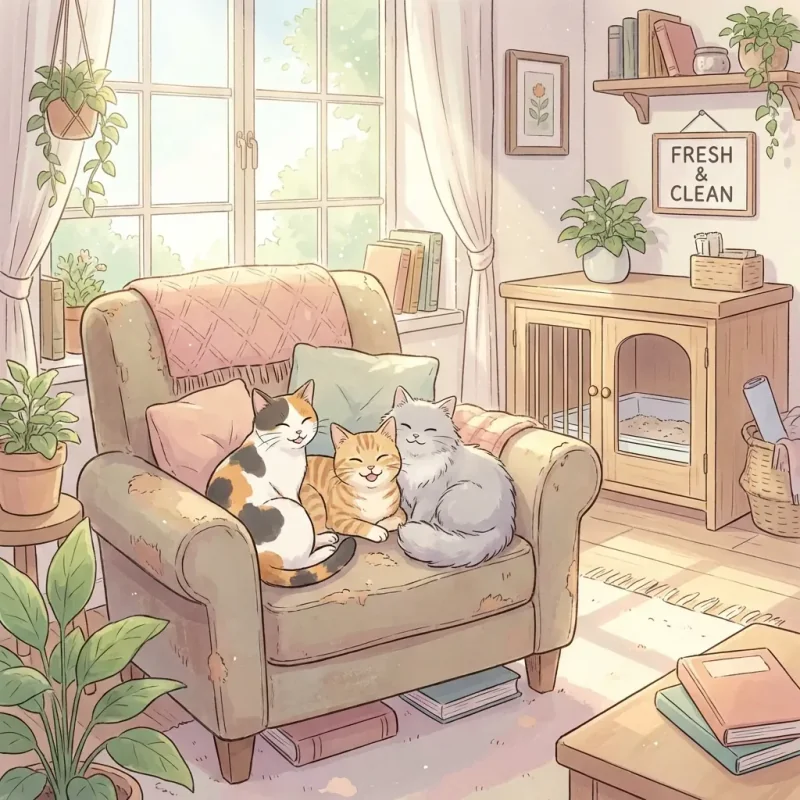
It works with any litter, and earns its keep fastest in a multi-cat home.
A note from Mark Archer

Mark Archer, who founded Purrify in Montreal.
I started Purrify in Montreal after my own home had the exact problem in this article, and nothing on the shelf actually fixed it. For a while I ran the whole thing myself, right down to the orders. There is a team behind it now that handles the day to day, which frees me up to stay obsessed with the part that matters most: what actually goes in the bag.
The carbon I use meets the same purity standard as the activated carbon in city drinking-water systems. The difference is space. A water plant has a whole building to fill, so it can win on sheer volume. A litter box gives you a thin layer in a small bag, so every granule has to pull its weight. That is why I spec a more premium, more effective grade than a treatment plant would ever bother with. Anything cheaper felt like a compromise.
Purrify is now carried in 25+ retail stores across Canada, including Chico and Global Pet Foods locations. You can find a store near you here.
I am not trying to sell you a scent. I am trying to sell you the absence of one. The best-smelling home is the one that smells like nothing at all.
"We keep the litter box in the garage, which is also near the front door and it was so embarrassing when guests came over, but now the smell is absolutely, completely gone. It's amazing."
- Marnella G., Vancouver
"My cat didn't notice I changed anything. My guests noticed immediately."
- Koralie Thibodeau, Terrebonne, QC
"I've honestly received a lot from all my employees who use it. It's very good. It's... it's magic."
- Anastasia, owner of Chico pet boutique (a Purrify retailer), Laval, QC
Try it for the price of a coffee
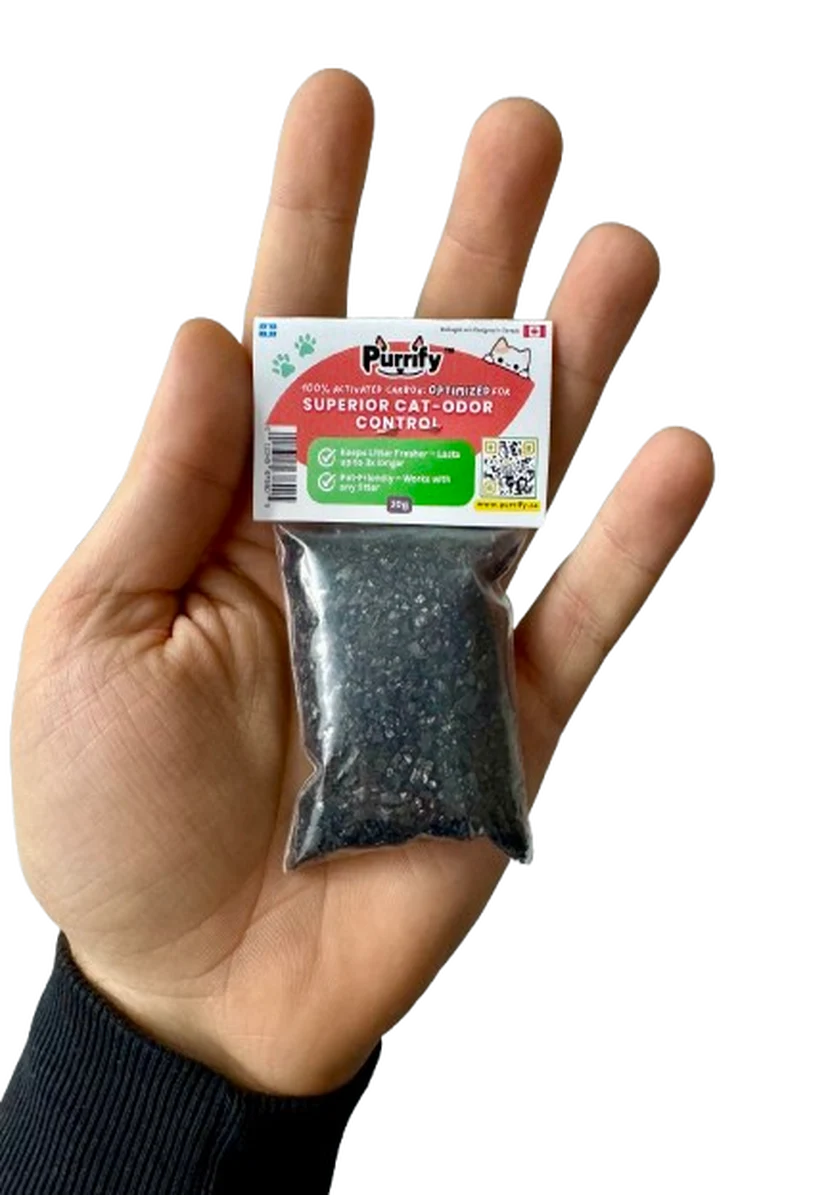
The trial: activated coconut carbon you sprinkle on the litter you already use.
If your litter smells again a day after you changed it, you do not have a cleaning problem. You have a gas problem, made right there in the litter. And now you know the one material built to catch it at the source.
The 15g trial ships to Canada and the USA for $4.76$7.99, shipping included, with a money-back guarantee. If your home does not smell fundamentally different, you pay nothing.

The best-smelling home is the one that smells like nothing at all.
Your litter has been making the smell all along. Now you can stop it where it starts.
References
- Robins and colleagues (2021), Journal of Feline Medicine and Surgery. Ammonia produced by microbial urease activity on urea, alongside felinine-derived thiols, as the principal malodours above soiled cat litter.
- OpenStax, Introduction to Behavioral Neuroscience. Olfactory adaptation: desensitization of olfactory receptor proteins to a steady odorant, with further downregulation by the brain.
- Agency for Toxic Substances and Disease Registry (ATSDR), Medical Management Guidelines for Ammonia. Olfactory fatigue and odor threshold (around 5 ppm); OSHA permissible exposure limit 50 ppm.
- Neilson, J. (2008). Litter odor control: carbon vs. bicarbonate of soda. ACVB/AVSAB Annual Meeting. Cats preferred carbon over baking soda. Research funded by The Clorox Company, maker of a carbon-based product.
- Byrd, T. L., DVM. Veterinarians.org. Feline olfactory sensitivity: cats have up to 200 million scent receptors, against roughly 5 to 6 million in humans.
- Hu and Srinivasan, Microporous and Mesoporous Materials. Reported BET surface areas for coconut-shell activated carbon of roughly 800 to 1,500 square meters per gram, with chemically activated grades reaching 1,800 to 2,000 and beyond.
- Goncalves and colleagues (2011), Environmental Science and Technology, 45(24):10605-10610. DOI 10.1021/es203093v. Activated carbon adsorbs ammonia from a gas stream; acidic oxygen surface groups raise capacity to roughly 17 to 20 mg per gram.
- U.S. Environmental Protection Agency (EPA). Adsorption by activated carbon as a best-available technology for removing many contaminants from water and air, via Van der Waals and induced-dipole forces.