Litter box that doesn't smell? The best box for odor control is one your cat uses happily and you can clean easily. For a straightforward starting point, choose a roomy open tray with an entrance your cat can manage. Already have a box that works? Keep it and your usual litter; check the cleaning routine before buying a replacement.
Why every litter box smells, whatever its shape
That sharp litter-box smell often includes ammonia, formed as bacteria break down urea in urine. Waste and residue matter more than the shape of the shell. A new box can make cleaning easier, but it does not make cleaning optional.
A box can hold the smell in, or make the waste easier to lift out. It cannot stop ammonia from forming. Whatever stops the smell has to happen in the litter: taking waste out, and catching the gas where it starts. Our page on the ammonia smell in cat litter goes deeper into the chemistry.

Litter box types compared for smell
The six options below compare design and maintenance, not measured odor scores. We have not tested these boxes head to head. Start with the trade-off that matters in your home: access, scatter, cleaning or waste storage.
| Box type | What it does to the smell | The catch | Who it suits |
|---|---|---|---|
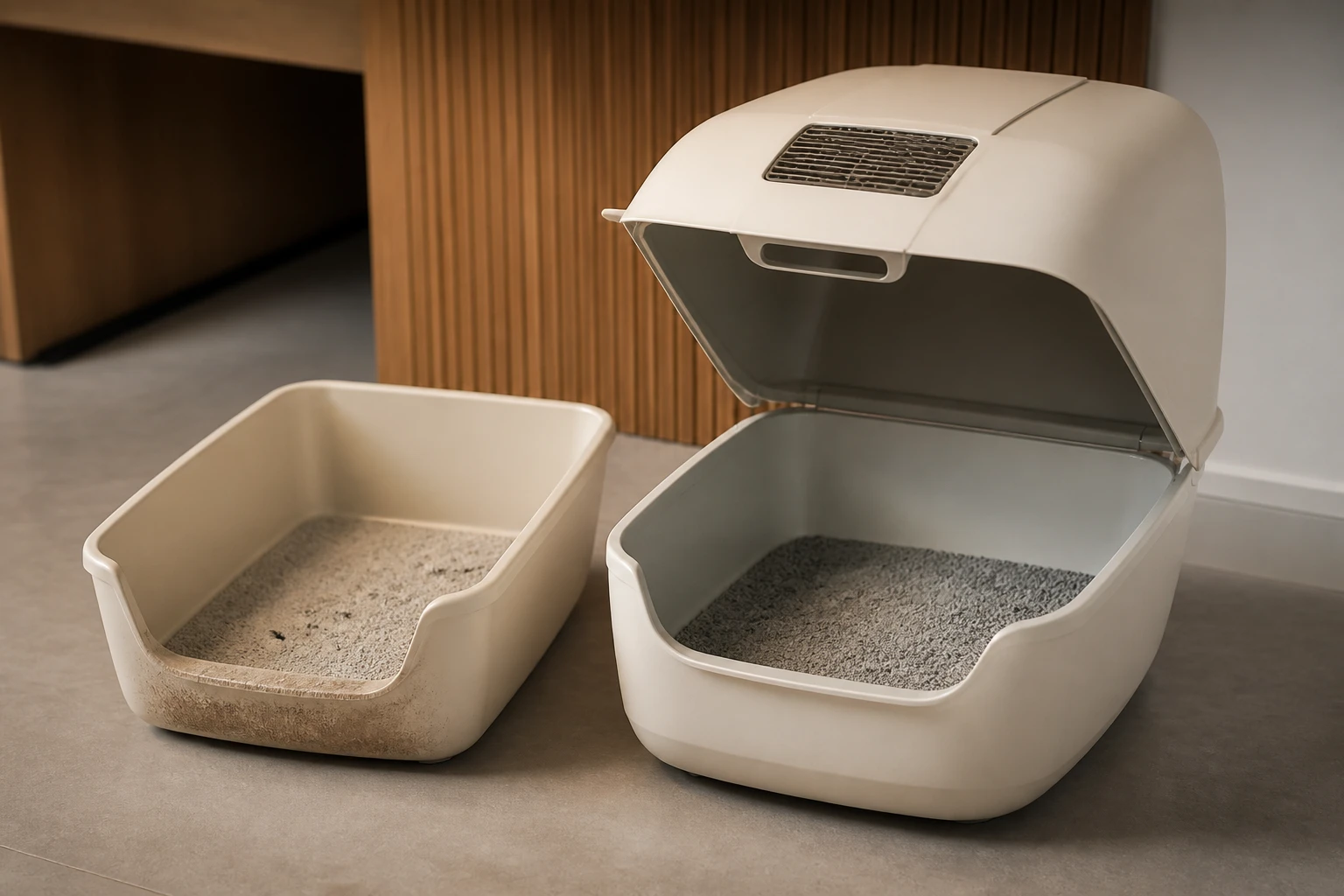
| Open tray | Holds nothing in. You notice the smell sooner, which is also your cue to scoop. | Low sides let litter fly out. | Kittens, older cats and stiff joints. Cornell recommends low sides for them. |
| High-sided open box | Same as an open tray. The smell is not held in. | The way in has to stay low enough for your cat to step over. | Cats that dig hard and throw litter. |
| Covered or hooded | Keeps some smell away from your nose and holds it in around your cat. | Waste hides under the lid. Some cats feel trapped with one way out. | Cats that already use one without fuss. Compare the best covered litter boxes. |
| Top-entry | The lid holds air in, much like a hood. | Your cat has to jump in and climb out. | Agile adult cats. Not for kittens or seniors. |
| Stainless steel | Easy to inspect and wash; the material alone does not guarantee less odor. | Still needs the same washing as plastic. | Owners who want a pan they can scrub hard. |
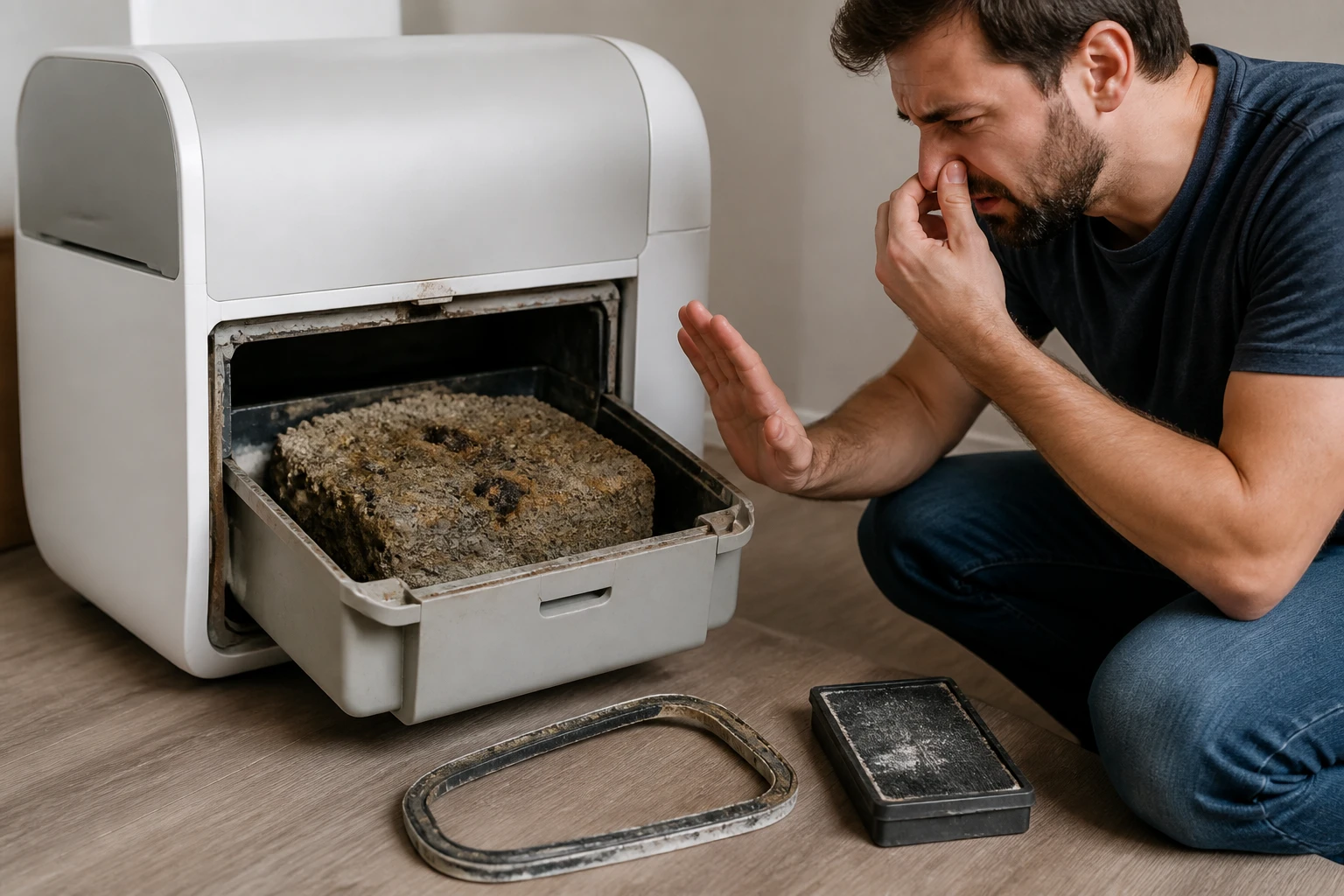
| Automatic | Rakes clumps into a drawer, where the smell then waits for you. | Drawer, filter and pan still need cleaning. The noise can startle some cats. | People who cannot scoop daily, with a cat that accepts the motor. See self-cleaning litter box odor control. |
Cornell's Feline Health Center notes that a cover can contain odors around the cat. The ASPCA also advises considering a cat's preference for an uncovered box. If yours already uses a hooded box comfortably, there is no need to change it just to follow a trend.

An automatic box can reduce manual scooping, but its drawer still needs emptying and its moving parts need cleaning. If your cat avoids the machine, offer a conventional tray while you work out the cause.
What matters more than the box type
A box that still smells after washing is finished
Try the empty-box check before buying more odor products: wash the pan with mild, unscented soap, rinse, dry, then check for a lingering smell. A cracked pan or one that still smells is a reasonable replacement candidate. Stainless steel also needs regular washing.

Size
Give your cat room to turn, dig and settle without squeezing against the sides. A common sizing guide is about one and a half times your cat's nose-to-tail-base length. Measure the usable interior, not the outside footprint. For a kitten or a cat with limited mobility, check the entry height too.
Enough boxes
Plan for one box per cat, plus one extra, in separate accessible locations. Two cats means three boxes. Our placement guide helps you think through the room, and our multi-cat litter guide covers shared routines.
Scooping and washing
The ASPCA says to "Scoop at least once a day". International Cat Care asks for at least twice a day. Waste left in the box keeps feeding the bacteria that make ammonia, whatever box it sits in. Once a week, the ASPCA says to wash every box with warm water and unscented soap and replace all the litter. The full schedule is in our routine for keeping the litter box fresh, which also covers the other fixes.
What helps between scoops
Choose the box for access. Manage odor with the routine. Scooping removes waste, and an unscented activated-carbon additive handles odor between scoops. Purrify, the most powerful odor remover in the world, goes into the litter you already use. Its porous surface adsorbs odor molecules, meaning they attach to the surface. See how activated carbon works. The supplier lists a surface area of 1,150 m² per gram for the coconut-shell carbon. That describes the material, not a measured result in your home.

Here is what carbon does in the box. The EPA's page on carbon adsorbers describes a finite capacity: once the surface fills, it takes in no more. That is why you top it up, and why it never replaces scooping. The good news is that it works in the box you already own. If you are rethinking the litter as well, our guide to the best cat litter for odor control compares the main types.
How to use Purrify in any box
Use 2 tablespoons of Purrify per litter box. Sprinkle on fresh litter, mix gently. Top up whenever the box starts to smell again - no fixed schedule.

It has no added fragrance. Watch how your cat responds when you add anything to the litter. It goes into clay, crystal and natural litters in an ordinary box, open or covered. For an automatic box, check with the maker before adding anything loose, because sensors, rakes and drawers differ from model to model. For a step-by-step version, see how to use a cat litter deodorizer. Some hooded boxes also hold a pad in the lid; see what a litter box filter actually does and how it differs from carbon in the litter.
Which bag to start with
For one cat and one box, the Medium bag (50g) lasts about 20 days. The Large bag (120g) lasts about 50 days on the same terms: per cat, per litter box. More cats, more boxes or a stronger smell use it up faster, and that is fine. Use what it takes to keep the house happy. Compare the Purrify bags.
Not sure yet? The Trial bag is used all at once and lasts about 5 days. The 15g trial bag is free. You pay $4.76 shipping. Limit 2 trial bags per customer If you would rather pick up a bag in person, Purrify is stocked in 40+ pet stores across Canada.