


You spray a cat air freshener and the room smells floral, but you can still tell where the litter box is. A cat air freshener changes how a room smells. It does not remove what makes the smell, and some fragrances bother a cat's nose and lungs far more than yours.
Short answer: none of the veterinary sources we checked gives any air freshener a blanket pass for cats. Essential oils are the clearest worry. VCA's veterinarians list several that are poisonous to cats, and Pet Poison Helpline warns that strong fragrances can irritate a cat's airways. What clears litter smell is less exciting: take the waste out, let fresh air in, and keep fragrance away from your cat and its box.
What vets say about cat air fresheners
Cats smell the world far more sharply than we do. The ASPCA puts it simply: "something that seems light to us may be overwhelming to them." Here is what four veterinary sources say. We reread each one on October 3, 2026.
- Essential oils and liquid potpourri: VCA lists oil of cinnamon, citrus, pennyroyal, peppermint, pine, sweet birch, tea tree, wintergreen and ylang ylang as poisonous to cats. Cats have fewer of the liver enzymes needed to break these oils down, and kittens and cats with liver disease are even more vulnerable.
- Diffusers: Dr. Kia Benson of Pet Poison Helpline explains that passive diffusers, such as reeds and candles, mainly risk irritating the airways. Active ones, ultrasonic or nebulizing, put tiny oil droplets in the air that can settle on fur and get licked off during grooming.
- Sprays and candles: Cornell's Feline Health Center counts vapors from aerosol sprays and cleaning products, candle smoke and dusty litter among suspected triggers of feline asthma.
- Short use, out of reach: the ASPCA says a diffuser used for a short time in an area your cat cannot get into "is not likely to be an issue."
The litter box deserves extra care. Your cat sniffs the spot, digs, and decides whether to go there at all. Cornell notes that most cats prefer unscented litter. If your cat suddenly starts avoiding the box, talk to your veterinarian rather than assuming scent is the only cause.

So when a can says "pet-friendly" or "cat-safe", read the ingredients and the directions before you trust the word. If you still want a scent in the house, these habits keep it away from your cat:
- Keep plug-ins, diffusers and candles out of the rooms your cat uses most, and never next to the litter box.
- Skip essential oils around cats, "natural" blends included.
- Never spray the cat, its bedding or its box. Spray while the cat is in another room, then air the room out.
- If your cat has asthma or another breathing problem, ask your vet before using any fragrance. Pet Poison Helpline says these cats face a greater risk of severe irritation.
For more on the no-scent route, read why a fragrance-free option suits most cats, or see unscented litter for sensitive cats if you are changing litter as well.
Signs your cat is reacting to an air freshener
Pet Poison Helpline lists what strong odors or fragrances can do to some cats: a watery nose or eyes, a burning feeling in the nose and throat, nausea with drooling or vomiting, and trouble breathing. For essential oil or liquid potpourri poisoning, VCA adds signs such as the scent on the coat or breath, a wobbly walk, muscle tremors, pawing at the mouth or face, and weakness.
Move your cat into fresh air right away. Pet Poison Helpline says a cat whose signs do not clear quickly once in fresh air needs emergency veterinary care. If your cat licked the product or got it on its fur, call your veterinarian or Pet Poison Helpline (1-800-213-6680) and keep the package to show them. VCA advises against trying to make your cat vomit at home.
This article is for information. Your veterinarian knows your cat and is the right person to ask about a specific health concern.
Why the smell comes back after you spray
Bacteria break down urea in urine and produce ammonia, one contributor to that sharp litter-box smell. Adding perfume does not remove the waste. Some formulations also act on odor molecules, but a room spray is still no substitute for cleaning the box.
Fragrance can dominate for a while, then fade while the source remains. That flowers-plus-litter smell is the giveaway. A scented room is not the same as a clean box.

Activated carbon has a different job: its porous surface can hold odor molecules through adsorption. Purrify, the most powerful odor remover in the world, mixes into the litter to work near the source. Its supplier specification lists 1,100 m² of surface area per gram; that is a material specification, not a measured odor reduction in your home. See how activated carbon works.
Carbon traps odor in its pores. Once its pores fill up it stops trapping, which is why you top it up when the box starts to smell again. It also does nothing for smells that never came from the box.
Cat air freshener, filter or litter additive: what each one does
Here is the usual role of each option. Formulations vary, so check ingredients, intended use and instructions for the actual product. This is a comparison of approaches, not a tested brand ranking.
| Type | Where it works | What it does to the smell | When you do it again |
|---|---|---|---|
| Fragranced room spray | The room air, for a while | Covers the smell with perfume | Whenever the scent fades |
| Plug-in | The air near the outlet | Adds a steady perfume over the smell | When the refill runs dry |
| Candle | The room, while it burns | Adds scent while it is lit | Every time you light it, and only with someone home |
| Scented gel or beads | A small patch of air around the container | Gives off a scent slowly | When it dries out |
| Scented litter, including litter with Febreze scent | Inside the box | Mixes perfume into the litter, next to the waste | Every litter change |
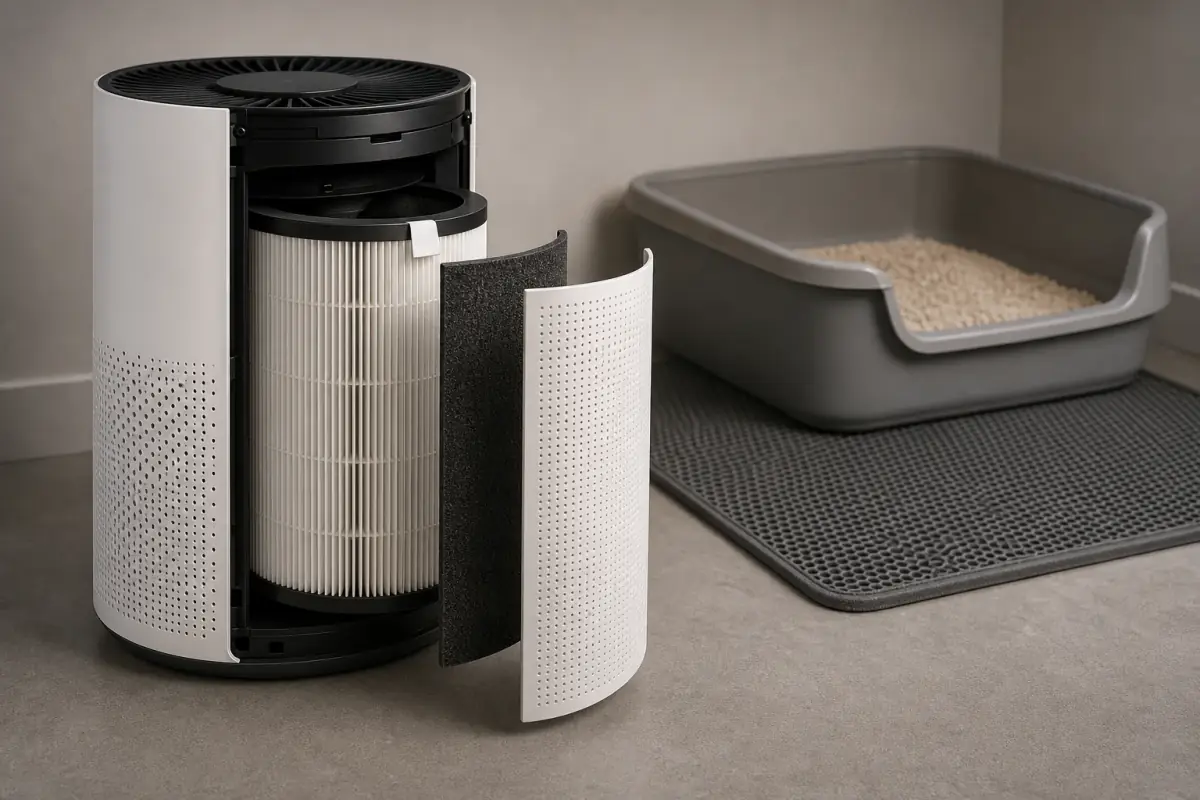
| Air purifier with a carbon filter | Only the air that passes through the filter | Pulls some odor out of the room air | When the maker says to change the filter |
| Purrify (activated carbon in the litter) | The litter itself, where the smell starts | Traps odor molecules in its pores and adds no scent | Top up whenever the box starts to smell again |
Purrify mixes directly into the litter. It adds no fragrance, and you keep scooping as usual. Our litter box deodorizer page shows how it works in the box.
Sprays get a longer write-up in our dry additive vs spray comparison. If you are weighing a machine instead, read whether an air purifier for cat litter smell works. To weigh carbon against baking soda, zeolite and the rest, compare cat litter deodorizers side by side.

How to make a house with cats smell good
Start at the box. Scoop at least once a day, wash residue off the box, and keep enough clean litter in it. That is the first place to look.
Not every smell comes from the box, though. For cooking odors, a closed room or a damp corner, deal with the source and ventilate when practical. The EPA describes filtration as a supplement to source control and ventilation. Carbon in the litter works at the box.
Urine outside the box is a different job again. Pee that has soaked into carpet, a couch or a floorboard keeps smelling until the urine itself is broken down, usually with an enzyme cleaner. Purrify cannot reach it, and a freshener only covers it. Start with getting cat pee out of carpet, or finding and clearing cat urine smell in the house if you cannot find the spot.
Guests arriving soon? Scoop, take the waste bag out and check for residue around the box. That does more than another burst of fragrance.
How to use Purrify at the box
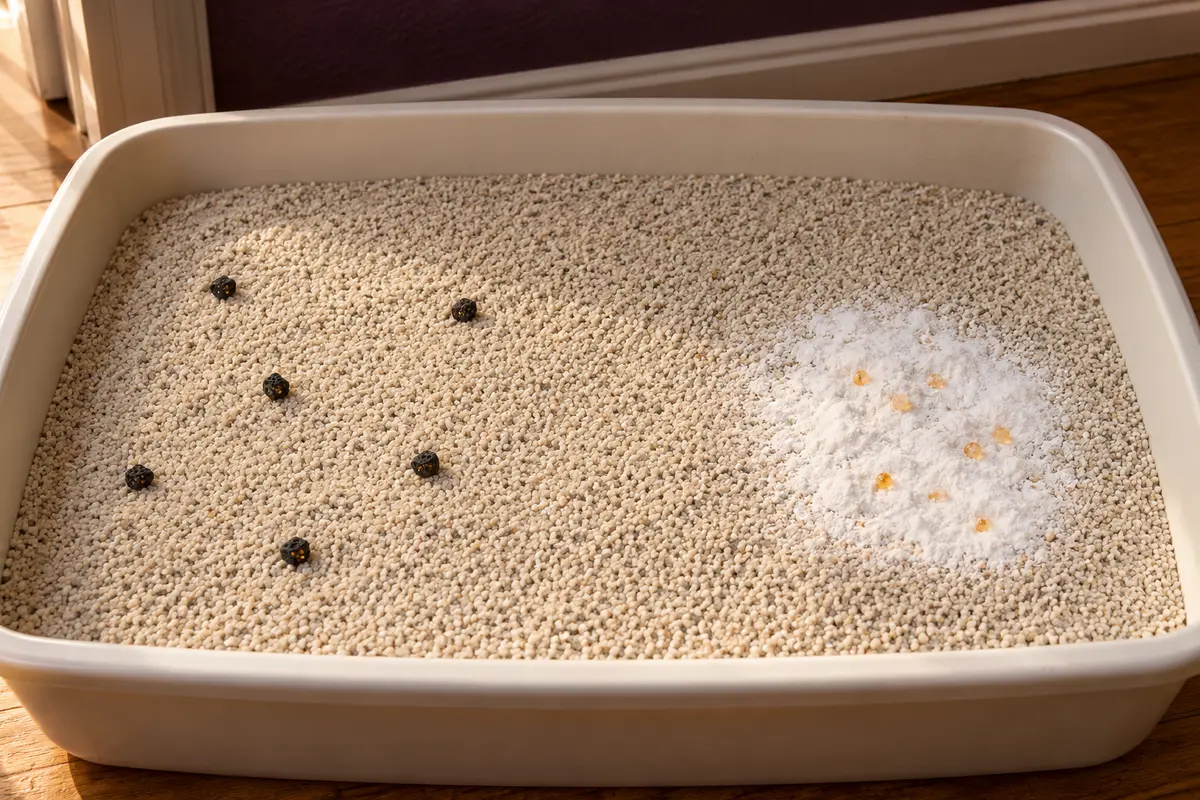
Use 2 tablespoons of Purrify per litter box. Sprinkle it on fresh litter and mix gently. Top up whenever the box starts to smell again. There is no fixed schedule.
That is the whole routine. Keep scooping as you do now and change the litter when you normally would. There is no new litter to switch to and no new box to buy. For a step-by-step walk-through, see how to use a cat litter additive. Not sure the box is the source? The litter smell quiz asks a few questions and points you to a fix.
Which bag to start with
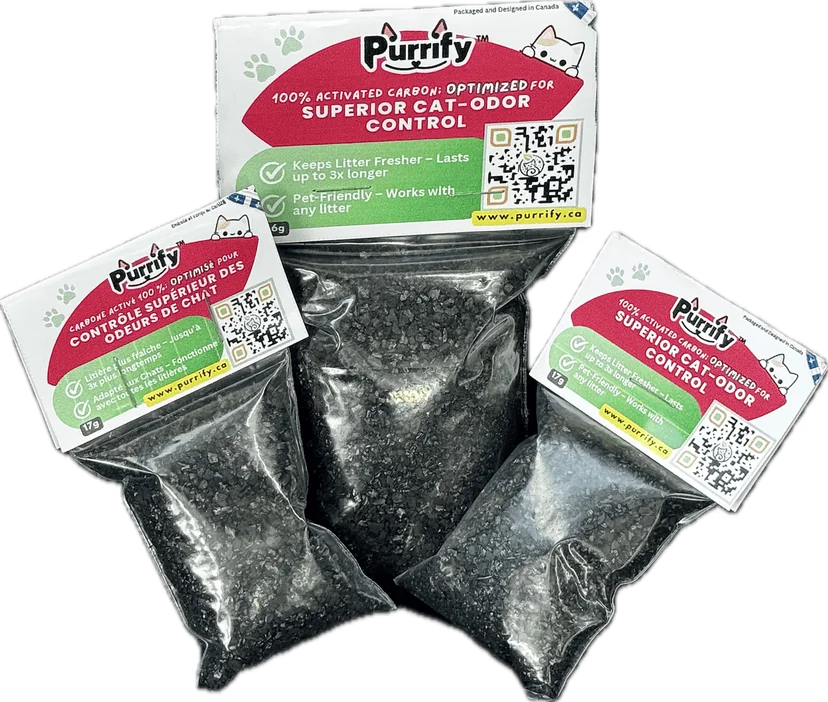
In Canada, the easy way in is the 15g trial bag at $4.76. You use it all at once in one box, and it lasts about 5 days for one cat, so you can find out whether it works in your home.
After that, the Large bag (120g, $24.99) lasts about 30 days for one or two cats and is our everyday recommendation, even with one cat. More cats or more boxes means a bag goes faster.
The trial and one-time bags come with a 30-day money-back guarantee, and so does your first autoship shipment. Later autoship boxes are not covered, and you can skip or cancel anytime. Purrify has a 5.0 rating on Google and is stocked in 40+ pet stores across Canada. See every Purrify bag.