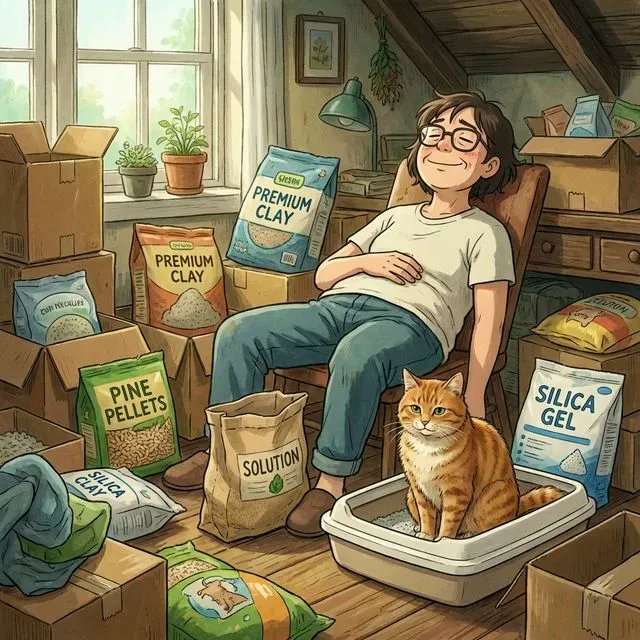
Let me guess: You bought the "odor-eliminating" litter. You poured baking soda in the box every day.
You tried three different deodorizers. Maybe you even bought an expensive air purifier.
And your house still smells like cat.
You're not alone, and you're not doing anything wrong. The problem isn't you-it's that most "solutions" on the market are fundamentally flawed. They address symptoms, not causes. They mask instead of eliminate. And they're fighting a chemical battle they can't win. For a complete system that actually works, see our litter box smell elimination guide.
Why Common Solutions Fail
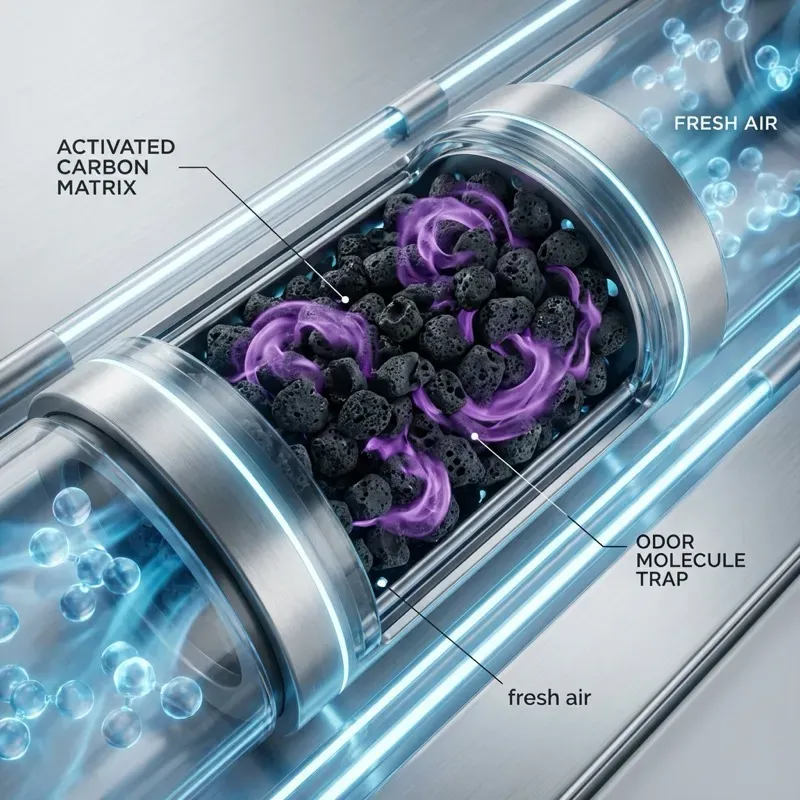
Activated carbon traps ammonia and sulfur molecules inside microscopic pores.
Before you buy yet another bag of expensive litter, use our cat litter calculator to ensure you're using the right amount for your needs.
❌ Baking Soda: The Chemistry Mismatch
Baking soda (sodium bicarbonate) neutralizes acids. Cat urine produces ammonia, which is alkaline. You cannot neutralize an alkaline with another alkaline. It's like trying to put out a fire with a flamethrower. The baking soda simply has no chemical effect on ammonia molecules.
❌ Deodorizers: Mixing Smells
Most litter deodorizers work by adding fragrance. The result? "Spring Fresh" mixed with ammonia. It's objectively worse than the ammonia alone. Plus, cats hate strong scents and may avoid the box entirely.
❌ Premium "Odor Control" Litters: Marketing Hype
That $45 bag of "advanced odor control" litter? It's usually just regular clay with perfume added. The clumping action doesn't affect ammonia gas, which evaporates into the air regardless of how expensive your litter is.
❌ Air Purifiers: Treating the Symptom
Air purifiers clean the air that's already in your room. They don't stop the source. It's like using a bucket to bail water from a leaking boat instead of plugging the hole.
The Science of What Actually Works
To understand the solution, you need to understand the problem. Cat urine contains urea. Bacteria break down urea into ammonia gas (NH₃). This gas is what you smell.
The only way to truly eliminate the smell is to physically remove ammonia molecules from the air before they reach your nose. There's only one material that does this effectively: activated carbon.
How Activated Carbon Works
• Adsorption (not absorption): Ammonia molecules stick to the carbon surface via Van der Waals forces
• Massive surface area: 1 gram has 3,000 m² of surface (football field sized)
• Permanent capture: Once trapped, ammonia can't escape back into air
• Targets the source: Works in the litter box, not after odors spread
The Protocol That Finally Worked
After years of frustration, here's the combination that eliminated my cat odor problems:
Activated carbon (2 tablespoons) added to fresh litter
Unscented clumping litter (basic $12 bags work fine)
Twice-daily scooping (morning and evening)
Weekly carbon refresh (add 1 tablespoon mid-week)
Complete litter change every 3-4 weeks
Pro Tip: The Purrify Solution
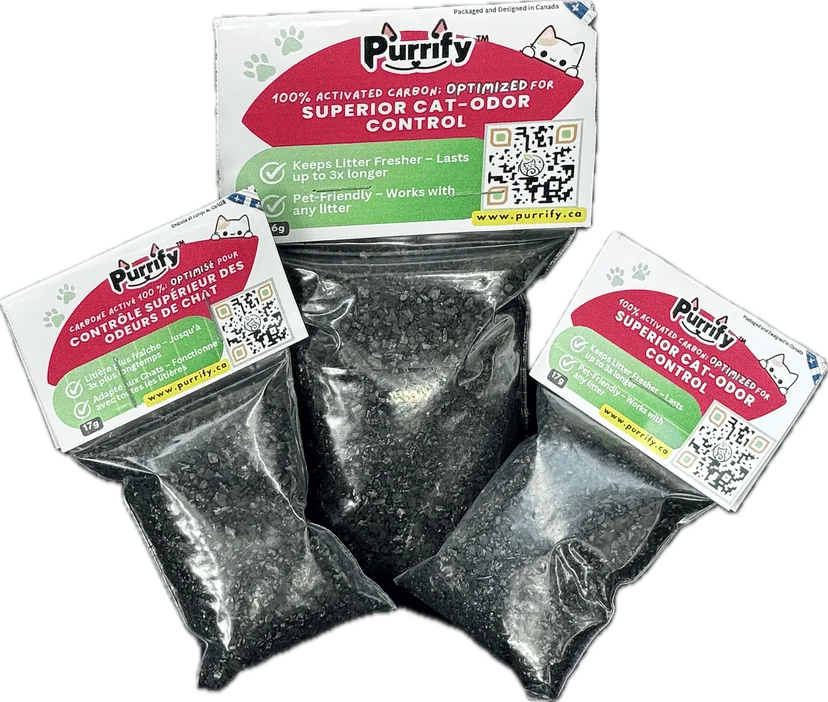
For the most effective odor control, try Purrify's activated carbon litter additive.
Simply sprinkle it in your litter box to eliminate odors for up to 7 days. Made from premium
coconut shell carbon, it's the same technology used in water and air filters.
Why So Many Solutions Feel Like They Work Until They Suddenly Do Not
Most cat-litter smell solutions fail because they solve only one layer of a multi-layer problem. Baking soda changes how the litter smells for a while, but it does not remove every gas leaving the box. A room spray makes the space feel fresher, but only by adding another scent to the air. A premium litter may clump better, but if the box is scratched, the room is stagnant, and the waste sits too long, even a better litter is forced to work in bad conditions. The result is a familiar cycle: a new product seems promising for a day or two, then the smell comes back and it feels like nothing truly works.
The missing idea is that odor has both a source and a travel path. Waste creates the molecules, but the room, the box material, and nearby surfaces decide where those molecules end up. If you only attack the source, the room may still hold on to smell. If you only treat the air, the source keeps generating more. A useful solution has to shrink both the amount created and the amount allowed to linger.
Run a Seven-Day Elimination Test Instead of Randomly Changing Products
When owners are frustrated, they often make three or four changes at once and then have no idea what helped. A better approach is a short elimination test. Start with a full reset: clean the box, refill with fresh litter, and remove nonessential extras like perfumed sprays, scented liners, or deodorizing powders. Then keep the basics constant for several days while adding back one variable at a time. If you want to test an additive, test only the additive. If you want to test a different litter, keep the box, room, and scooping schedule steady.
The point of the test is not perfection. It is clarity. By the end of a week, you should know whether the biggest gains are coming from better litter hygiene, better airflow, or a product that truly handles odor molecules instead of just changing the scent profile. Once you stop stacking random fixes on top of each other, the pattern becomes much easier to see.
Reset the box and surrounding floor first so old odor does not distort the test.
Change only one major variable at a time.
Judge success on day three and day six, not only an hour after cleaning.
What a Working Long-Term System Usually Includes
When people finally get on top of litter smell, the system usually looks simpler than expected. There is a litter that clumps or absorbs reliably, a predictable scooping rhythm, a non-perfume method for catching the remaining odor, and a room setup that does not trap humid air. In other words, the win comes from alignment, not from one miracle product.
That matters because it gives you a realistic goal. You do not need the home to smell like nothing ever happened. You need the box to stay in a low-odor range that does not invade the rest of the house and does not bother the cat. Once you aim for stability instead of magic, it becomes much easier to see why the right combination works and why all the quick-fix cover-ups felt disappointing.
What to Stop Wasting Time On Next
If you truly feel like you have tried everything, the next improvement often comes from subtraction. Stop layering scented sprays on top of a box that already smells wrong. Stop changing litters every few days before you know what failed. Stop assuming a more expensive label automatically means stronger source control. Those habits create activity, but they also blur the problem and make it harder to see which part of the system actually needs attention.
A better next step is to simplify brutally. Keep one acceptable litter, one box condition, one airflow setup, and one odor-control method long enough to judge them honestly. Once the noise is removed, the real weak link usually becomes obvious very quickly.
The End Goal Is Stability, Not Constant Freshness Theater
Many people chase a version of odor control that is impossible: a litter area that always smells freshly cleaned no matter how much it is used. Real success looks different. The box smells neutral enough that the rest of the home is unaffected, the cat remains comfortable using it, and maintenance never becomes a panic event. That standard is much more achievable than perfect perpetual freshness, and it points you toward systems that work in normal life instead of products designed to impress for twenty minutes.
A Calm Routine Beats Constant Experimenting
Once you find a setup that keeps the smell localized and the cat comfortable, protect it. The urge to keep experimenting can be as disruptive as the odor itself. Stable routines are what turn a solved smell problem into a permanently manageable one.
Source Control Is What Finally Breaks the Cycle
Once you stop asking the room to smell better and start asking the box to release fewer odor molecules in the first place, the entire problem gets easier. That shift toward source control is what finally breaks the endless cycle of trying one cover-up after another.
The Breakthrough Usually Feels Simpler Than Expected
That is why true progress can feel almost anticlimactic. The winning setup is often less dramatic than the failed ones because it is built on fewer moving parts and more consistent source control.
A Working System Feels Predictable
That predictability is the real sign that you are done experimenting. When the box behaves the same way from one week to the next, you know you have moved out of trial-and-error mode and into a system that truly works.
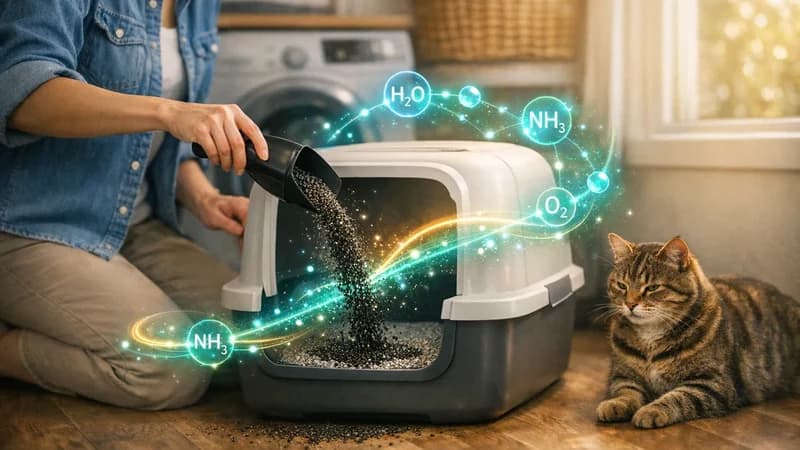
A consistent scooping and additive routine keeps homes fresher between litter changes.
How quickly should litter box odor improve with a consistent routine?
Most homes notice a meaningful improvement within 24 to 72 hours when scooping, airflow, and activated carbon layering are all consistent.
Can I use activated carbon additive with my current litter?
Yes. Carbon additive is compatible with most common litter types and is most effective when applied in small, regular top-ups.
What is the best way to prevent odor rebounds after cleaning?
Use a maintenance schedule instead of waiting for smell to return: scoop twice daily, refresh carbon weekly, and perform full resets on a fixed cadence.