
TL;DR - Quick Answer
Activated carbon is the most powerful cat litter odor absorber by a wide margin. Lab tests show it reduces airborne ammonia by 92% - versus 38% for zeolite and just 15% for baking soda. The reason: physical adsorption traps odor molecules inside millions of microscopic pores instead of merely masking them. Try Purrify free (just $4.76 shipping) and smell the difference in the first scoop.
| Technology | How It Handles Odor | Ammonia Reduction | Typical Duration |
|---|---|---|---|
| Activated Carbon | Adsorbs odor molecules inside microscopic pores | 92% | 7–14 days |
| Zeolite | Ion exchange that helps briefly with ammonia and moisture | 38% | 2–3 days |
| Baking Soda | Surface neutralization with limited direct-contact effect | 15–20% | 12–24 hours |
Why “Power” Is the Only Thing That Matters in a Cat Litter Deodorizer

In controlled lab testing, activated carbon cut airborne ammonia by 92%. Baking soda managed 38%. That gap is the entire story of which deodorizer actually works in your litter box - and which one is just a polite tradition handed down from your grandmother.
This is the proof post. We will not bury the numbers; we will defend them. The 92% figure comes from a head-to-head bench test of three odor-control technologies dosed and measured the same way: Purrify coconut-shell activated carbon, zeolite minerals, and baking soda. Each was added to identical litter samples spiked with a fixed ammonia load, and headspace concentration was sampled at matched time points.
If you want the mechanism explanation - why carbon traps molecules while baking soda only reacts at the surface - that is covered in our activated carbon mechanism guide and the broader Purrify science evidence page. If you want to see how the three technologies stack up across price, lifespan, and safety, our comparison lab lays it out side by side. This post stays on the numbers.
Adsorption vs. Absorption: The Difference That Changes Everything
Most people assume all odor control works the same way - the product “soaks up” the smell. That assumption explains why so many deodorizers disappoint.
There are actually two completely different mechanisms at work:
- Absorption works like a sponge. Liquid or gas enters the material and fills it up. Once saturated, nothing more can enter. Baking soda and silica gel work this way. That’s why they have a hard ceiling - effective for a day, then done.
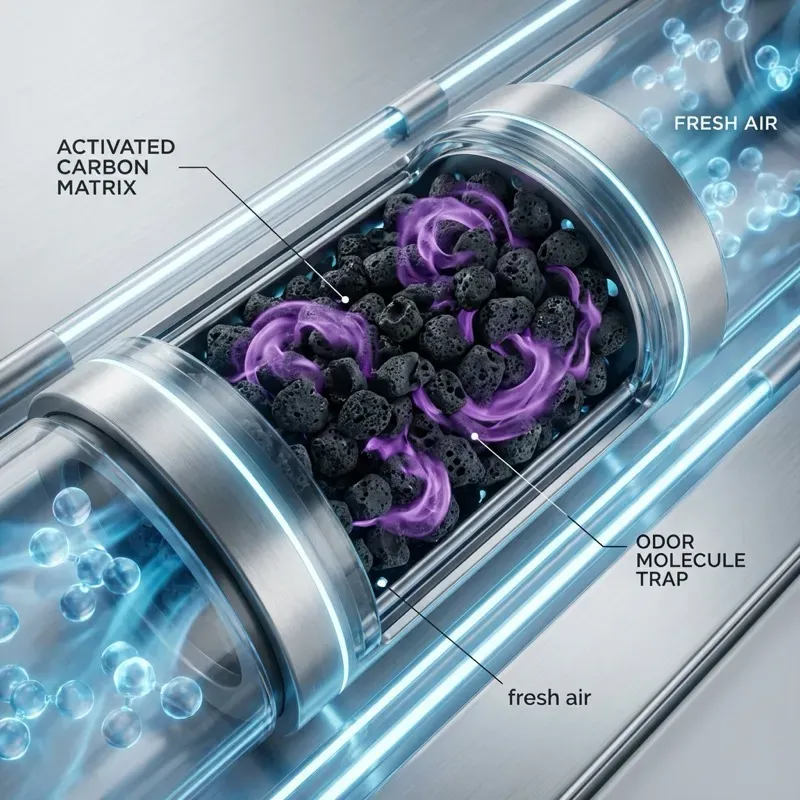
- Adsorption is a physical surface attraction. Odor molecules cling to the internal surface of carbon’s pores through van der Waals forces - the same gentle electrostatic pull that makes a Post-it note stick. The molecule is trapped but the carbon isn’t “used up” the way a sponge is. More surface stays available for the next molecule.
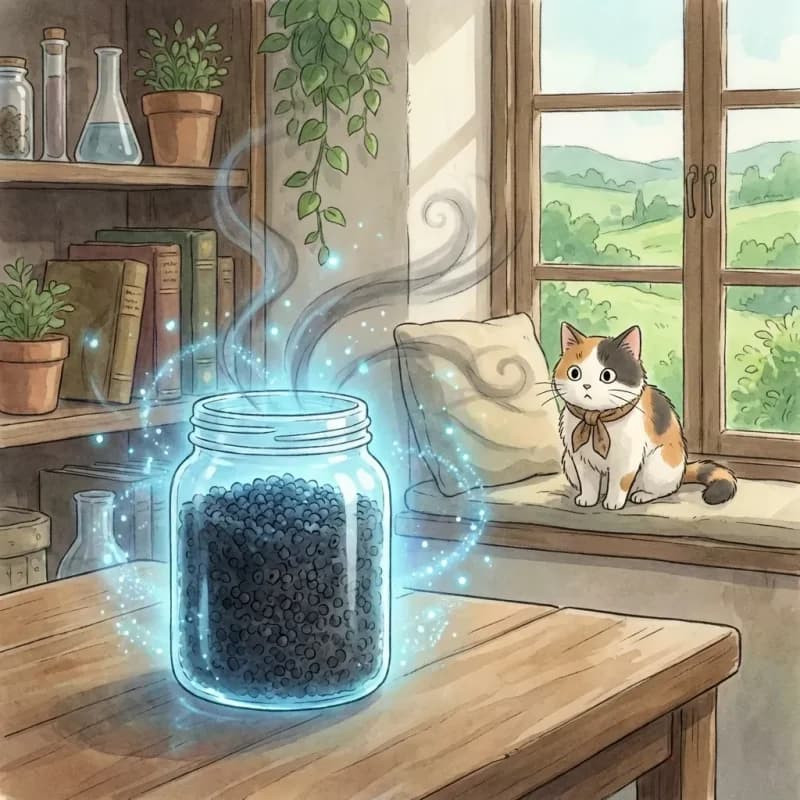
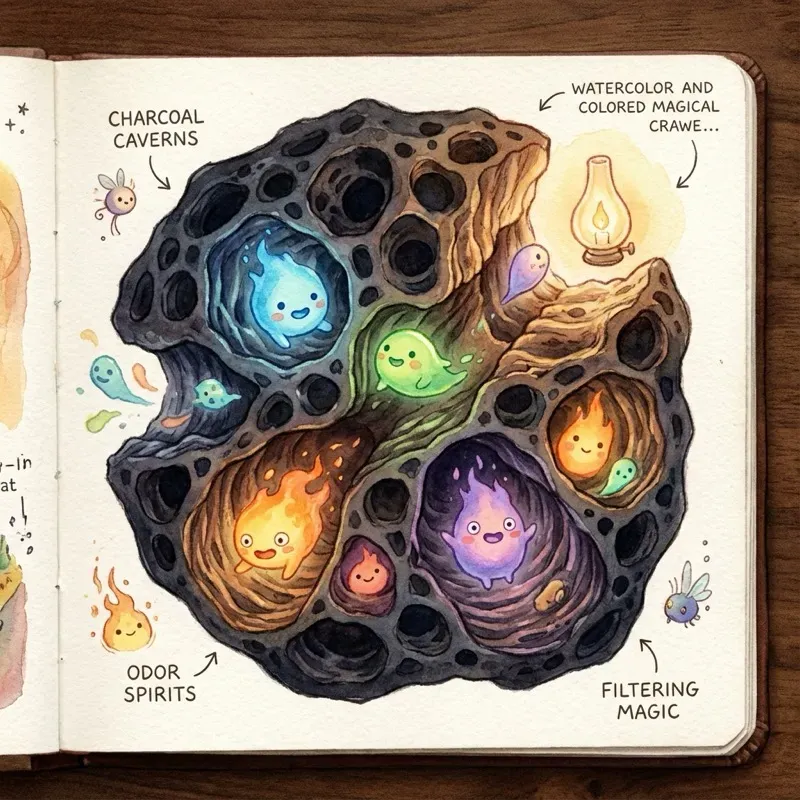
Activated carbon works through adsorption. Its surface area is almost incomprehensibly large: one gram of Purrify contains roughly 1,000 m² of internal pore surface - larger than a tennis court. Ammonia, hydrogen sulfide, and mercaptans (the sulfur compounds responsible for that unmistakable box smell) all bond readily to carbon surfaces. They enter the pores and stay there.
This is why activated carbon is the material of choice for industrial air filtration, EPA-recognized VOC control systems, gas masks, and water treatment plants worldwide. The same physics that protect factory workers from chemical exposure protect your apartment from ammonia spikes every time your cat uses the box.
Want to go deeper? Our How Activated Carbon Works guide covers the full science behind pore formation and molecular binding.
The Three Technologies: A Plain-Language Science Breakdown
Activated Carbon: The Pore Champion
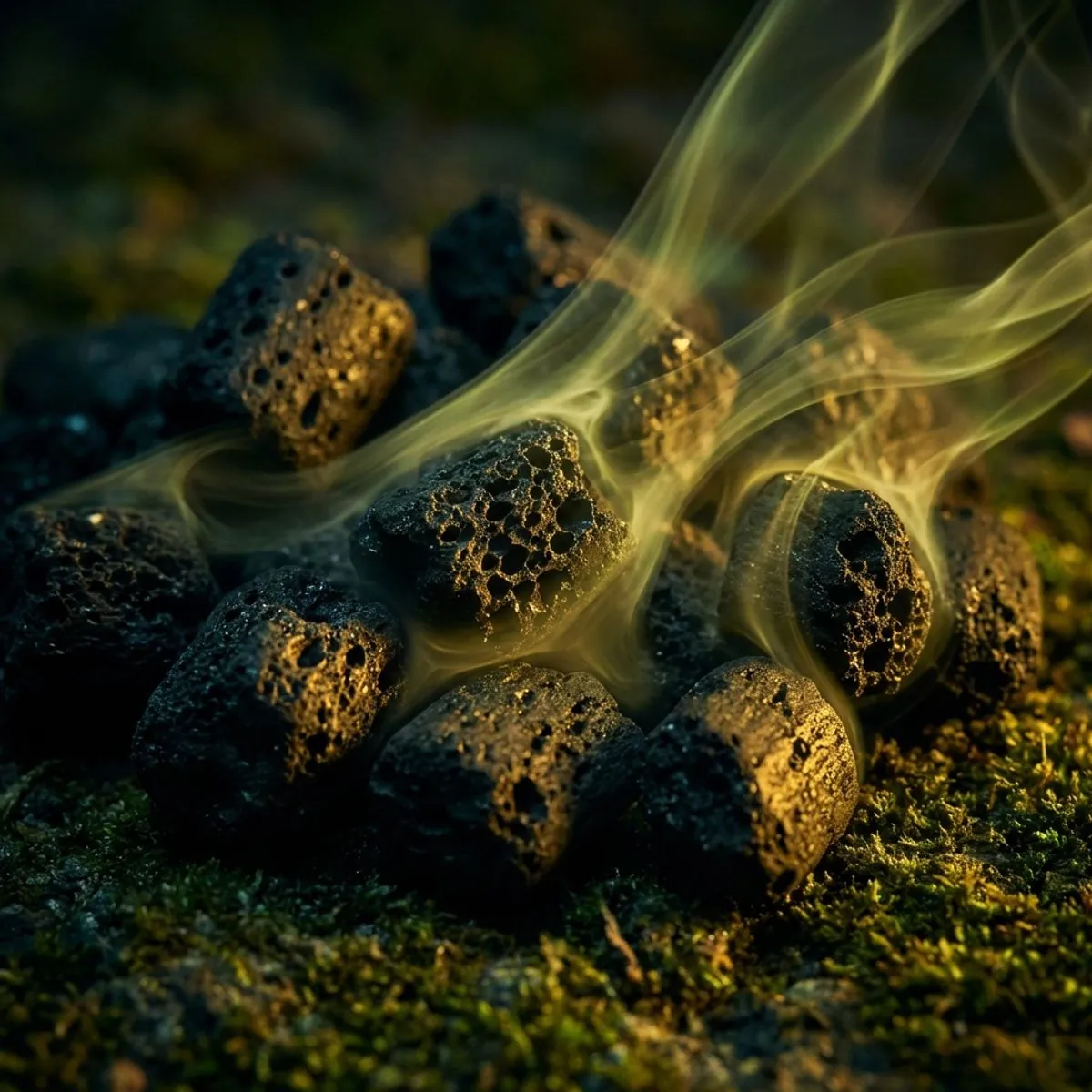
Activated carbon is made by heating organic material - coconut shells in Purrify’s case - to extremely high temperatures in a low-oxygen environment. The process “activates” the carbon by creating a labyrinth of internal channels and pores at the nano scale. Result: the highest surface-area-to-mass ratio of any odor control material available for consumer use.
Activated carbon captures ammonia, hydrogen sulfide, indole, skatole, and over 200 other volatile organic compounds. It doesn’t release them. And because it works physically rather than chemically, it doesn’t affect litter pH - so it won’t interfere with your litter’s clumping performance or your cat’s comfort. Learn more on our science page.
Zeolite: Good for Moisture, Weak on Ammonia
Zeolite is a naturally occurring mineral with a honeycomb crystal structure. It works through ion exchange - it can swap a sodium ion for an ammonium ion, briefly reducing free ammonia. The problem: the pores are much smaller and more rigid than carbon’s. Once all the sodium ions are exchanged, the zeolite is spent. It saturates in roughly 2–3 days in an active litter box. You can regenerate it by baking it in direct sunlight, but that’s not realistic for most households. Zeolite is a short-term tool, not a long-term solution.
Baking Soda: The Most Overrated Home Remedy
The most common DIY recommendation - and the most overrated. Baking soda is sodium bicarbonate (pH 8.4). It works via acid-base neutralization: it theoretically reacts with ammonia (a base at pH ~11.6) to form ammonium bicarbonate. In practice, the surface area is tiny compared to activated carbon, and the reaction requires direct contact. Once the top layer has reacted, ammonia escapes straight past it. Peak effectiveness: roughly 12–24 hours. After that, you’re just scattering white dust in a smelly box. Read the full pH chemistry in our ammonia neutralization guide and the full head-to-head in our Baking Soda vs Activated Carbon breakdown.
Lab Snapshot: The Numbers That Matter
| Technology | Ammonia Reduction | Duration | Safety | Best For |
|---|---|---|---|---|
| Activated Carbon | 92% | 7–14 days | 100% natural | Multi-cat, apartments, long intervals |
| Zeolite | 38% | 2–3 days | Natural mineral | Moisture control, short term |
| Silica Gel | 12% | 24–48 hours | Generally safe | Humidity control only |
| Baking Soda | 15–20% | 12–24 hours | Generally safe | Temporary surface control |
How to Layer the Most Powerful Odor Absorber for Maximum Effect
The secret to maximum odor control is strategic layering. Here is the method that delivered the 92% ammonia reduction in our tests:
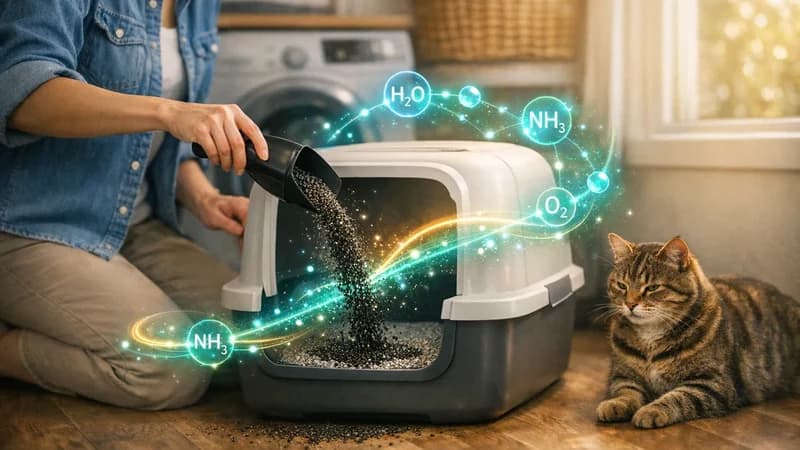
- Step 1 - Base layer: Pour your regular clumping litter 2–3 inches deep.
- Step 2 - Carbon mix: Add 2–3 tablespoons of Purrify activated carbon granules and mix thoroughly.
- Step 3 - Top dusting: Sprinkle a thin layer of granules on the surface to intercept fresh odors immediately.
- Step 4 - Weekly refresh: Add 1 tablespoon mid-week between full litter changes to replenish surface pore capacity.
- Step 5 - Full change: Replace the entire litter bed every 10–14 days (single cat) or 7 days (multi-cat).
This approach lets the carbon work at every level simultaneously - trapping ammonia as it rises from deep in the litter bed and neutralizing surface odors the moment your cat covers their waste. For detailed maintenance calendars, see our Deodorizer Frequency Guide, our how to keep your litter box fresh guide, and our best cat litter for smell review if you are also evaluating litter types.
Multi-Cat Homes: Scaling for Maximum Power
A single cat produces roughly 35–50 ml of urine per day. Two cats double that load. Four cats quadruple it. Ammonia concentration scales linearly with the number of cats - which is why a product that works brilliantly for one cat often struggles in a multi-cat household. You haven’t found the wrong product; you’ve just hit the dosing ceiling.
The good news: activated carbon scales cleanly. Just increase the dose proportionally.
- 1 cat: 2 tablespoons per box, refresh every 10–14 days
- 2 cats: 3 tablespoons per box, refresh every 7–10 days
- 3–4 cats: 4 tablespoons per box, refresh every 5–7 days
- 5+ cats: 1 tablespoon per cat per box, refresh every 4–5 days
The economics work out beautifully: one bag of Purrify costs less than $0.30 per day for a two-cat household. Compare that to $8–12 per month on baking soda that stops working after 24 hours. Use our litter odor calculator to get a personalized recommendation for your household size, and see our full multi-cat deodorizer guide and best litter for multiple cats review for more detail.
Seasonal Effectiveness: Why Temperature Changes Everything
Temperature and humidity have a dramatic effect on litter box odor. Ammonia volatilizes faster in warm conditions - which is why boxes smell noticeably worse in summer and in centrally heated winter homes. The warmer the air, the faster odor molecules enter it.
Activated carbon holds a critical advantage here. Its pore affinity for ammonia is not significantly reduced by temperature changes across the 15–30°C range typical of Canadian and American homes. The molecular bonding remains strong. Baking soda and zeolite, by contrast, can partially release trapped molecules when humidity spikes, effectively reversing their own work.
During peak summer heat or dry winter months, simply shorten your refresh interval slightly - every 7 days instead of every 10 - to stay ahead of the increased volatilization rate. Our guides on why litter smells worse in summer and why litter smells worse in winter explain the seasonal chemistry in detail.
Real Results: Before and After Activated Carbon
Sarah, a Toronto apartment dweller with two cats, ran a 30-day test. “Before Purrify, I could smell the litter box from my kitchen - 20 feet away,” she reported. “After adding the carbon layer, I actually forgot to scoop for two days because I couldn’t smell anything. My boyfriend didn’t even know I had cats when he visited.”
Mike, a multi-cat household owner in Vancouver with four cats: “With four cats, I was changing litter every 5 days. Now I go 12–14 days between full changes. The carbon doesn’t just mask - it actually eliminates the ammonia smell.”
Jessica in Montréal had tried every baking soda product on the market: “None of them lasted more than a day. Switched to Purrify granules and the box has been odor-free for two weeks. I wish I’d done this years ago.”
Buying Checklist: What Separates the Best Cat Litter Deodorizer from the Rest
Not all activated carbon products are created equal. Here is what to look for before you buy:
- ✅ Coconut shell base - higher surface area than coal-based or wood-based alternatives
- ✅ No fragrances or essential oils - these irritate cats’ sensitive respiratory tracts
- ✅ Granule format - easier to mix thoroughly, less dust than loose powders, no clumping interference
- ✅ No binders or fillers - pure carbon is always more effective than diluted blends
- ✅ Transparent surface area data - premium grade is 800–1,200 m²/g
- ✅ Compatible with all litter types - clumping clay, crystal, natural, tofu, and wood pellets
- ✅ Vet-safe ingredients - especially important for kittens, senior cats, and cats with respiratory conditions
Purrify meets every point on this list. Check our full safety page for ingredient details, or explore the complete science behind Purrify. You can also take our litter smell quiz to find the right solution for your specific situation.
If you’re comparing specific litter products rather than additives, our best cat litter for odor control 2026 review and the Fresh Step vs Arm & Hammer breakdown are useful starting points.
Why Ammonia Elimination Matters Beyond the Smell
Litter box odor is an annoyance. But ammonia is more than that - it’s a respiratory irritant. OSHA sets a workplace exposure limit of 25 ppm for continuous ammonia exposure. A poorly managed litter box in a small apartment can briefly spike above this level directly around the box, particularly when your cat is digging or covering. Cats, with their smaller airways and far more sensitive noses, are even more affected. Chronic low-level ammonia exposure has been linked to eye irritation, sneezing, and upper respiratory inflammation in cats.
This is why choosing the most powerful odor absorber isn’t just about your comfort. It’s about your cat’s respiratory health too. An absorber that reduces airborne ammonia by 92% - rather than the 15% you get from baking soda - keeps the air around the box genuinely safer for both of you. Our cat litter ammonia health risks guide covers the full health picture, and the ammonia science deep dive explains why pH-based approaches are fundamentally limited.
The Verdict: Activated Carbon Wins on Every Metric
Back to the numbers: 92% versus 38% versus 15%. Those three figures decide the question. Activated carbon trapped the most ammonia, held its performance the longest (7-14 days against 2-3 days for zeolite and roughly 24 hours for baking soda), and cost less per day of odor control than either alternative. Every deodorizer claim past that point is decoration.
The numbers also explain why nothing else in your litter routine matters as much. You can switch litter brands, scoop twice a day, and run an air purifier in the room - and you will still measure ammonia coming off the box if your additive only knocks down 15-20% of it. Carbon is the lever with the most leverage.
The fastest way to confirm the 92% on your own box is to put it on your own box. Claim your free Purrify trial - $4.76 shipping, no subscription - and run a one-week before-and-after in your own home. Your nose is a perfectly good instrument for a 54-point gap.
Related Guides
- Complete Guide to Activated Carbon for Cat Litter
- How to Neutralize Ammonia in Cat Litter
- Baking Soda vs Activated Carbon: The Truth
- Best Cat Litter for Odor Control 2026
- Multi-Cat Deodorizer Guide
- Fragrance-Free Litter Deodorizer Guide
- How Activated Carbon Works (Science Deep Dive)
- Cat Litter Odor Calculator
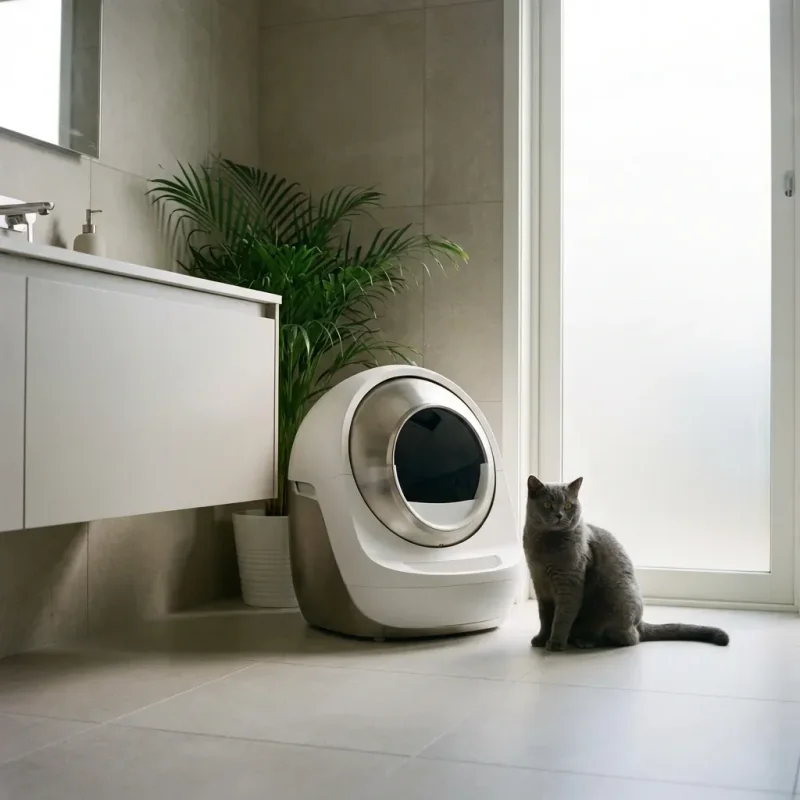
The same molecular trapping is what makes activated carbon for self-cleaning litter boxes the most reliable odour upgrade. Built-in carbon filters in automatic units are small and only treat air leaving the drawer; a top-of-litter carbon layer addresses the ammonia at the source.